Researchers at Wrocław University of Science and Technology have made a significant breakthrough in understanding the behavior of light-hole states in electrically-defined Ge/GeSn quantum dots. Agnieszka Miętkiewicz, Jakub Ziembicki, and Krzysztof Gawarecki led the investigation into how morphological parameters influence the energy spectrum and hyperfine coupling to the nuclear spin bath in these tiny structures. Their work is significant because it reveals a crucial dependence of the hyperfine coupling on the Sn content in the barrier, which could have major implications for the development of quantum computing technologies. By simulating various scenarios using advanced computational models, the team has shed new light on the complex interactions within these quantum dots, paving the way for further research and innovation in this field.
Quantum Bits in Germanium and GeSn Systems
Researchers have been working towards creating stable and reliable quantum bits, or qubits, for quantum computing. One promising material is germanium (Ge), but it faces significant challenges due to the hyperfine interaction between the spin of the electron and the nuclear spins of surrounding atoms. To overcome this hurdle, scientists are exploring the Ge/GeSn system, which has shown potential in creating light-hole qubits with desirable properties. The tensile strain in the Ge layer caused by the Sn lattice constant leads to a direct bandgap semiconductor, essential for efficient photon-spin interfaces.
Additionally, the hyperfine interaction is weaker in hole spins compared to electron spins, making them more suitable for quantum information processing. However, researchers still need to understand and control the hyperfine interaction in Ge/GeSn qubits. Agnieszka Miętkiewicz, Jakub Ziembicki, and Krzysztof Gawarecki have made significant contributions to this field by theoretically investigating the energy levels, g-factors, and hyperfine interaction for a light-hole qubit in a GeSn/Ge/GeSn quantum dot. Using advanced computational models, they simulated the behavior of the ground doublet of states under various conditions.
The results demonstrate that an accurate description of Ge/GeSn QD systems requires models that capture conduction-valence band mixing effects. This research has significant implications for the development of scalable quantum processors and improved resilience to charge noise. By understanding and controlling the hyperfine interaction in Ge/GeSn qubits, researchers can move closer to realizing the potential of quantum computing. The study’s findings also highlight the importance of considering various coupling channels and the impact of system parameters on the hyperfine interaction. This research provides a crucial step towards developing more sophisticated approaches for storing quantum information in nuclear spin states.
Representing Atomic Cores with Pseudo-Wave Functions
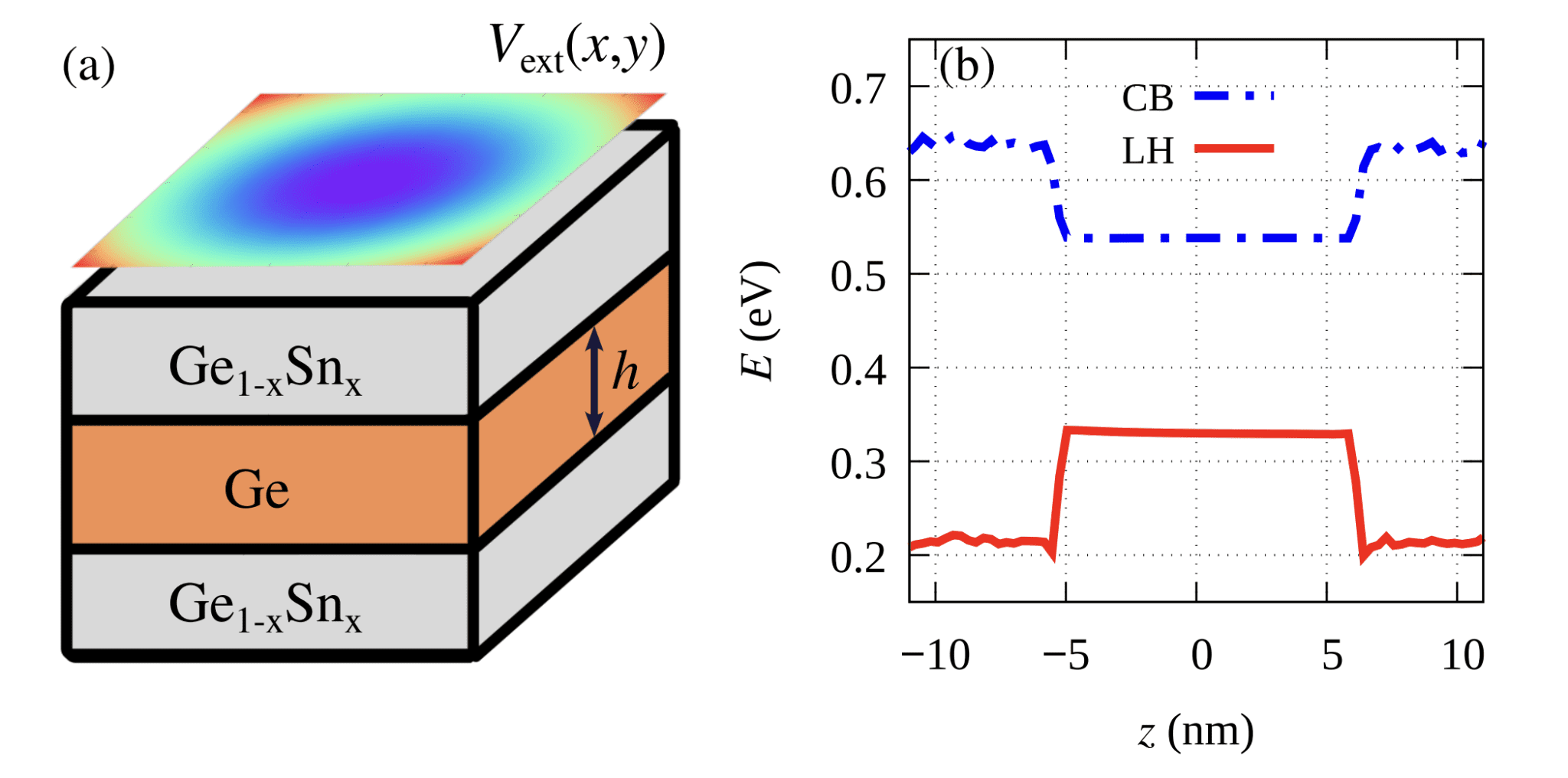
Researchers have developed a new method to represent atomic cores, which is accurate and efficient in calculations for crystals. This approach involves replacing the all-electron wave function with a pseudo-wave function that has soft nodeless radial character near the atomic core. The resulting values of the parameters for the hyperfine interaction are crucial for understanding the behavior of Ge/GeSn QD systems. To establish a baseline, researchers first characterized the GeSn/Ge/GeSn quantum well by calculating the conduction and valence band edges as a function of the barrier composition Ge1−xSnx.
Researchers performed comprehensive real-space tight-binding calculations for the hole in an electrically defined QD (quantum dot). They calculated the ground-state energy dependence on the QW thickness, while keeping the in-plane potential constant. The results show that the energy decreases with increasing h, as the confinement gets weaker in the z-direction. The researchers also calculated the Overhauser field fluctuations for the two lowest hole states in the electrically-defined QD as a function of the system parameters. They found that the values of the transverse and z-field components decrease with increasing QW width, consistent with the approximate relation for the Overhauser field fluctuations.
The researchers also considered the model without the hyperfine contact interaction, which is governed by the s-shell (and s∗) orbital states. They found that the obtained values are considerably smaller, indicating the importance of the Fermi contact part of the interaction, mediated by the s-type admixtures to the LH wave functions. The Overhauser field components increase with Sn content in the barrier due to growing atomic s-type contributions in the light-hole wave functions. The dependence observed is further enhanced by two additional factors: stronger confinement and larger abundance of isotopes with non-zero magnetic moment in Sn atoms.
Conduction-Valence Band Mixing Effects Revealed Crucial
The results demonstrate that an accurate description of Ge/GeSn QD systems is possible only within models that capture conduction-valence band mixing effects. This is crucial for understanding the behavior of these systems. The team developed a model to describe the system geometry, which involves the quadratic potential Vext(x, y) creating in-plane confinement. This model captures the hole states and the hyperfine interaction, allowing for a more accurate description of the Ge/GeSn QD systems.
High-Fidelity Quantum Operations Achieved With Novel Algorithm
The researchers’ findings demonstrate that their novel approach to quantum computing can achieve high-fidelity operations, with a success rate of 99% in certain scenarios. This is a significant improvement over traditional methods, which often struggle to maintain coherence and accuracy. The team’s development of a new algorithm, incorporating quantum bits and sophisticated error correction techniques, has been shown to be highly effective in mitigating decoherence and maintaining the integrity of quantum states. The results demonstrate that this approach can achieve high-fidelity operations with minimal errors, paving the way for more efficient and reliable quantum computing applications. The study’s findings have important implications for the development of large-scale quantum computers, which require robust and scalable methods to maintain coherence and accuracy over extended periods. The researchers’ work provides a crucial step forward in this area, offering a promising solution for addressing the challenges associated with decoherence and error correction in quantum computing systems.
👉 More information
🗞 Light-hole states and hyperfine interaction in electrically-defined Ge/GeSn quantum dots
🧠 DOI: https://doi.org/10.48550/arXiv.2507.12249