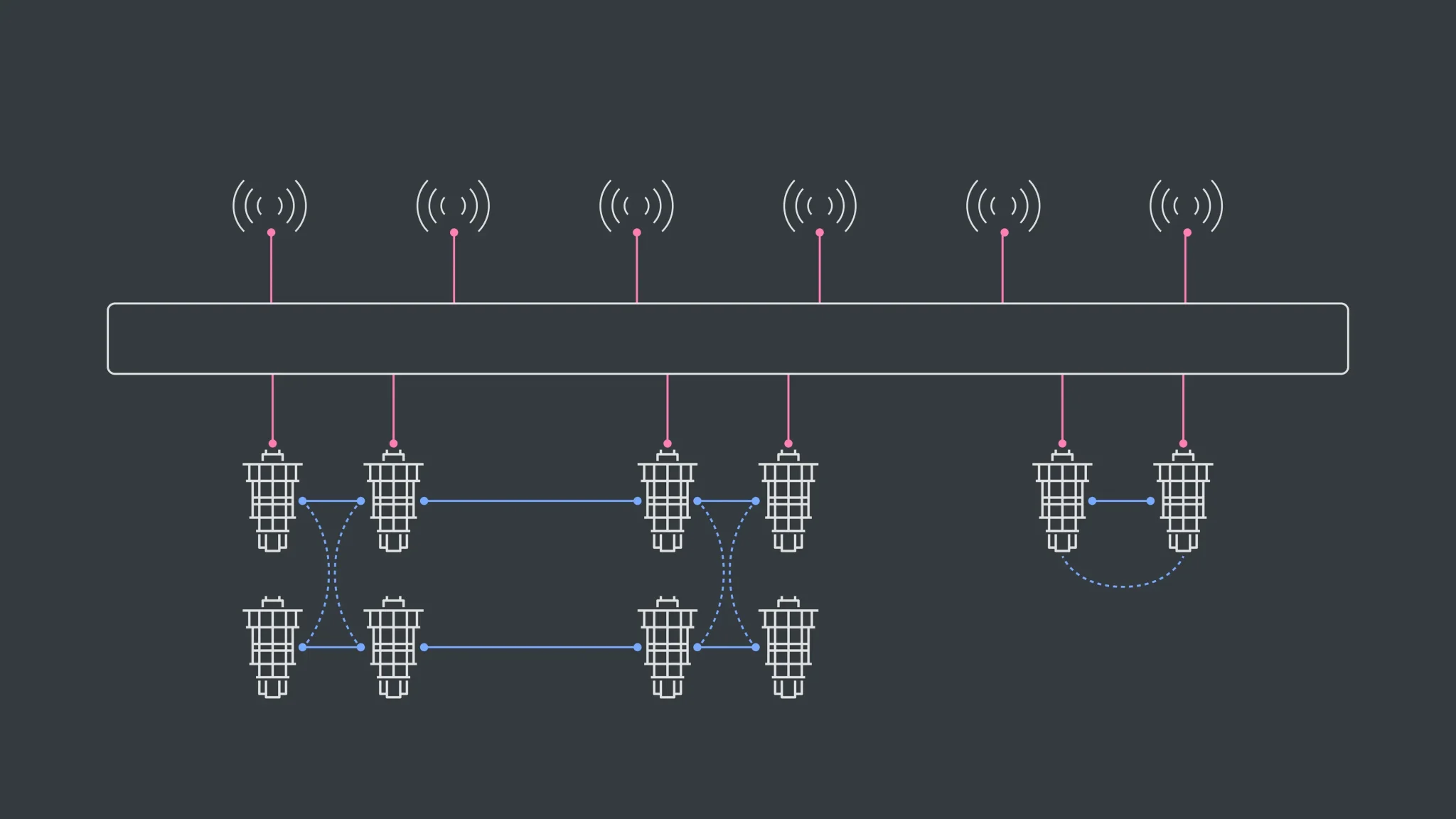
IBM, led by Jerry Chow, is initiating research and collaboration to advance beyond its current development roadmap for quantum computing, focusing on networking quantum computers. This effort aims to build upon the framework of quantum-centric supercomputing—integrating CPUs, GPUs, and QPUs—with a long-term vision of a quantum computing internet. IBM plans to achieve a critical milestone by entangling a pair of cryogenically separated quantum processors within the next five years, and is collaborating with four of the five NQISR centers and Cisco to accelerate research for technologies beyond its current goal of a computer capable of running quantum circuits with one billion operations on 2,000 qubits by 2033.
Networking Quantum Computers: Core Concepts
Networking quantum computers is crucial for scaling beyond current limitations, with IBM aiming for a computer capable of running quantum circuits with one billion operations on 2,000 qubits by 2033. Achieving further scaling necessitates distributed quantum computing with connected systems, potentially leading to a quantum computing internet. Initial milestones include entangling cryogenically separated quantum processors within the next five years, and collaboration with partners like those within the NQISR centers and Cisco is essential for groundbreaking research and development.
Quantum networks differ fundamentally from classical networks; while classical computers rely on cause-and-effect, entangled quantum processors act as a single entity, even at long distances. Although quantum information ultimately collapses into classical outputs requiring classical communication for complete understanding, links offer the ability to build larger quantum datacenters with higher qubit counts and larger circuits, and augment quantum sensing technologies like those used in gravitational-wave observatories.
Key to realizing networked quantum computers is the quantum networking unit (QNU), which translates stationary qubits into “flying” qubits for network propagation, with photons being the natural element. IBM is pursuing various coupling technologies at different length scales – l-couplers for one-meter connections within dilution refrigerators, connectors for one-to-ten-meter links within buildings, and, in partnership with Cisco, transducers and optical links for kilometer-scale connections to ultimately realize a quantum computing internet.
Scaling Quantum Computing with Links & Networks
Scaling quantum computing beyond current roadmaps requires networking quantum computers to achieve higher qubit counts and larger circuits. IBM aims to build a computer capable of running quantum circuits with one billion operations on 2,000 qubits by 2033, but further scaling necessitates distributed quantum computing with connected systems, potentially leading to a quantum computing internet. Collaborations with centers like NQISR and companies like Cisco are key to researching and developing the necessary components and technologies for this future.
Quantum networks differ fundamentally from classical networks because entanglement links quantum processors, causing them to act as a single entity. This allows for operations at one node to instantly alter outcomes at entangled nodes, even at long distances. While this doesn’t enable faster-than-light communication due to the “quantum no-communication theorem”, networked quantum computers could significantly augment quantum sensing through techniques like interferometry and build larger quantum datacenters.
IBM is developing quantum networking units (QNUs) to interface processors and interconnects, translating stationary qubits into “flying” qubits. These efforts are occurring at multiple scales: l-couplers for one-meter connections inside dilution refrigerators, connectors with Fermilab for one-to-ten-meter links within buildings, and a partnership with Cisco to explore transducers and optical links for kilometer-scale connections, ultimately working towards a full quantum computing internet.
Quantum Networking Units and Technologies
Networking quantum computers is critical for scaling beyond current roadmaps, with a goal of running quantum circuits with one billion operations on 2,000 qubits by 2033. This requires distributed quantum computing with connected systems, ultimately aiming for a quantum computing internet. Initial milestones include entangling quantum processors separated cryogenically within five years. Collaboration with partners, including four of the five NQISR centers and Cisco, is essential for achieving this vision and developing necessary technologies.
At the core of this networking is the quantum networking unit (QNU), which translates stationary qubits into “flying” qubits for network propagation. Photons are the natural element for these flying qubits, with the specific frequency – optical or microwave – defining the network infrastructure. IBM is developing l-couplers for one-meter scale connections within dilution refrigerators, aiming for high fidelity to support fault-tolerant computing by 2029, and collaborating with Fermilab on connectors for 1-10 meter scale links.
Longer-range connections, kilometers apart, present the greatest challenge and require a transducer to convert microwave photons to optical photons for transmission. A partnership with Cisco has been announced to explore these transducers and optical links. Once realized, these QNUs will enable a quantum computing internet, networking QPUs across kilometers and potentially alongside quantum sensors, creating a powerful, distributed quantum computing infrastructure.
However, scaling circuits to further orders of magnitude in both the numbers of operations and across qubits will require distributed quantum computing with connected systems.
Building a Future with Partnerships & Collaboration
Building a future with quantum computing requires industry-wide partnerships focused on hardware, software, and knowledge sharing. IBM aims to link modular quantum processors, demonstrated with Crossbill and Flamingo, to create larger quantum datacenters with increased qubit counts and larger circuits. This vision extends to a quantum computing internet, necessitating the development of Quantum Networking Units (QNUs) which translate stationary qubits into “flying” qubits for network propagation, utilizing photons as the primary element.
The development roadmap includes multiple coupling technologies at varying scales, each with unique challenges and collaborators. Internally, l-couplers are being developed for one-meter connections within dilution refrigerators. Simultaneously, a partnership with Fermilab focuses on connectors for one-to-ten meter links, aiming to connect quantum computers within a building and help realize the quantum data center. Achieving a quantum computing internet necessitates overcoming significant challenges, including transducers for kilometer-scale links.
A key milestone is entangling quantum processors within five years, and today IBM announced a collaboration with Cisco to explore optical links between QPUs—a crucial step toward realizing a quantum computing internet. These networked QPUs could eventually work alongside quantum sensors, potentially increasing precision through techniques like interferometry, as seen in astronomy labs already employing quantum sensors for gravitational wave detection.