Procedural generation, a technique used in computer graphics and game development, has long been limited by classical computing’s inability to handle complex patterns and structures efficiently. However, the emergence of quantum computing presents an opportunity to revolutionize this field.
Researchers at Purdue University have successfully applied the Quantum Approximate Optimization Algorithm (QAOA) to Wave Function Collapse (WFC). This procedural generation algorithm generates patterns by collapsing a superposition of possible configurations into a single output based on local constraints.
This breakthrough has significant implications for fields such as video games, architecture, and art, where procedural generation is used to create content on the fly. By leveraging the power of quantum computing, researchers can explore new approaches to optimization and pattern generation that were previously impossible or impractical, potentially unlocking new creative possibilities in these fields.
What is Wave Function Collapse, and How Does it Relate to Quantum Computing?
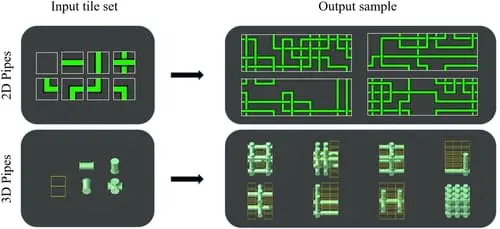
Wave Function Collapse (WFC) is a procedural generation algorithm used for pattern generation. It divides an input tileset into small chunks, which are then rearranged for content generation. This process involves collapsing a superposition of possible configurations to produce an output based on local constraints. In quantum computing, WFC can be reformulated as a Constraint Satisfaction Problem (CSP), where the edge rules in classical WFC are encoded as linear constraints.
The use of WFC in quantum computing is particularly relevant because it allows for the generation of valid tile configurations in both 2D and 3D spaces. This demonstrates the potential of quantum computing in hybrid quantum-classical systems, where quantum computers can be used to accelerate certain tasks while classical computers handle others. However, the algorithm’s current implementation is constrained by limitations set by current quantum computers, preventing real-world deployment at this stage.
The WFC algorithm has been successfully demonstrated using Quantum Approximate Optimization Algorithm (QAOA), which is a hybrid quantum-classical algorithm that combines the strengths of both paradigms. QAOA uses a classical optimization routine to find an approximate solution to a problem, while leveraging the power of quantum computing to speed up certain calculations.
What are the Key Concepts and Techniques Used in Wave Function Collapse?
At its core, WFC is a procedural generation algorithm that relies on the concept of superposition. In quantum mechanics, a superposition refers to the ability of a system to exist in multiple states simultaneously. In the context of WFC, this means that the input tileset can be divided into small chunks, which are then rearranged to produce an output based on local constraints.
The key technique used in WFC is the
The key technique used in WFC is the encoding of edge rules as linear constraints. This allows for the efficient generation of valid tile configurations by collapsing a superposition of possible configurations. The use of linear constraints also enables the algorithm to be reformulated as a CSP, which can be solved using QAOA.
Another important concept in WFC is the idea of local constraints. These are rules that govern how tiles can be arranged relative to each other, and they play a crucial role in determining the output configuration. By encoding these constraints as linear equations, WFC can efficiently generate valid tile configurations while ensuring that the resulting pattern adheres to the specified rules.
What is Quantum Approximate Optimization Algorithm (QAOA) and How Does it Relate to Wave Function Collapse?
Quantum Approximate Optimization Algorithm (QAOA) is a hybrid quantum-classical algorithm that combines the strengths of both paradigms. QAOA uses a classical optimization routine to find an approximate solution to a problem, while leveraging the power of quantum computing to speed up certain calculations.
In the context of WFC, QAOA is used to solve the CSP formulation of the problem. By encoding the edge rules as linear constraints, WFC can be reformulated as a CSP that can be solved using QAOA. This allows for the efficient generation of valid tile configurations while leveraging the power of quantum computing.
The use of QAOA in WFC is particularly relevant because it enables the algorithm to take advantage of the strengths of both paradigms. By combining classical optimization with quantum speedup, QAOA can efficiently solve complex problems that would be difficult or impossible for classical computers to tackle on their own.
What are the Implications and Potential Applications of Wave Function Collapse in Quantum Computing?
The successful demonstration of WFC using QAOA has significant implications for the field of quantum computing. By leveraging the power of quantum computing, WFC can efficiently generate valid tile configurations in both 2D and 3D spaces.
One potential application of WFC is in generating realistic patterns or textures for use in computer graphics or video games. By using QAOA to solve the CSP formulation of the problem, WFC can efficiently generate high-quality patterns that would be difficult or impossible to produce using classical computers alone.
Another potential application of WFC is in materials
Another potential application of WFC is in materials science, where the generation of realistic crystal structures is crucial for understanding material properties and behavior. By leveraging the power of quantum computing, WFC can efficiently generate valid tile configurations that can be used to model complex crystal structures.
What are the Current Limitations and Future Directions of Wave Function Collapse in Quantum Computing?
While the successful demonstration of WFC using QAOA is a significant achievement, several limitations and challenges still need to be addressed. One major limitation is the current implementation’s reliance on classical optimization routines, which can limit the algorithm’s scalability and efficiency.
Another challenge facing WFC is the need for more efficient quantum algorithms that can take advantage of the strengths of both paradigms. By developing new quantum algorithms or improving existing ones, researchers can unlock WFC’s full potential and enable it to tackle even more complex problems.
In terms of future directions, one promising area of research is the development of hybrid quantum-classical algorithms that combine the strengths of both paradigms. By leveraging the power of quantum computing while using classical optimization routines, researchers can create more efficient and scalable algorithms that can tackle a wide range of problems.
Overall, the successful demonstration of WFC using QAOA has significant implications for the field of quantum computing. By leveraging the power of quantum computing, WFC can efficiently generate valid tile configurations in both 2D and 3D spaces, with potential applications in computer graphics, materials science, and beyond.
Publication Date: 2024-11-19
Authors: Z. Zhang, SW Cheng, Xiao Kong, Priyam Gupta, et al.
Source:
DOI: https://doi.org/10.1145/3681758.3698015