Researchers successfully estimate the ground state energy of a frustrated antiferromagnetic Heisenberg model on a Kagome lattice using a superconducting quantum computer. Employing qubit reduction via the Contextual Subspace methodology and a hybrid error mitigation strategy, they achieve energy estimates with error rates of approximately 0.01%, demonstrating the capability of near-term devices to investigate complex materials.
The pursuit of understanding exotic states of matter, particularly those exhibiting quantum behaviour at relatively high temperatures, continues to drive innovation in computational and experimental physics. A key challenge lies in accurately modelling systems with strong electron correlations and geometric frustration, where traditional computational methods often falter. Researchers are now applying quantum computing techniques to address these limitations, seeking to characterise the properties of materials like spin liquids, which exhibit unusual magnetic behaviour. A team led by Tim Weaving, Alexis Ralli, and Vinul Wimalaweera at University College London, in collaboration with Peter J. Love at Tufts University and Peter V. Coveney, report their investigation into the antiferromagnetic Heisenberg model on a Kagome lattice, a geometrically frustrating structure known to host potential spin liquid states. Their work, detailed in the article “Simulating the Antiferromagnetic Heisenberg Model on a Spin-Frustrated Kagome Lattice with the Contextual Subspace Variational Quantum Eigensolver”, demonstrates the successful application of a hybrid quantum-classical approach utilising a superconducting quantum processor, achieving energy estimates with error rates below 0.01%. The team employed a combination of qubit reduction techniques, informed by Density Matrix Renormalization Group (DMRG) calculations, and advanced error mitigation strategies to overcome the limitations of current noisy intermediate-scale quantum (NISQ) devices.
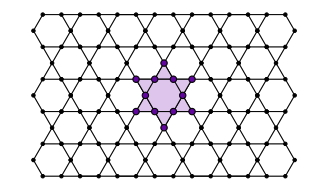
Researchers successfully investigate the ground state properties of the antiferromagnetic Heisenberg model on a Kagome lattice using a superconducting Noisy Intermediate-Scale Quantum (NISQ) device, demonstrating a potential application of near-term quantum computing to materials science. The Kagome lattice, characterised by a network of corner-sharing triangles, exhibits geometric frustration, leading to a complex energy spectrum and challenging computational modelling.
The computational demands of simulating quantum systems on these lattices are substantial, necessitating innovative approaches to reduce the required quantum resources. Researchers employ the Contextual Subspace methodology, a technique for reducing the number of qubits required for the simulation. This reduction is refined through a classical-quantum hybrid approach, leveraging results from Density Matrix Renormalization Group (DMRG) calculations, a well-established numerical method for studying strongly correlated systems. Specifically, the DMRG data informs the biasing of subspace stabilizers via a symplectic approximate symmetry generator extraction algorithm, optimising the qubit reduction process.
The quantum computation itself utilises the Variational Eigensolver
The quantum computation itself utilises the Variational Eigensolver (VQE) algorithm, a hybrid quantum-classical algorithm designed to find the ground state energy of a quantum system. Implementation involves tiled circuit ensembles, a strategy for constructing efficient quantum circuits. Crucially, the fidelity of the results relies on mitigating the inherent errors present in NISQ devices. Researchers achieve this through a robust error mitigation strategy combining Readout Error Mitigation (REM), which corrects for errors in measuring qubit states, Symmetry Verification (SV), which exploits known symmetries of the system to identify and correct errors, and Zero Noise Extrapolation (ZNE), a technique for estimating the result of a computation in the absence of noise.
The methodology achieves error rates on the order of 0.01%, indicating the feasibility and potential of this approach for tackling complex quantum systems in materials science. This work represents a notable advancement in utilising NISQ technology to investigate materials with complex magnetic properties and may pave the way for the design of novel materials with tailored functionalities.
🗞 Simulating the Antiferromagnetic Heisenberg Model on a Spin-Frustrated Kagome Lattice with the Contextual Subspace Variational Quantum Eigensolver
🧠 DOI: https://doi.org/10.48550/arXiv.2506.12391