

Combinatorial optimisation presents a significant challenge for modern computation, demanding increasingly innovative approaches to solve complex problems efficiently. Pranav Chandarana, Sebastián V. Romero, Alejandro Gomez Cadavid, and colleagues at Kipu Quantum GmbH and the University of the Basque Country EHU, now present hybrid sequential quantum computing (HSQC), a new paradigm that systematically integrates classical and quantum methods within a structured workflow. This research demonstrates that by combining the strengths of both classical heuristics, which efficiently explore the solution landscape, and quantum optimisation, which refines candidate solutions and tunnels through barriers, HSQC consistently recovers ground-state solutions to challenging higher-order unconstrained binary optimisation problems. Applied to a 156-qubit superconducting processor, the team achieves speedups of up to 700times compared to simulated annealing and up to nine times over memetic tabu search, establishing HSQC as a flexible and scalable framework capable of delivering significant performance improvements on advanced commercial processors.
Quantum Optimisation, Hardware and Algorithm Advances
The field of quantum computing is rapidly advancing, with researchers exploring its potential to solve complex optimization problems beyond the reach of classical computers. Current investigations encompass a wide range of approaches, from quantum annealing systems to gate-based algorithms and hybrid classical-quantum methods. A central goal is to demonstrate quantum advantage, achieving faster or better solutions for real-world challenges. Several hardware platforms are under development, each with unique characteristics and capabilities. D-Wave Systems is pioneering quantum annealing machines, with ongoing research focused on improving their performance and integrating them with classical solvers.
IBM Quantum is developing gate-based quantum computers, with efforts directed towards enhancing qubit coherence and reducing noise through their Qiskit framework. Researchers are also investigating alternative platforms, such as trapped ion and Rydberg atom quantum computers, to explore diverse approaches to quantum hardware. A variety of quantum algorithms are being refined to tackle optimization problems, including quantum annealing, variational quantum optimization (VQE), and the quantum approximate optimization algorithm (QAOA). Quantum simulated annealing, utilizing Rydberg atoms, and digitized adiabatic quantum computing are also under investigation.
These algorithms are being applied to a broad spectrum of optimization problems, including the quadratic assignment problem, Boolean satisfiability, protein folding, and constrained and multi-objective optimization. Researchers are also exploring ways to enhance existing classical optimization techniques with quantum algorithms. This includes using classical solvers to pre- or post-process quantum results and developing hybrid algorithms that combine both approaches. Addressing the challenges of noisy quantum hardware is crucial, and researchers are developing error mitigation techniques and noise-aware algorithms. Current research directions focus on demonstrating quantum advantage, improving scalability, enhancing error correction, developing new algorithms, and exploring applications in quantum machine learning and topological quantum computing.
Hybrid Classical-Quantum Optimization for HUBO Problems
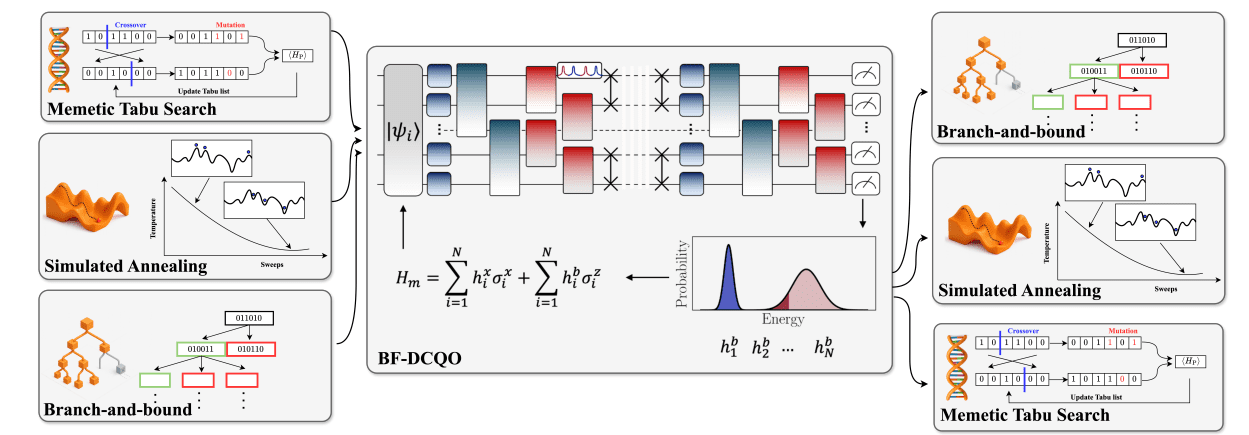
Scientists have pioneered a new methodology, hybrid sequential quantum computing (HSQC), to address complex combinatorial optimization problems. This approach systematically integrates both classical and quantum computing techniques within a structured, stage-wise workflow, capitalizing on the strengths of each paradigm. The study began by employing classical optimizers to broadly explore the solution landscape of challenging higher-order unconstrained binary optimization (HUBO) problems, effectively identifying promising initial configurations. Subsequently, quantum optimization, specifically bias-field digitized counterdiabatic quantum optimization (BF-DCQO), was harnessed to refine these candidate solutions and tunnel through energy barriers that often trap classical algorithms.
The team implemented two distinct HSQC instantiations to demonstrate the versatility of this framework, utilizing a 156-qubit heavy-hexagonal superconducting quantum processor. Following the quantum refinement stage, a final classical solver was applied to further optimize the quantum-enhanced state and recover nearby or exact-optimal solutions. Experiments consistently recovered ground-state solutions to challenging HUBO problems in just a few seconds, demonstrating the efficiency of the HSQC framework. Performance comparisons revealed that HSQC achieves a speedup of up to 700times over standalone simulated annealing and up to 9times over memetic tabu search in estimated runtimes, establishing a clear quantum-advantage level on advanced commercial quantum processors.
Hybrid Sequential Computing Outperforms Classical Solvers
Scientists have developed a new computing paradigm called hybrid sequential quantum computing (HSQC), which systematically integrates classical and quantum methods to solve complex optimization problems. This approach strategically combines the strengths of both classical algorithms, which efficiently explore initial solution landscapes, and quantum processing, which refines those solutions by tunneling through barriers that trap classical methods. The team designed HSQC to address limitations in both classical and quantum computing, leveraging each where it performs best. Experiments focused on higher-order unconstrained binary optimization (HUBO) problems executed on a 156-qubit superconducting quantum processor.
The researchers implemented two HSQC workflows, one combining simulated annealing, bias-field digitized counterdiabatic quantum optimization (BF-DCQO), and memetic tabu search, and another using simulated annealing, BF-DCQO, followed by a second round of simulated annealing. Results demonstrate that HSQC consistently recovers ground-state solutions to these challenging problems in just a few seconds. Compared to standalone classical solvers, HSQC achieves a speedup of up to 700times over simulated annealing and up to 9times over memetic tabu search in estimated runtimes, demonstrating a quantum-advantage level on advanced commercial quantum processors.
Hybrid Sequential Computing Outperforms Classical Solvers
Scientists have developed a new computing paradigm called hybrid sequential quantum computing (HSQC), which systematically integrates classical and quantum methods to solve complex optimization problems. This approach strategically combines the strengths of both classical algorithms, which efficiently explore initial solution landscapes, and quantum processing, which refines those solutions by tunneling through barriers that trap classical methods. The team designed HSQC to address limitations in both classical and quantum computing, leveraging each where it performs best. Experiments focused on higher-order unconstrained binary optimization (HUBO) problems executed on a 156-qubit superconducting quantum processor.
The researchers implemented two HSQC workflows, one combining simulated annealing, bias-field digitized counterdiabatic quantum optimization (BF-DCQO), and memetic tabu search, and another using simulated annealing, BF-DCQO, followed by a second round of simulated annealing. Results demonstrate that HSQC consistently recovers ground-state solutions to these challenging problems in just a few seconds. Compared to standalone classical solvers, HSQC achieves a speedup of up to 700times over simulated annealing and up to 9times over memetic tabu search in estimated runtimes, demonstrating a quantum-advantage level on advanced commercial quantum processors.
👉 More information
🗞 Hybrid Sequential Quantum Computing
🧠 ArXiv: https://arxiv.org/abs/2510.05851

