Scientists are tackling the complex challenge of building a complete software and hardware ecosystem for quantum computing, and a new workflow promises significant advances in the field. Ang Li, from the Pacific Northwest National Laboratory (PNNL), alongside colleagues, present NWQWorkflow , an end-to-end system designed to streamline application development, compilation, benchmarking, simulation, control, and execution on superconducting testbeds. This integrated approach, reflecting eight years of research at PNNL, uniquely enables closed-loop software-hardware co-design and, crucially, fosters collaboration by releasing key components as open-source tools, potentially accelerating the path towards scalable quantum supercomputing.
Scientists are tackling the complex challenge of building a complete software and hardware ecosystem for quantum computing, and a new workflow promises significant advances in the field.
NWQWorkflow a complete quantum development ecosystem
The team achieved this by designing a cohesive system, rather than assembling disparate tools through manual effort and ad-hoc interfaces, thereby improving reproducibility and reuse. NWQWorkflow distinguishes itself through its open-source design, encompassing nearly the entire quantum computing process, including programming environments, algorithm libraries, intermediate representations, compilation, quantum error correction, benchmarking, large-scale simulation, data management, control software, and hardware testbeds. Core components, such as the compiler, simulator, quantum error correction framework, and control stack, are primarily implemented in C++, minimizing external dependencies and maximizing performance. This focus on self-containment and performance is crucial for deployment and scaling on shared HPC systems, where Python-based ecosystems can introduce overheads.
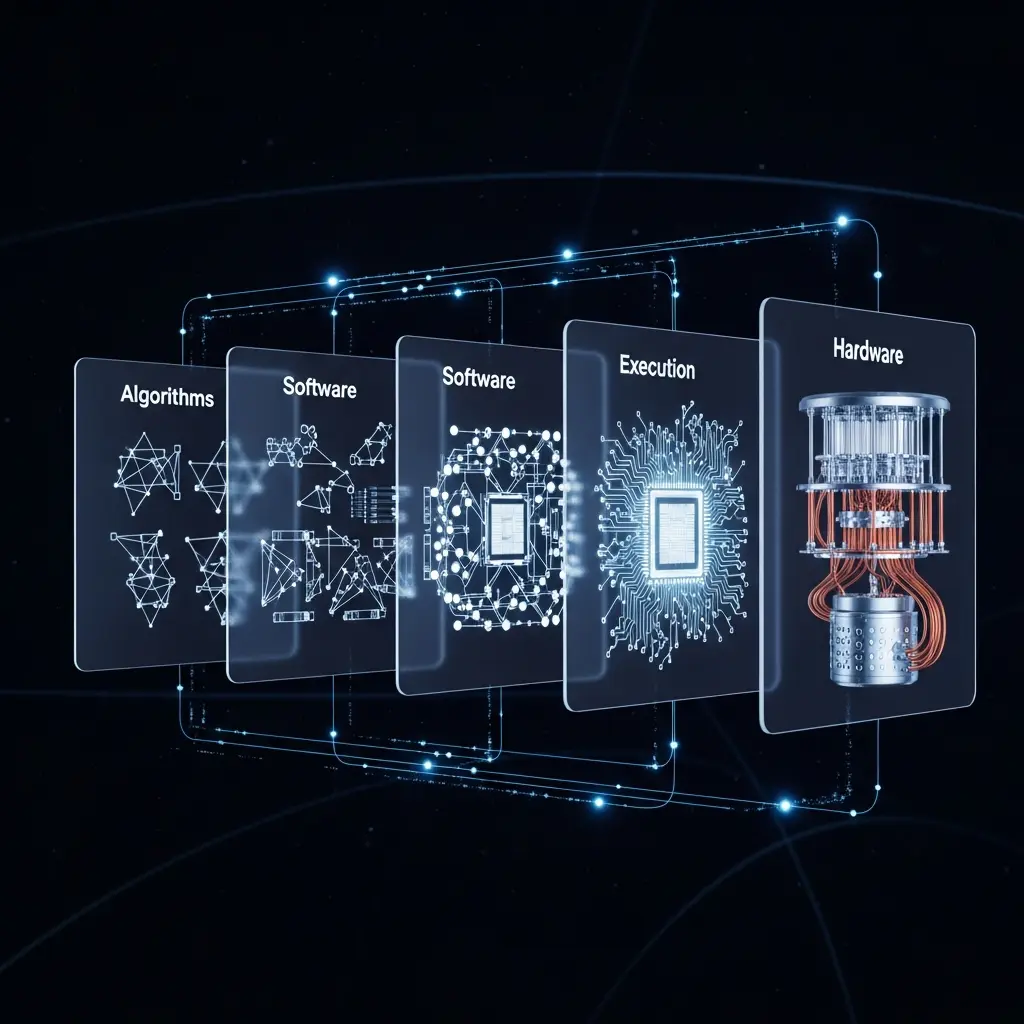
Experiments show that NWQWorkflow is device- and application-agnostic, targeting general quantum computing workloads without restricting itself to specific hardware modalities or application domains. The system’s architecture, detailed in Table 1, features readily available components released through GitHub, forming a complete software stack designed to support scientific applications relevant to the DOE and PNNL. Figure 1 illustrates the layered software and hardware stack, while Figure 2 demonstrates an exemplar quantum chemistry workflow developed at PNNL, highlighting the system’s potential for close co-design between chemistry and computing teams and paving the way for future quantum computing user facilities and quantum data centers.
Scientists Method
This integrated workflow combines NWQStudio, a programming GUI, with NWQASM, a novel intermediate representation, and QASMTrans, a dedicated compiler, to facilitate closed-loop software-hardware co-design over the past eight years. The study pioneered an exemplar quantum chemistry workflow beginning with ExaChem, a suite of scalable electronic structure methods implementing Hartree, (T), CCSD-Lambda, EOM-CCSD, RT-EOM-CCSD, GFCCSD, and double unitary coupled-cluster methods. Resulting Hamiltonians undergo optimization using SymGen, a framework generating symmetry-adapted Hamiltonians, and TAMM, a parallel tensor algebra library, both enhancing efficiency and reducing problem dimensionality. Downfolding, a systematic model-reduction technique implemented within ExaChem, further diminishes the Hilbert space by partitioning it into active and inactive subspaces, enabling accurate treatment of strongly correlated systems with fewer degrees of freedom.
Selected downfolded Hamiltonians, such as benzene and free-base porphyrin, are distributed via the DUCC-Hamiltonian-Library and processed by quantum algorithm solvers like ADAPT-VQE or the GCM method from the NWQLib library. Logical quantum circuits, generated by integrating solvers with state-preparation routines, are expressed in NWQASM, an extension of OpenQASM 2.0. These circuits are then transpiled by C++-implemented quantum compilers, QASMTrans for NISQ scenarios and NWQEC for fault-tolerant quantum computing, optimizing them for target basis gates. The resulting physical circuits are executed either via large-scale numerical simulation using NWQSim on HPC resources or on the NWQSC superconducting testbed, leveraging pulse generation and optimization provided by NWQControl.
NWQStudio, developed in Python using PyQt5, integrates all major NWQWorkflow components through a GUI, forming a comprehensive programming and evaluation environment. Initially designed to simplify NWQSim usage on HPC systems, the IDE progressively incorporated transpilation, device execution, benchmarking, and AI assistance. The NWQStudio interface allows users to configure input circuits, specify compiler and simulator paths, load device configurations, and visualize qubit topology, facilitating automated Git checkout, compilation, and setup for streamlined quantum workflows.
NWQWorkflow integrates AI for quantum co-design
Researchers achieved seamless integration of an AI agent supporting both direct API key input and linkage to a PNNL AI Incubator server, enhancing tool configuration and simulation parameter setting. This agent demonstrably assists in reasoning about simulation and execution results, providing feedback for new experiment development and managing NWQStudio jobs, crucial given the time-consuming nature of HPC simulations and cloud-based quantum device executions. Experiments revealed that NWQSim, utilising the density matrix simulator DM-Sim on the NERSC Perlmutter HPC system, successfully simulated QASMTrans-transpiled circuits. Simulation results included detailed fidelity metrics, computed by comparing noisy simulations, utilising device parameters like T1, T2, gate time, and readout fidelity, against ideal state-vector simulations.
Measurements confirm that bit-string results, visualised as histograms ranked by occurrence frequency, provide a clear representation of simulation outcomes, alongside runtime statistics including simulation time and memory usage. Tests prove that NWQStudio leverages multi-threading to manage jobs, spawning dedicated threads to monitor submissions until completion, and supports batched evaluation of multiple circuits to reduce cloud execution costs, particularly beneficial for iterative workloads like VQE0.3.2. The team measured performance of the NWQLib algorithm solver library, co-designed for applications in nonlinear transport, electric power grids, and quantum chemistry. Solvers targeted include quantum linear solvers such as HHL and LCHS, quantum optimisation algorithms like QAOA and Quantum Hamiltonian Descent, and methods for solving many-body electron systems including VQE, ADAPT-VQE, and Quantum Phase Estimation. Early evaluations of HHL for nonlinear transport and power grid applications are documented, demonstrating the library’s potential for diverse problem domains. NWQASM, built upon and fully compatible with OpenQASM 2.0, serves as the intermediate representation, ensuring broad applicability across quantum platforms and facilitating workflow-level integration.
NWQWorkflow streamlines quantum program lifecycle development, from design
Scientists have developed NWQWorkflow, a comprehensive, full-stack software and hardware toolchain designed to bridge the gap between emerging quantum applications and both Noisy Intermediate-Scale Quantum (NISQ) and fault-tolerant quantum computing (FTQC) hardware. This workflow integrates a suite of tools, including programming environments, compilers, benchmarking systems, high-performance computing simulators, control systems, and quantum testbeds, into a cohesive system for quantum application development and execution. The authors acknowledge a limitation in that transitioning fully to fault-tolerant quantum computing algorithms requires replacing current NISQ components and integrating quantum error correction protocols. Future work will focus on demonstrating chemistry workflows under fault-tolerant conditions and fostering a collaborative quantum information science ecosystem through open-source availability of software components. The system’s ability to support both NISQ and FTQC hardware is particularly significant, as it provides a pathway for scaling quantum computing capabilities as the technology matures.
👉 More information
🗞 NWQWorkflow: The Northwest Quantum Workflow
🧠 ArXiv: https://arxiv.org/abs/2601.15521