The nonunitary time-dependent Schrödinger equation, a key component of quantum physics, is typically solved using classical computers. However, due to the complexity of the algorithm and the quantum resources required, this can be challenging. A new method proposes solving this equation more efficiently on a quantum computer using a fully quantum algorithm. The method involves adding a complex absorbing potential (CAP) to the real-time evolution of the equation and using the dilation quantum algorithm. The results obtained on a quantum computer match those on a classical computer, suggesting the potential effectiveness of this approach.
What is the Nonunitary Time-Dependent Schrödinger Equation and How Can It Be Solved Efficiently on a Quantum Computer?
The nonunitary time-dependent Schrödinger equation is a fundamental component of quantum physics. It describes the time evolution of quantum systems, which is crucial for simulating microscopic physics. This equation is commonly used in various scientific domains, including many-body systems, electron-phonon interactions, quantum field theory, and even hydrodynamics.
The equation is typically solved using classical computers, especially for low-dimension problems. However, the practical simulation of such problems can be challenging due to the quantum resources required and the complexity of the algorithm. This article explores the possibility of solving this equation more efficiently on a quantum computer using a fully quantum algorithm.
The proposed method involves adding a complex absorbing potential (CAP) to the real-time evolution of the equation. This technique is standard in classical computing to reduce numerical resources when the evolution is solved on a grid. It involves adding an imaginary potential that absorbs the wave function escaping from a certain region of interest, thereby reducing the effects of boundary conditions and potentially decreasing the number of mesh points needed to simulate the evolution accurately.
How Does the Dilation Quantum Algorithm Work in This Context?
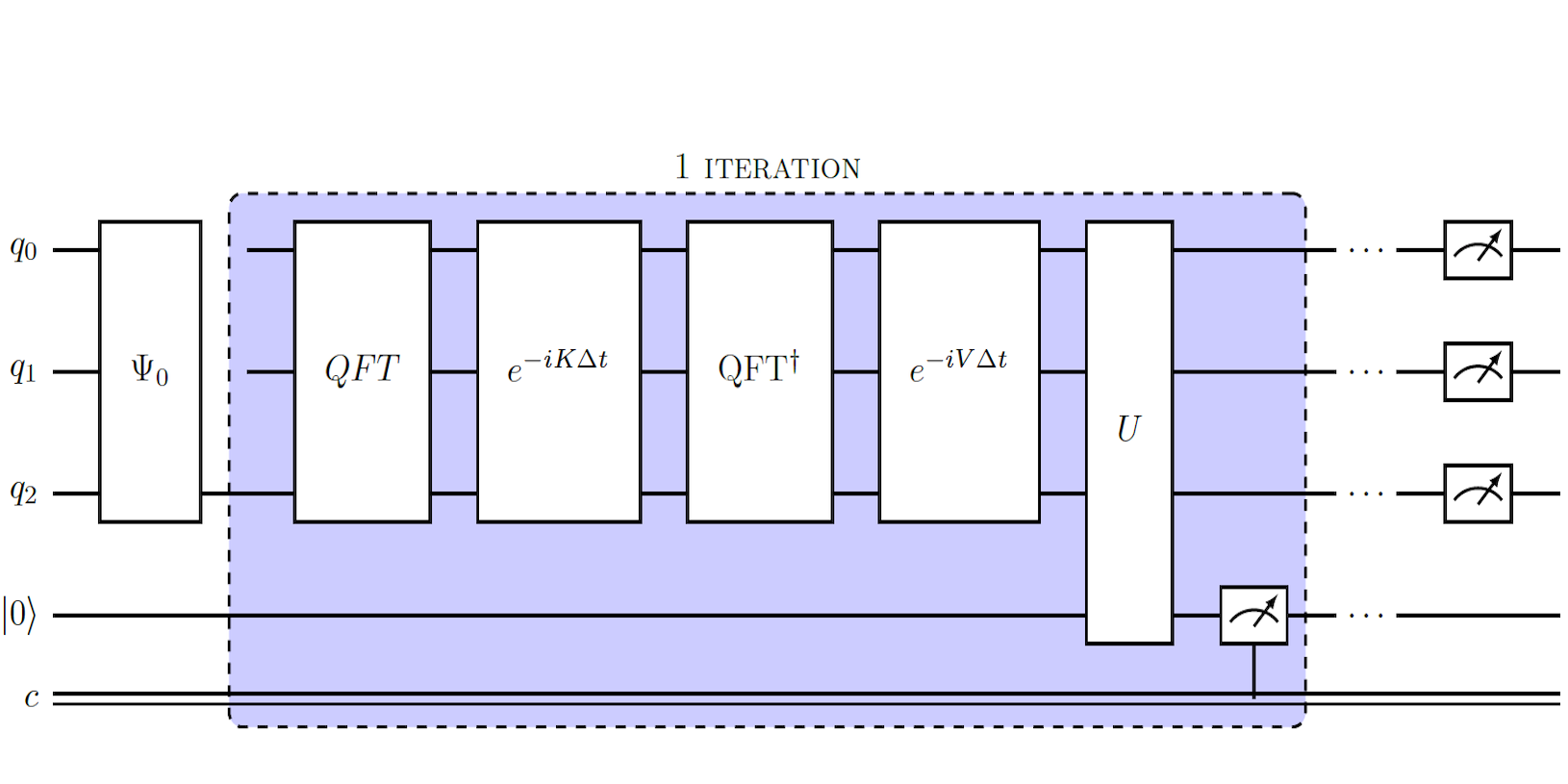
The dilation quantum algorithm is used to treat the imaginary-time evolution in parallel to the real-time propagation. This method has the advantage of using only one reservoir qubit at a time, which is measured with a certain success probability to implement the desired imaginary-time evolution.
A specific prescription for the dilation method is proposed, where the success probability is directly linked to the physical norm of the continuously absorbed state evolving on the mesh. It is expected that this prescription will keep a high probability of success in most physical situations.
Applications of the method are made on one-dimensional wave functions evolving on a mesh. The results obtained on a quantum computer identify with those obtained on a classical computer, indicating the potential effectiveness of this approach.
What is the Complexity of Implementing the Dilation Matrix?
The complexity of implementing the dilation matrix is a crucial consideration in this method. Due to the local nature of the potential for n-qubits, the dilation matrix only requires 2n CNOT and 2n unitary rotation for each time step. In contrast, it would require of the order of 4n+1 CNOT gates to implement it using the best known algorithm for general unitary matrices.
This suggests that the proposed method could offer a more efficient solution for solving the nonunitary time-dependent Schrödinger equation on a quantum computer. However, further research and testing are needed to confirm this and to explore potential applications of this method in various scientific domains.
What are the Potential Applications of This Method?
The potential applications of this method are vast, given the widespread use of the nonunitary time-dependent Schrödinger equation in various scientific domains. For instance, it could be used to extract the ground state energy of microscopic systems by relying on the exponential decay of excited states.
This is just one of many applications of these powerful methods, which have been applied with great success not only in particle and nuclear physics but also in condensed matter and quantum chemistry. By developing algorithms on quantum computers able to efficiently encode evolution operators, it could be possible to simulate a broad range of microscopic systems on quantum devices.
What are the Future Directions for This Research?
The research conducted by Mariane Mangin-Brinet, Jing Zhang, Denis Lacroix, and Edgar Andres Ruiz Guzman represents a significant step forward in the field of quantum computing. However, there is still much work to be done.
Future research should focus on further testing and refining the proposed method, as well as exploring its potential applications in various scientific domains. Additionally, more research is needed to explore other methods for solving the nonunitary time-dependent Schrödinger equation on a quantum computer, to compare their effectiveness and efficiency with the proposed method.
Overall, this research opens up exciting new possibilities for the use of quantum computers in scientific research and could have far-reaching implications for our understanding of quantum physics.
Publication Date: 2024-04-08
Authors: M. Mangin-Brinet, Jing Zhang, Denis Lacroix, Edgar Andres Ruiz Guzman, et al.
Source: Quantum
DOI: https://doi.org/10.22331/q-2024-04-08-1311