Researchers from the Institute for Quantum Information RWTH Aachen University and Institute for Theoretical Nanoelectronics PGI2 Forschungszentrum Jülich have proposed a novel scheme for Quantum Error Correction (QEC) that doesn’t require measuring qubits. QEC is crucial for fault-tolerant quantum computation, but its implementation is challenging due to issues like decoherence and quantum noise. The new scheme, which can be used for any low-distance CSS code, involves coherently copying errors to a logical auxiliary qubit. The researchers have outlined how this scheme could be implemented in ion traps and with neutral atoms in a tweezer array.
What is Quantum Error Correction and Why is it Important?
Quantum error correction (QEC) is a critical component of quantum computing. It is a set of techniques used to protect quantum information from errors due to decoherence and other quantum noise. Quantum error correction is essential for fault-tolerant quantum computation that can correct any small errors in quantum states.
The concept of QEC is based on the idea of repeatedly performing QEC cycles to protect logical qubits from decoherence. These algorithms must be compiled to the specific hardware platform under consideration to practically realize a quantum memory that operates for arbitrary long times. All circuit components must be assumed as noisy unless specific assumptions about the form of the noise are made.
However, implementing QEC schemes in physical architectures is challenging, especially where in-sequence measurements and feed-forward of classical information cannot be reliably executed fast enough or even at all. This is where the research by Sascha Heußen, David F Locher, and Markus Müller from the Institute for Quantum Information RWTH Aachen University and Institute for Theoretical Nanoelectronics PGI2 Forschungszentrum Jülich comes in.
What is the New Quantum Error Correction Scheme?
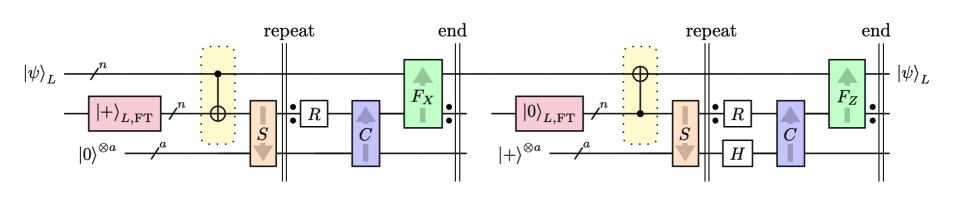
The researchers have proposed a novel scheme to perform QEC cycles without the need for measuring qubits. This scheme is fully fault-tolerant with respect to all components used in the circuit and can be used for any low-distance CSS code. The only requirement towards the underlying code is a transversal CNOT gate.
In this scheme, errors are coherently copied to a logical auxiliary qubit, and then a coherent feedback operation from the auxiliary system to the logical data qubit is applied. The logical auxiliary qubit is prepared fault-tolerantly without measurements too.
The researchers benchmarked logical failure rates of the scheme in comparison to a flag-qubit-based EC cycle. They mapped out a parameter region where their scheme is feasible and estimated physical error rates necessary to achieve the breakeven point of beneficial QEC with their scheme.
How Can This Scheme be Implemented?
The researchers outlined how their scheme could be implemented in ion traps and with neutral atoms in a tweezer array. For recently demonstrated capabilities of atom shuttling and native multi-atom Rydberg gates, they achieved moderate circuit depths and beneficial performance of their scheme while not breaking fault tolerance.
These results thereby enable practical fault-tolerant QEC in hardware architectures that do not support mid-circuit measurements. This is a significant step forward in the field of quantum computing, as it addresses one of the major challenges in implementing QEC schemes.
What are the Challenges in Implementing Quantum Error Correction?
Implementing QEC in quantum computing hardware platforms is not straightforward due to various limitations. For example, in superconducting transmons, error rates of measurements are typically larger than error rates of physical gates, and measurement crosstalk can affect neighboring qubits.
In many hardware platforms, measurements are much slower than gate operations, leading to errors on qubits that are idling during measurement and feedback. In trapped-ion and neutral-atom platforms, this problem is exacerbated by the necessity of applying relatively slow laser recooling of ions after qubit detection or laser cooling during detection to avoid atom loss.
What is the Future of Quantum Error Correction?
The research by Heußen, Locher, and Müller represents a significant advancement in the field of quantum error correction. Their novel scheme provides a practical solution to the challenges of implementing QEC in quantum computing hardware platforms.
However, there is still much work to be done. Future experiments that involve in-sequence logic might require technologies such as cavity-enhanced fluorescence imaging, shuttling of atoms into dedicated readout zones, or the use of multiple atom species.
Despite these challenges, the continuous effort in finding QEC schemes that circumvent the need of measuring individual qubits to obtain information about potential errors is promising. This research opens up new possibilities for the practical implementation of fault-tolerant quantum error correction, bringing us one step closer to the realization of large-scale universal quantum computation.
Publication Date: 2024-02-27
Authors: Sascha Heußen, David F. Locher and Markus Müller
Source: PRX Quantum 5, 010333
DOI: https://doi.org/10.1103/PRXQuantum.5.010333