

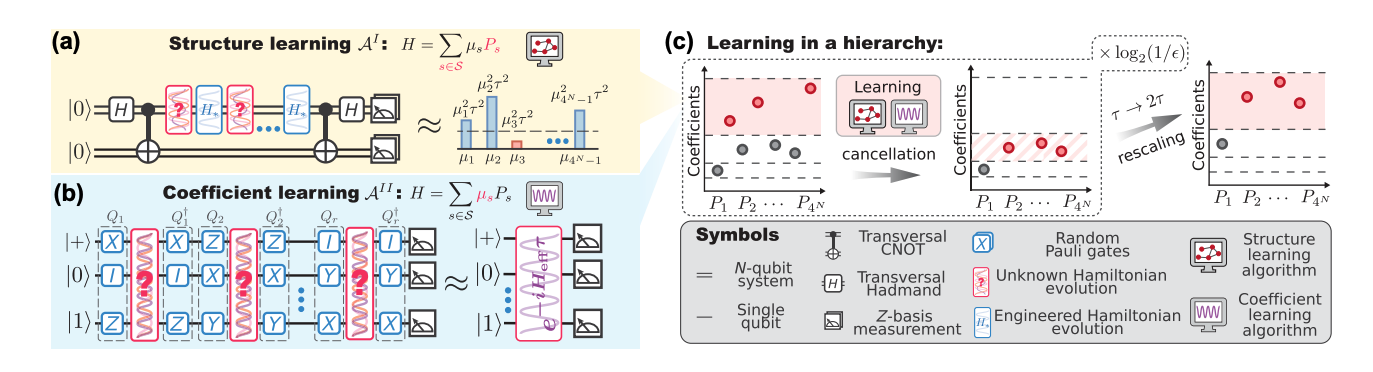
Unlocking the secrets of a quantum system’s underlying rules has long been a pivotal goal in physics, with implications ranging from building more powerful quantum computers to designing ultra-sensitive sensors. Now, researchers have achieved a breakthrough in “Hamiltonian learning,” the process of identifying those governing interactions, surpassing a critical barrier known as the standard quantum limit. Published in PRX Quantum, a new quantum algorithm demonstrates, for the first time, the ability to learn any sparse Hamiltonian—without making assumptions about its structure—and achieve the coveted Heisenberg limit in precision. This advancement, based on black-box queries and minimal digital controls, not only promises faster, more accurate quantum simulations but also offers a robust path for benchmarking and validating quantum hardware, even in the presence of experimental errors.
Ansatz-Free Hamiltonian Learning Explained
A new quantum algorithm addresses the challenge of “ansatz-free Hamiltonian learning,” determining the interactions within a quantum system without predefined assumptions about its structure —a limitation of previous methods. Published in PRX Quantum, research from Hu, Ma, and colleagues demonstrates a pathway to Heisenberg-limited scaling in estimation error, surpassing the standard quantum limit and offering a significant advancement in precision. Unlike existing techniques that require specific Hamiltonian forms, this approach learns arbitrary sparse Hamiltonians using only black-box queries into the system’s real-time evolution and minimal digital controls. Crucially, the algorithm exhibits resilience to common experimental errors, such as those arising from state preparation and measurement, thereby increasing its practicality. Numerical validations confirm its performance against state-of-the-art Heisenberg-limited learning, while also establishing a fundamental trade-off between evolution time and the degree of quantum control needed for accurate Hamiltonian learning.
Algorithm Performance and Validation
A key advancement detailed in this research centres on algorithm performance and validation in the challenging field of Hamiltonian learning, specifically achieving Heisenberg-limited scaling without pre-defined structural assumptions – termed “ansatz-free” learning. Previous methods suffered from limitations that required high-order inverse polynomial dependencies for precision, preventing them from achieving this gold standard. This new quantum algorithm demonstrably overcomes these hurdles, learning arbitrary sparse Hamiltonians using only black-box queries and minimal digital controls, and reaching the desired Heisenberg limit in estimation error. Rigorous numerical demonstrations validate the protocol’s efficacy in learning physical Hamiltonians and benchmarking analogue quantum simulations against existing Heisenberg-limited approaches. Furthermore, the study establishes a crucial trade-off between total evolution time and the degree of quantum control required, highlighting a fundamental interplay impacting the performance of any Hamiltonian learning algorithm.
Fundamental Trade-offs in Learning
Recent research in quantum Hamiltonian learning—the process of discerning the governing interactions within a quantum system—highlights a fundamental trade-off between the total time required for system evolution and the degree of quantum control needed to achieve optimal precision. Published in PRX Quantum, a new algorithm demonstrates Heisenberg-limited scaling in estimating arbitrary sparse Hamiltonians, surpassing the standard quantum limit previously unattainable without assumptions about interaction structure. However, this enhanced precision isn’t free; the study establishes that any learning algorithm faces an intrinsic interplay between controllability—the ability to manipulate the quantum system—and the total evolution time required for accurate estimation. Essentially, minimising one factor necessitates an increase in the other, revealing a core limitation in learning complex quantum interactions and demanding careful optimisation in experimental design and algorithmic development. This trade-off has implications for benchmarking quantum devices and validating analogue quantum simulations.


