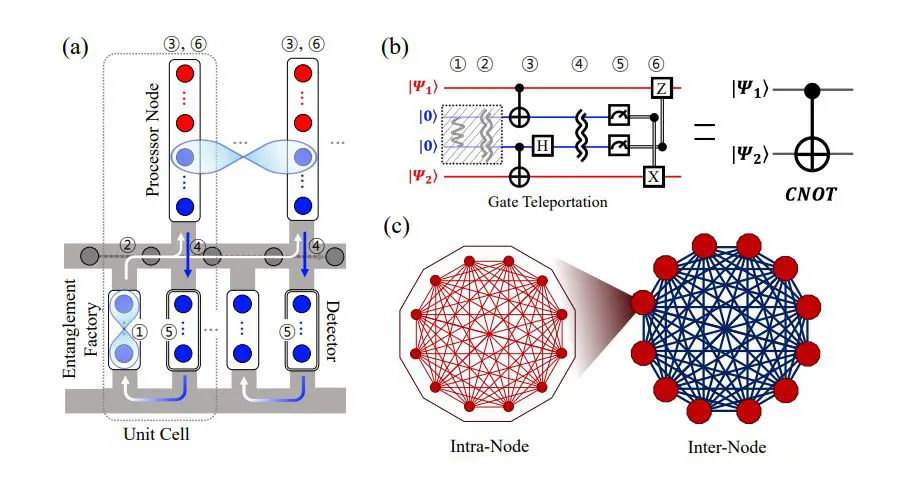
Distributed quantum computing represents a promising path towards realising powerful, scalable quantum processors, and a team led by Seunghyun Baek, Seok-Hyung Lee, and Dongmoon Min from Sungkyunkwan University, along with Junki Kim, now presents a novel architecture to advance this field. Their work introduces Shuttling-based Distributed Quantum Computing (SDQC), a hybrid approach that uniquely combines the benefits of physically moving qubits with the advantages of distributing quantum information across multiple processing units. This innovative system performs complex operations by distributing entangled ion qubits through a deterministic shuttling process, achieving both high accuracy and increased computational speed. The researchers demonstrate that SDQC significantly outperforms existing distributed quantum computing methods, achieving lower error rates and faster clock speeds when tackling complex problems such as the 256-bit elliptic-curve discrete logarithm problem.
This innovative approach combines the advantages of physically shuttling qubits with the principles of distributed quantum processing, allowing for non-local quantum operations through the deterministic distribution of entangled ion qubits. The team presents a practical architecture incorporating quantum error correction and pipelining strategies to maximize parallelism in both entanglement distribution and measurement processes.
Quantum Hardware, Error Correction and Algorithms
This compilation details research into the fundamental building blocks and techniques driving advancements in quantum computing, encompassing diverse quantum hardware implementations like trapped ions, superconducting circuits, and photonic qubits. A significant focus lies on quantum error correction, exploring methods to protect fragile quantum information from noise and decoherence, such as surface codes and color codes. This work combines the strengths of physical qubit shuttling with distributed quantum processing, enabling non-local operations through deterministic ion qubit distribution. The team presents a practical architecture incorporating quantum error correction and pipelining strategies to maximize parallelism in both entanglement distribution and measurement processes. Performance evaluations demonstrate that for a 256-bit elliptic-curve discrete logarithm problem, requiring 2,871 logical qubits at code distance 13, SDQC achieves a logical error rate comparable to that of Photonic DQC and significantly lower than that of Charge-Coupled Device (QCCD) architectures.
Specifically, the logical error rate attained by SDQC is on par with Photonic DQC and substantially lower than that observed in QCCD systems. Crucially, SDQC delivers a 2. 82times faster logical clock speed than QCCD, representing a substantial improvement in computational efficiency. The research details a system where ions are spatially confined using electromagnetic potentials, forming linear Coulomb crystals with quantized motional modes. Quantum information is encoded in the internal electronic states of these ions, exhibiting coherence times exceeding one hour.
High-fidelity state preparation and measurement are achieved with errors as low as 10 -6 , and reported fidelity for entangling operations reaches 99. 97%. The team successfully demonstrates all-to-all connectivity between qubits, a key advantage of trapped-ion systems, and has achieved programmable quantum operations with dozens of qubits. The team successfully designed a practical architecture incorporating error correction and implemented pipelining strategies to enhance parallelism in entanglement distribution and measurement. Performance evaluations demonstrate that this approach achieves a logical error rate comparable to other leading architectures while providing a significant improvement in logical clock speed for a demanding computational task. The researchers demonstrate the potential of their system by applying it to a 256-bit elliptic-curve discrete logarithm problem, achieving a lower execution time and higher success rate than existing scalable trapped-ion architectures with a modest increase in space cost. The architecture utilizes asynchronous entanglement distribution to achieve scale-independent time costs and deterministic shuttling to deliver entangled qubit pairs with high fidelity, resulting in fast and scalable quantum computation. Future work will focus on extending the architecture to support fault-tolerant non-Clifford operations through the design of magic state preparation and exploring co-optimization opportunities between different quantum error correction codes and the architecture itself.
🗞 SDQC: Distributed Quantum Computing Architecture Utilizing Entangled Ion Qubit Shuttling
🧠 ArXiv: https://arxiv.org/abs/2512.02890