The pursuit of robust quantum computing relies on harnessing uniquely quantum resources, and recent research focuses on ‘magic’, a property essential for surpassing the capabilities of classical computers. Halima Giovanna Ahmad, Gianluca Esposito, and Viviana Stasino, alongside Jovan Odavic, Carlo Cosenza, and Alessandro Sarno, demonstrate the first experimental realisation of ‘non-local magic’ within a superconducting quantum processor. This achievement represents a significant step forward because non-local magic, the portion of this resource resistant to manipulation by local operations, is crucial for complex quantum behaviours and fault-tolerant computation. By directly accessing and characterising the quantum processor, the team not only confirms the presence of both local and non-local magic, but also validates a noise model with remarkable accuracy, paving the way for more reliable quantum devices and accelerating hardware-aware research in the near future.
Superconducting Qubit Error Characterization and Mitigation
Improving Superconducting Qubit Reliability and Error Mitigation
This research details a comprehensive quantum computing experiment focused on improving the reliability of superconducting qubits. Scientists meticulously calibrated the qubits, optimized control pulses, and addressed issues like leakage and crosstalk to enhance performance. The team explored error mitigation strategies, including bit-flip averaging, zero-noise extrapolation, and post-processing techniques to correct measurement errors, employing Randomized Benchmarking to assess gate fidelity and overall system performance. Detailed methods were developed for characterizing different error types, such as readout and gate errors, and mirror circuits were used to refine the accuracy of benchmarks. The research leveraged the Quantify software package for controlling and characterizing the quantum hardware, and explored the potential of quantum machine learning for decoding and information retrieval. This work represents a significant contribution to the field of quantum computing, detailing the challenges and advancements in building and characterizing a superconducting qubit system, ultimately advancing the development of more reliable quantum computers.
Quantifying Non-Local Magic Resources via Measurements
Non-Local Magic Quantification via Randomized Measurements
Measuring Non-Local Magic Resources in Quantum Processors
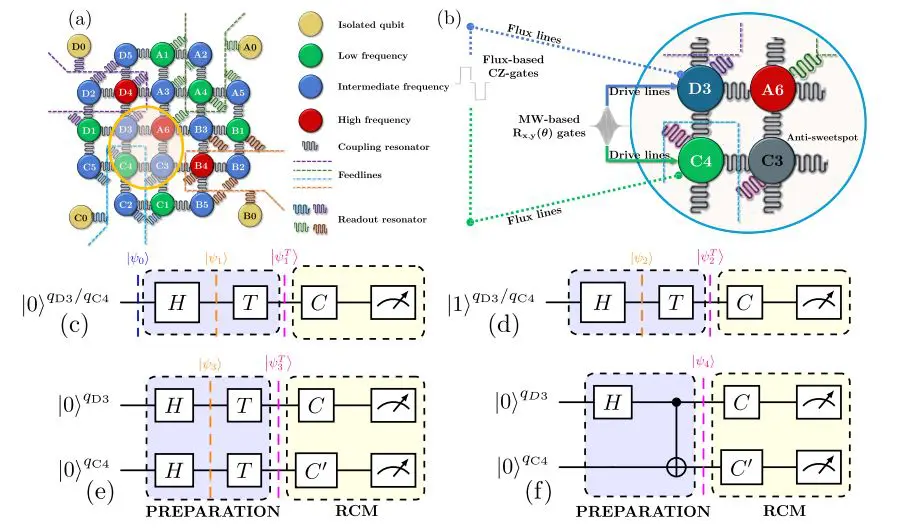
Scientists have pioneered the first experimental demonstration and measurement of non-local magic, a crucial resource for advancing fault-tolerant quantum computing, using a superconducting quantum processing unit. The research harnessed Stabilizer (Rényi) Entropy, and experimentally measured it via a Randomized Measurement toolbox, enabling the quantification of this resource in a real quantum device. Researchers employed two distinct methods to measure non-local magic across three classes of quantum states, confirming consistent results aligning with theoretical predictions. The study investigated the relationship between experimentally measured magic and intrinsic noise sources, revealing that readout errors represent the dominant source of error, injecting local magic into the system. Researchers modeled non-local noise as a depolarizing Controlled-Z channel, successfully incorporating this understanding into the quantum state preparation process. They demonstrated that while non-local noise has a limited effect on overall state purity, readout noise is more impactful but can be mitigated using established error mitigation techniques, extending beyond conventional protocols like Randomized Benchmarking.
Non-Local Magic Demonstrated in Superconducting Qubit
Experimental Demonstration of Non-Local Quantum Magic
Scientists have achieved the first experimental demonstration of non-local magic, a fundamental resource for advancing fault-tolerant quantum computing, using a superconducting quantum processing unit. This work proves the capability of harnessing both local and non-local magic resources separately, paving the way for more reliable pre-fault-tolerant devices. The team measured non-local magic using two distinct methods, both confirming theoretical predictions. Experiments investigated three classes of quantum states: those possessing primarily local magic, those with both local and non-local magic, and those containing only non-local magic.
Results reveal that readout errors are the greater source of error, injecting local magic into the system. Researchers modeled non-local noise as a depolarizing Controlled-Z channel, successfully accounting for it during quantum state preparation. They analytically computed non-local magic for pure two-qubit states, linking it to the purity of the reduced density matrix, and demonstrated a direct measurement of non-local magic from the anti-flatness of the entanglement spectrum.
Harnessing and Characterising Quantum Magic Resources
The Essential Role of Magic for Scaling Quantum Systems
Necessity of Magic and Entanglement for Scaling
This work presents the first experimental demonstration of non-local magic, a quantum resource essential for achieving scalable and fault-tolerant computing, within a superconducting quantum processing unit. The findings confirm that both magic and entanglement are necessary for quantum advantage, and demonstrate the ability to harness these resources separately, paving the way for more reliable near-term quantum devices. The team also developed a method for empirically identifying unitaries that effectively erase local magic directly on the quantum processor, without requiring complete knowledge of the noise affecting the system. This approach, combined with hardware-informed noise modelling which identified measurement readout and depolarizing noise as key factors, allows for a targeted mitigation strategy. Future work may focus on refining noise mitigation techniques as circuit complexity increases, but this study establishes a crucial foundation for advancing hardware-aware quantum research and building more robust quantum computers.
🗞 Experimental demonstration of non-local magic in a superconducting quantum processor
🧠 ArXiv: https://arxiv.org/abs/2511.15576
Achieving Non-Local Magic via Coupled Quantum Architecture
The realization of non-local magic fundamentally requires precise control over inter-qubit coupling and coherent energy transfer. In superconducting architectures, this is typically achieved via engineered coupling elements, such as tunable couplers, which allow the interaction strength between adjacent transmons to be modulated dynamically. The characterization of this coupling strength, particularly its dependence on frequency detuning, is critical because it dictates the native interaction Hamiltonian and determines which quantum resource—be it local or non-local magic—is predominantly available for computation.
Addressing decoherence remains paramount to scaling. Superconducting qubits are particularly susceptible to environmental noise, especially flux noise and charge noise, which introduce $T_1$ (energy relaxation) and $T_2$ (dephasing) limitations. To mitigate these effects, researchers are increasingly employing materials science improvements, such as depositing high-quality Josephson junction materials and optimizing substrate interfaces. These advancements aim to push the coherence times toward the limits imposed by quantum measurement resolution, thereby improving the circuit depth achievable before the signal degrades below the noise floor.
From a computational complexity perspective, the successful quantification of non-local magic provides direct insight into the computational space accessible to the processor. This resource is often mathematically linked to the dimensionality of the effective Hilbert space that can be robustly prepared and manipulated. By quantifying this resource, the team provides an empirical metric that can be utilized to benchmark different hardware modalities, guiding the selection of optimized quantum algorithms that maximize the utilization of the physical quantum resources.