Building a truly useful quantum computer demands overcoming a significant hurdle: performing complex calculations without succumbing to the errors inherent in quantum systems. Researchers are exploring innovative ways to protect fragile quantum information, and a new study published in PRX Quantum details a promising advancement using “erasure qubits.” These specialized qubits, designed to signal when an error has occurred, dramatically improve the process of “magic state injection,” a critical step for performing any calculation beyond the most basic. By cleverly harnessing these error signals, scientists have shown they can inject the necessary quantum building blocks with higher fidelity and potentially reduce the resources needed for fault-tolerant quantum computation, bringing practical quantum computers closer to reality.
Erasure Qubits and Error Correction
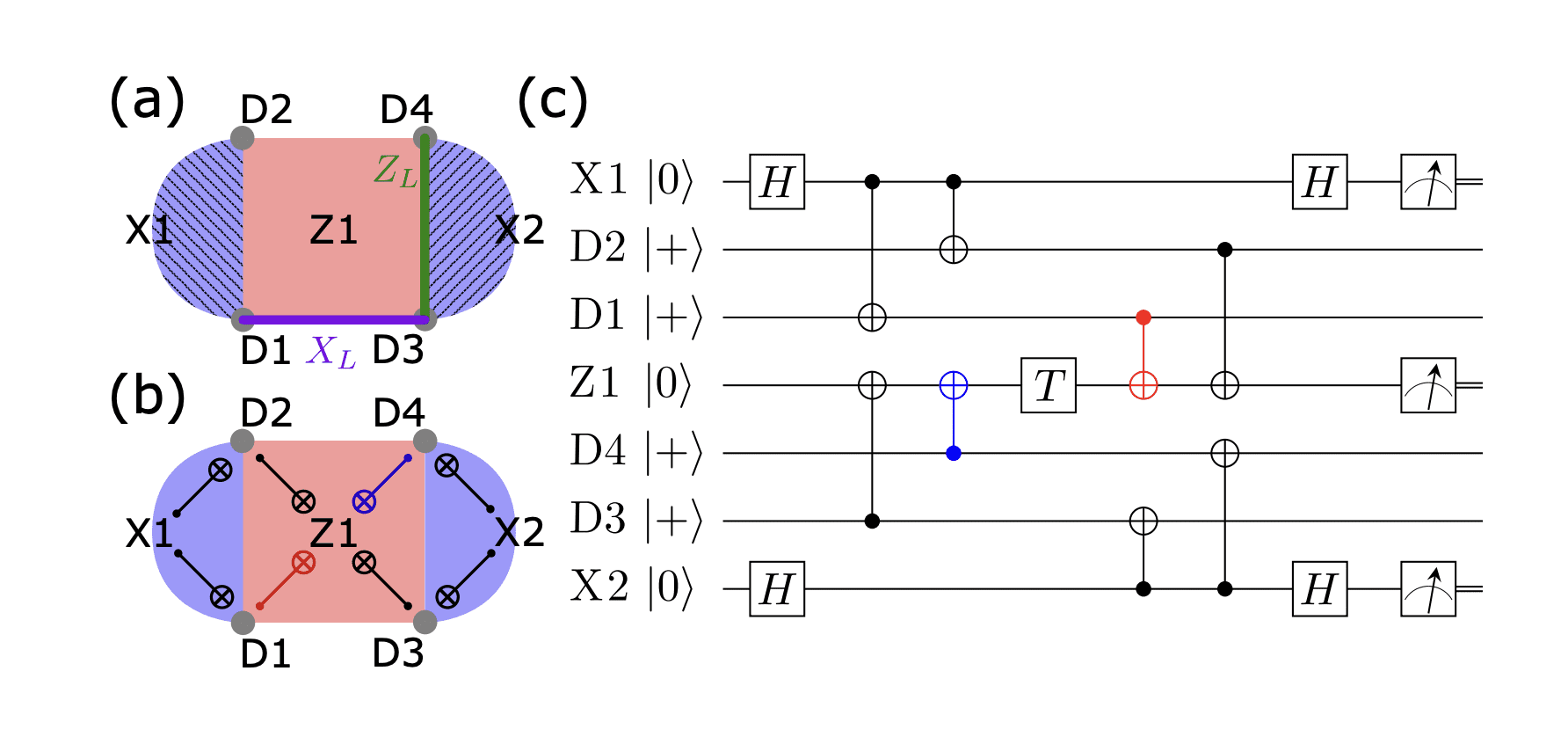
A promising avenue for reducing the resource demands of fault-tolerant quantum computing lies in the use of erasure qubits, which significantly improve both error-correction thresholds and the scaling of logical error rates. Recent research, detailed in PRX Quantum, extends the application of erasure qubits beyond quantum memories to the critical process of magic state injection – essential for implementing non-Clifford gates. The study demonstrates that, by post-selecting on erasures, the logical error rate of the injected magic state is primarily determined by residual Pauli errors, with only a marginal increase in space-time overhead compared to traditional qubits with similar noise levels. Notably, the benefits are substantial for both injection into the surface code – achievable with just three strategically placed erasure qubits – and for “magic state cultivation” on the color code, where utilizing erasure qubits across the entire patch proves most effective. These findings suggest that algorithmically relevant logical error rates may be attainable without magic state distillation, particularly with erasure rates below 4 x 10^-3 and residual Pauli error rates around 10^-4.
Magic State Injection and Fidelity
Magic state injection, a crucial yet resource-intensive component of fault-tolerant quantum computation, benefits significantly from the incorporation of erasure qubits, according to recent research. This approach focuses on improving the fidelity of injected magic states—essential for non-Clifford operations like the T gate—and reducing the overall resource demands of subsequent distillation processes. The study demonstrates that post-selection based on erasure events leads to a logical error rate determined by the residual Pauli error, with only a marginal increase in spacetime overhead compared to traditional qubit injection with similar noise levels. Notably, the research highlights the potential for substantial gains with just three strategically placed erasure qubits within a surface code patch, while full implementation across a cultivation patch yields even greater benefits. Achieving residual Pauli error rates around 10−4, coupled with erasure rates below 4 × 10⁻³, could enable near-term applications without the need for computationally expensive magic state distillation.
Performance Gains in Surface & Color Codes
Recent research demonstrates significant performance gains in magic state injection—a critical component of fault-tolerant quantum computation—when utilizing erasure qubits within both surface and color codes. By leveraging the ability to herald and correct erasure errors, researchers have shown logical error rates are primarily determined by residual Pauli errors, with only a marginal increase in spacetime overhead compared to traditional, non-erasure qubit systems exhibiting similar noise levels. Notably, for surface code implementations, most benefits are achievable with just three strategically placed erasure qubits, regardless of the code patch size. Conversely, the color code benefits from utilizing erasure qubits across the entire cultivation patch. These advancements suggest that algorithmically relevant logical error rates may be attainable without the need for magic state distillation, specifically with erasure rates below 4 x 10⁻³ and residual Pauli error rates around 10−4, potentially streamlining near-term quantum applications.