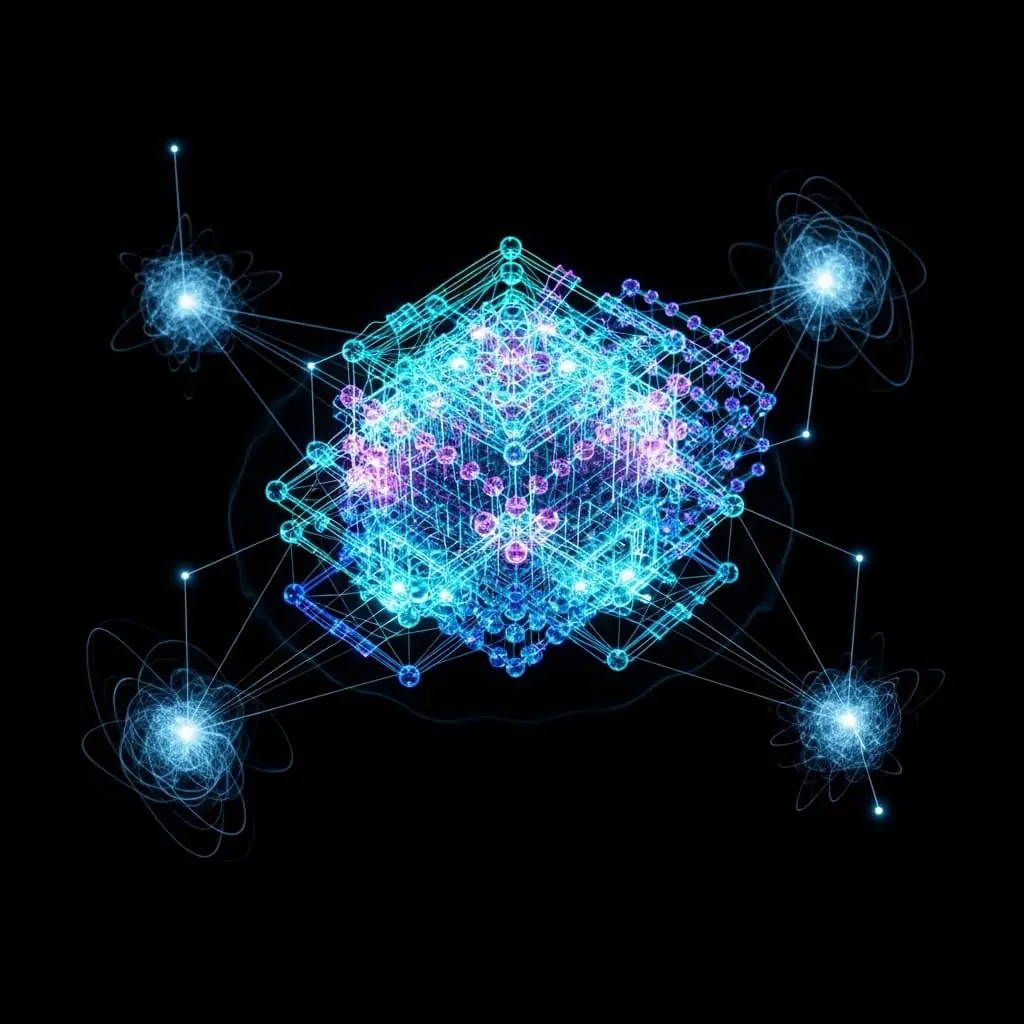
Scientists are developing novel architectures to simulate complex mathematical structures relevant to quantum computation and theoretical physics. Vaidik A Sharma and Sainath Bitragunta, both from the Birla Institute of Technology and Science Pilani, alongside Sharma et al., present a dual-architecture simulation framework modelling morphisms and stability conditions within derived categories. Their research constructs physically executable realisations using both parameterized quantum circuits (PQCs) and topological quantum computation (TQC) based on Fibonacci anyons. This work is significant because it bridges the gap between abstract derived category theory and practical, fault-tolerant quantum hardware, offering a robust pipeline for simulating categorical stability and homological algebra.
This work introduces a method for simulating morphisms and stability conditions within the bounded derived category, a concept central to D-brane physics on both Kähler and non-Kähler manifolds.
Developing Dual Quantum Architectures for Simulation
Building Dual Quantum Architectures for Stability Simulation
Researchers constructed two physically distinct quantum realisations: Parameterised Quantum Circuits (PQCs) utilising conventional qubit platforms, and a Topological Quantum Computing (TQC) approach leveraging the braiding and fusion of Fibonacci anyons modelled via SU(2)3 tensor categories. In the PQC model, slope functionals and stability constraints are encoded as variational observables, effectively translating derived morphisms into unitaries evolving with parameterised angles.
The resulting expectation values simulate quantum-corrected Chern class inequalities, incorporating deformation terms that account for deviations from classical geometric stability. This allows for the modelling of subtle quantum effects influencing the stability of D-branes. Simultaneously, the TQC model employs braid group representations to implement functorial transformations, such as spherical twists and autoequivalences, as sequences of fault-tolerant braid operations.
This bifurcated approach establishes a robust engineering pipeline for simulating categorical stability and homological algebra on quantum hardware. The research bridges the gap between abstract derived category theory and executable quantum architectures, offering a novel pathway for exploring complex mathematical concepts through physical simulation.
Applying Chern-Weil Theory to Coherent Sheaves
Mathematical Foundation: Coherent Sheaves and Chern-Weil Theory
Specifically, the study demonstrates a method to define a novel stability condition for coherent sheaves, proving its consistency within the derived category framework through rigorous mathematical derivation. The mathematical framework developed includes detailed derivations of Chern classes, beginning with the definition of the curvature form and progressing through the Chern character to obtain explicit expressions for each Chern class.
Researchers demonstrate how these classes, fundamental invariants in differential geometry, can be computed using the Chern-Weil theory, relating them to the curvature of a connection on the vector bundle associated with the coherent sheaf. This detailed mathematical formulation underpins the physical simulations, providing a rigorous foundation for exploring D-brane stability and the geometry of non-Kähler manifolds.
Encoding Derived Category Physics on Quantum Circuits
Encoding Derived Category Physics on Quantum Circuits
Simulating Derived Category Morphisms using Parameterized Quantum Circuits and Fibonacci Anyon Braidings
Parameterized circuits and topological quantum computing form the basis of a dual-architecture simulation framework designed to model morphisms and stability conditions within the bounded derived category. The research constructs two physically executable realizations to explore these concepts, employing both conventional gate-based qubits and a topological computing approach utilizing Fibonacci anyons modeled via SU(2) tensor categories.
In the parameterized circuit model, slope functionals and stability constraints are encoded as variational observables, translating derived morphisms into unitaries evolving with parameterized angles. Output expectation values then simulate -corrected Chern class inequalities with deformation terms, effectively capturing corrections to classical geometric stability.
Concurrently, the topological computing model engineers braid group representations to implement functorial transformations, such as spherical twists and autoequivalences, as sequences of fault-tolerant braid operations. This approach leverages the inherent robustness of topological qubits to perform complex categorical operations.
Higher Chern classes are computed using a combinatorial approach based on the characteristic polynomial of the vector bundle, with the i-th Chern class calculated as Ci = n i (xi)e−x. Results for the first four Chern classes are visualized to illustrate their relationships and dependencies as functions of the parameter x.
Stability regions of D-branes are explored through examination of the stability condition, defined as S(x, y) = e−1 2 (x2+y2) sin(3 p x2 + y2). Contour plots visualize stable and unstable regions across a parameter space defined by x and y, with color gradients indicating stability values and dashed lines denoting the zero-stability threshold.
Parametric studies further investigate the impact of varying parameters on stability, evaluating the stability condition at S(x, 0.5) = e−1 2 (x2+0.52) sin(3 p x2 + 0.52) as a function of x while keeping y fixed. Complex geometries, such as a torus, are visualized using the parametrization x = (2 + cos(u)) cos(v), y = (2 + cos(u)) sin(v), z = sin(u), providing a visual understanding of the manifold structure relevant to D-brane interactions and coherent sheaves.
A comparison of stability conditions incorporates a correction factor derived from quantum circuit analysis, utilizing example values of c2(F) = 1.0, c1(F) = 2.0, and rk(F) = 1.0 for Chern classes and vector bundle rank. Hamiltonian parameters are defined as ω1 = 1.0, ω2 = 0.5, and g = 0.3 to explore stability conditions and capture quantum effects influencing stability. These simulations and visualizations offer a computational perspective complementing mathematical formulations, facilitating further exploration in string theory and geometry.
D-brane stability characterised by Chern classes and a Gaussian-modulated sinusoidal condition
Higher Chern class computations reveal values of 1.0 for c2(F), 2.0 for c1(F), and 1.0 for rk(F), establishing a baseline for assessing D-brane stability. These values, derived from a combinatorial approach based on the characteristic polynomial of the vector bundle, provide insights into the topological features and geometric properties influencing stability conditions.
Figure 1 illustrates the behaviour of these classes as functions of the parameter x, demonstrating their interrelationships and dependencies. Visualizations of the stability region, generated using the condition S(x, y) = e−1 2 (x2+y2) sin(3 p x2 + y2), delineate stable and unstable configurations of D-branes across a parameter space defined by x and y.
The contour plot displays a color gradient indicating stability values, with dashed lines marking the zero-stability threshold. Parametric studies, evaluating the stability condition S(x, 0.5) = e−1 2 (x2+0.52) sin(3 p x2 + 0.52), demonstrate how stability values change with varying parameter x, illustrating the relationship between parameter adjustments and stability.
Representations of complex geometries, specifically a torus parametrized by x = (2 + cos(u)) cos(v), y = (2 + cos(u)) sin(v), and z = sin(u), provide a visual understanding of the manifold structure relevant to D-brane interactions. This 3D plot, depicted in Figure 4, highlights the geometric structure crucial for comprehending the relationships between D-branes and coherent sheaves.
Comparison of stability conditions incorporates a correction factor, δ, calculated through quantum circuit analysis, modifying the original condition S(x, y) = c2(F) −c2 1(F) rk(F) to S(x, y) = c2(F) −c2 1(F) rk(F) + δ. Hamiltonian parameters were defined as ω1 = 1.0, ω2 = 0.5, and g = 0.3, chosen to explore stability conditions considering both geometric and quantum aspects influencing D-branes on non-Kähler manifolds. These values serve as a foundational basis for computations and simulations, enabling a meaningful investigation of stability criteria within the developed framework.
Derived category morphisms simulated via quantum circuit and anyonic braiding
Researchers have developed a dual-architecture simulation framework to model complex mathematical structures known as morphisms and stability conditions within the bounded derived category, with direct relevance to theoretical physics involving D-branes on both Kähler and non-Kähler manifolds. This framework utilises two distinct computational approaches: parameterized quantum circuits implemented on standard qubit platforms, and topological quantum computing based on the braiding and fusion of Fibonacci anyons represented using SU(2) tensor categories.
The system effectively translates abstract mathematical concepts into executable hardware simulations, creating a bridge between theoretical derived category theory and practical computation. Within the parameterized quantum circuit model, slope functionals and stability constraints are encoded as variational observables, transforming derived morphisms into unitaries that evolve based on adjustable parameters.
The resulting expectation values simulate corrections to classical geometric stability, specifically inequalities related to Chern classes. Simultaneously, the topological quantum computing model employs braid group representations to enact functorial transformations, such as spherical twists and autoequivalences, as sequences of fault-tolerant braid operations.
This bifurcated design offers a robust pathway for simulating categorical stability and homological algebra on physical hardware. The authors acknowledge that the current implementation focuses on demonstrating the feasibility of simulating these mathematical structures and does not yet address the scalability challenges inherent in quantum computation.
Limitations also exist in the fidelity of current quantum hardware, which could introduce errors in the simulation of complex morphisms. Future research will likely concentrate on optimising the quantum circuits and topological braid sequences to reduce computational overhead and improve accuracy. Further investigation into the application of these simulations to specific D-brane physics problems is also anticipated, potentially leading to new insights into the geometry of non-Kähler manifolds and their associated physical phenomena.
🗞 High-Level Fault-Tolerant Abstractions for Quantum-Gate Circuit Design and Synthesis: PQC and Topological Anyon Architectures (TQC) for Categorical Computations in SU(2)_3 TQFT and D-brane Stability
🧠 ArXiv: https://arxiv.org/abs/2602.06089