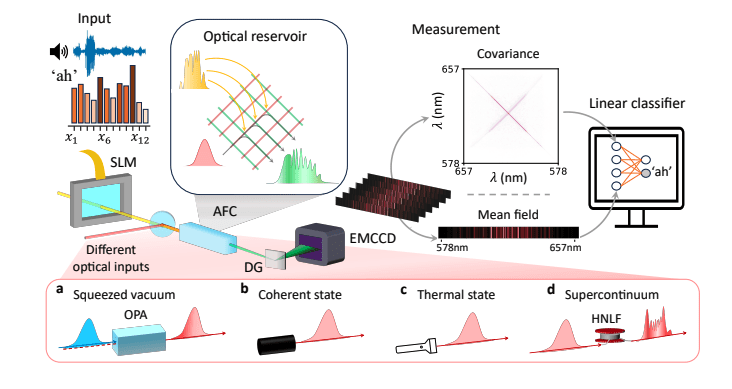
Experiments utilising a frequency-multiplexed Gaussian boson sampler demonstrate its effectiveness as a quantum reservoir for machine learning. Access to correlations between measured modes significantly improved classification accuracy on tasks including vowel and digit recognition, exceeding performance with mean-only access. Squeezed light consistently yielded the highest accuracies.
Quantum machine learning seeks to leverage the principles of quantum mechanics to enhance computational capabilities, particularly in areas such as pattern recognition and data analysis. Recent work demonstrates the potential of photonic systems to fulfil this promise, utilising a specialised quantum device known as a Gaussian boson sampler (GBS) as the core component of a ‘quantum reservoir’. This approach, termed quantum reservoir computing, exploits the complex interference patterns generated within the GBS to process information. Researchers from Sapienza Università di Roma and Cornell University, alongside NTT Research, Inc., report findings detailed in their article, ‘Large-scale quantum reservoir computing using a Gaussian Boson Sampler’, which experimentally validates the efficacy of this architecture and highlights the importance of quantum correlations in achieving improved performance on benchmark machine learning tasks.
Quantum Photonic Systems Demonstrate Enhanced Machine Learning Performance
Quantum machine learning aims to exploit quantum mechanical principles to improve computational tasks, particularly in areas like pattern recognition and data analysis. Recent research indicates photonic systems, specifically utilising Gaussian boson samplers (GBS), offer a viable pathway to achieving this.
Researchers have implemented a frequency-multiplexed GBS, establishing it as a ‘quantum reservoir’ for machine learning applications. A quantum reservoir is a complex quantum system whose high dimensionality allows it to map input data into a feature-rich space, enabling complex classifications. The performance of this system was assessed using established benchmark problems: spoken vowel classification and the MNIST handwritten digit recognition dataset. Crucially, the researchers evaluated performance both with and without utilising correlations between the measured output modes of the GBS.
Experiments demonstrate that incorporating these correlations consistently improves classification accuracy. In several instances, utilising correlations enhanced accuracy by over 20 percentage points, a significant improvement over relying solely on the average number of photons detected in each mode. These findings align with theoretical predictions concerning the importance of quantum correlations in boosting the power of quantum reservoir computing.
To further validate the role of quantum effects, the GBS reservoir’s performance was compared against a classical analogue. The quantum system employed ‘squeezed light’ – a state of light exhibiting reduced quantum noise in one property at the expense of increased noise in another – while the classical analogue used conventional, non-squeezed light. Results consistently showed that using squeezed light – and therefore harnessing quantum correlations – yielded the highest, or tied highest, accuracy across all tested tasks. This comparison reinforces the importance of quantumness in achieving superior performance and demonstrates that the observed improvements are not simply a consequence of the GBS’s increased complexity.
The researchers constructed a 15,000-dimensional feature space by selecting the most informative elements from the covariance matrix of the acoustic data. This process allows for a more nuanced representation of the input signals. A linear Support Vector Machine (SVM) – a supervised learning model used for classification and regression – then classifies the speech sounds based on these features. The optimisation procedure, detailed in supplementary materials, minimises classification error by identifying the optimal boundary between different sound classes, thereby refining the model’s performance.
This study establishes a practical platform for investigating the role of quantumness and correlations in quantum machine learning at substantial system scales. By experimentally validating the GBS as an effective reservoir, this work contributes to the development of scalable quantum machine learning algorithms and provides a foundation for future explorations into the interplay between quantum resources and computational performance. Future research will focus on optimising the GBS architecture and exploring more complex datasets to fully realise the potential of this quantum machine learning approach.
👉 More information
🗞 Large-scale quantum reservoir computing using a Gaussian Boson Sampler
🧠 DOI: https://doi.org/10.48550/arXiv.2505.13695