

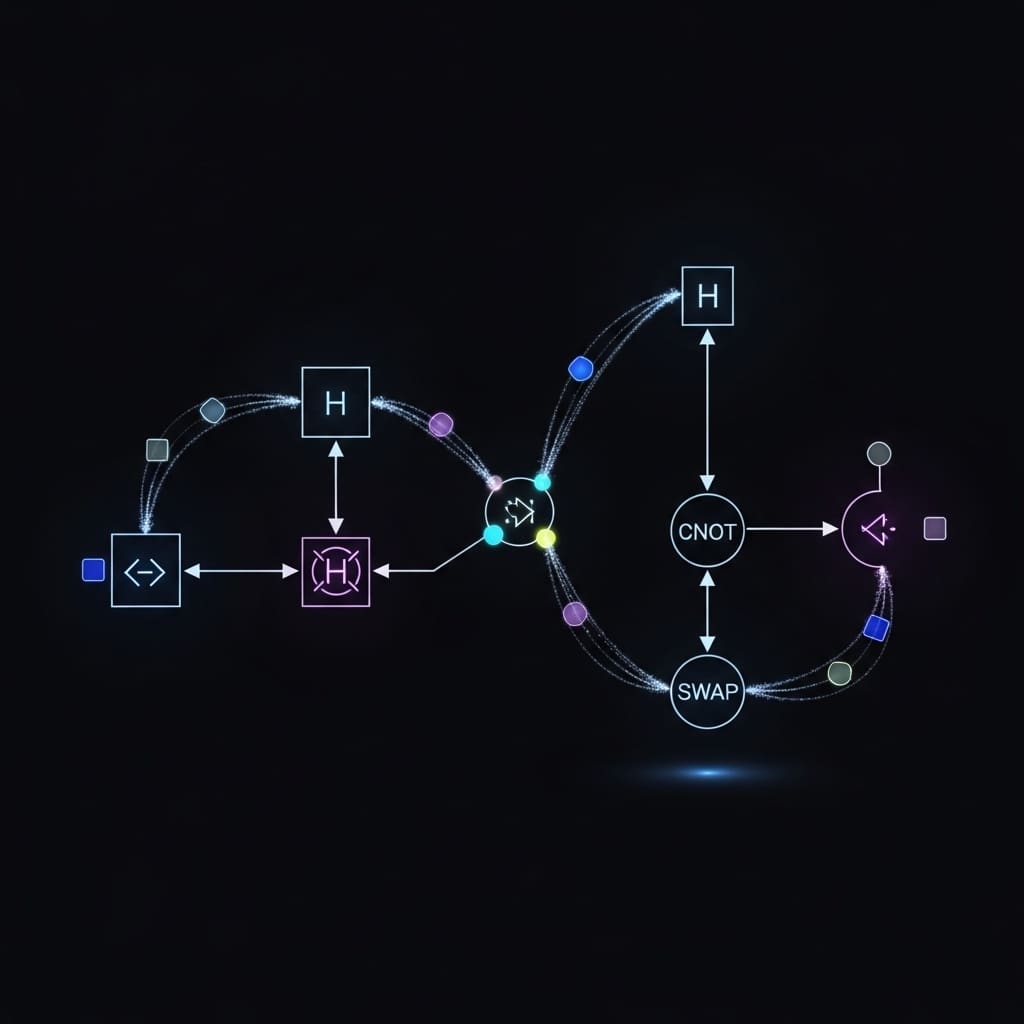
Researchers have long sought a complete and concise equational theory for quantum circuit verification and optimisation. Colin Blake from Université de Lorraine, CNRS, INRIA, LORIA Nancy, France, alongside colleagues, now present a uniform and finite axiomatisation of circuits utilising d-level systems, or qudits, applicable to any finite dimension d greater than or equal to two. Their work establishes a sound and complete set of local axiom schemata, involving at most three wires, that determines equivalence for unitary qudit circuits, achieved through a novel translation to the LOPP calculus and a treatment of control as a fundamental categorical construct. This research significantly extends previous qubit completeness results, such as those of Clément et al., and provides a uniform foundation for circuit rewriting and optimisation across arbitrary finite dimensions, representing a substantial advance in the field of quantum computation.
This work establishes a system for verifying the equality of unitary qudit circuits through a finite set of locally derived axioms, a significant advancement in the field of quantum computation.
The research introduces polycontrolled PROPs, a categorical framework where control, a fundamental operation in quantum circuits, is treated as a primitive constructor rather than a derived element. By incorporating control directly into the underlying structure, researchers achieved a bounded-arity axiom set, meaning the complexity of the axioms does not increase indefinitely with system size.
Specifically, the study defines a circuit PROP, denoted as CQCd, for each finite dimension d greater than or equal to 2. This PROP is equipped with control functors, enabling systematic construction of multi-controlled operations. A finite set of local axiom schemata, termed QCd, is then established, proving sound and complete for unitary d-level circuits.
This means two circuits are equivalent if and only if they can be inter-derived using these axioms, each involving at most three wires. The achievement extends previous qubit circuit completeness results to arbitrary finite dimensions, offering a uniform approach applicable to various qudit systems. This uniformity is characterised by fixed axiom shapes independent of dimension, with only dimensional indices varying.
The research leverages a translation to the LOPP calculus, a system for linear optics, and a d-ary Gray code to demonstrate completeness, effectively reducing the problem to a well-established framework. This breakthrough has implications for optimising and verifying native qudit circuits, potentially reducing resource requirements and exploiting the unique properties of higher-dimensional quantum systems.
By providing a fixed rewrite system, the work facilitates rewriting-based optimisation and verification without relying on complex matrix calculations, paving the way for more efficient quantum algorithm design and hardware compilation. The development of this equational theory represents a foundational step towards more robust and scalable quantum computation utilising qudits.
Axiomatic definition of qudit circuits via categorical semantics and Gray code translation
A finite schematic axiomatisation of circuits over qudits, systems utilising d-level quantum states, underpins this work, remaining uniform for all finite dimensions d greater than or equal to two. For each value of d, a PROP, a mathematical structure akin to a function space, was defined, equipped with a family of control functors that treat control as a fundamental categorical constructor.
This approach enabled the development of a complete and sound set of axiom schemata for unitary d-level circuits, achieved through a translation connecting qudit circuits to the LOPP calculus for linear based on d-ary Gray codes. Specifically, the research demonstrates that two circuits are equivalent, denoting the same unitary transformation, if and only if they can be inter-derived using axioms involving a maximum of three wires.
These generators are compatible with established universal qudit gate families, providing a sound equational basis for circuit rewriting and optimisation-by-rewriting techniques. This extends previous qubit circuit completeness results to arbitrary finite dimensions, while simultaneously instantiating the control-as-constructor approach in this expanded setting, all while maintaining uniformity in d.
Completeness was established via a mimicking theorem, demonstrating that every rewrite step within the LOPP calculus corresponds to a derivation within the developed axiomatic system, QCd. This connection ensures that the completeness of LOPP directly implies the completeness of QCd. The methodology innovatively leverages categorical constructions to provide a concise and uniform axiomatisation, offering a powerful tool for analysing and optimising qudit circuits across varying dimensions. This work paves the way for advancements in certified optimisation and verification pipelines tailored for native qudit hardware.
Finite axiomatic characterisation of unitary qudit circuits via local schemata
A finite schematic axiomatisation of circuits over d-level systems, or qudits, has been achieved, uniform in every finite dimension d greater than or equal to 2. For each d, a PROP equipped with a family of control functors was defined, treating control as a primitive categorical constructor. Employing a translation between qudit circuits and the LOPP calculus for linear operators based on d-ary Gray codes, a finite set of local axiom schemata, denoted as QCd, was obtained for each d.
These schemata are sound and complete for unitary d-level circuits, meaning two circuits denote the same unitary if and only if they are inter-derivable using axioms involving at most three wires. The generators are compatible with standard universal qudit gate families, yielding a sound equational basis for circuit rewriting and optimisation-by-rewriting.
This work extends the qubit circuit completeness results established by Clément et al to arbitrary finite dimension, while also instantiating the control-as-constructor approach of Delorme and Perdrix within this setting. Importantly, the axiom shapes remain uniform in d, providing a consistent framework across different qudit dimensions.
This research establishes a foundational completeness result, demonstrating that equality of unitary circuits can be axiomatised by a finite, syntax-directed equational theory within the circuit PROP. The use of control functors as primitive constructors is key to achieving bounded-arity axiom sets, allowing local schemata to directly reference control operations without quantification over numerous control wires. Consequently, a dimension-uniform finitary presentation of unitary qudit circuits has been realised, addressing a long-standing gap in qudit equational reasoning and facilitating rewriting-based optimisation and verification of native qudit circuits.
A categorical axiomatisation defines equivalence for finite dimensional unitary circuits
Scientists have developed a complete and uniform equational theory for qudit circuits, extending previous work on qubits to systems with an arbitrary finite dimension. This achievement establishes a finite set of axiom schemata, involving circuits with at most three wires, that precisely defines equivalence for unitary qudit circuits.
The system treats control, a fundamental aspect of quantum computation, as a primitive categorical constructor, offering a novel conceptual framework. The significance of this work lies in providing a sound and complete foundation for reasoning about qudit circuits. This allows for the formal verification and optimisation of circuits, potentially leading to more efficient quantum algorithms and hardware implementations.
By establishing a dimension-uniform theory, the research simplifies the process of adapting quantum computations to different qudit sizes without requiring a re-derivation of foundational principles. The authors acknowledge a limitation in that the current theory focuses solely on unitary circuits and does not yet encompass operations like ancilla initialisation, measurement, or general qudit channels.
Future research directions include extending the theory to handle more general qudit channels and exploring practical algorithms for circuit rewriting and optimisation based on the derived axioms. Investigating alternative embeddings and gate signatures could further streamline the metatheory and improve its compatibility with compiler design for qudit hardware. These advancements promise to facilitate the development of robust and efficient quantum computing technologies.
👉 More information
🗞 Polycontrolled PROPs for Qudit Circuits: A Uniform Complete Equational Theory For Arbitrary Finite Dimension
🧠 ArXiv: https://arxiv.org/abs/2602.09873


