Improvement problems are the holy grail of science and engineering. They require the identification of the best possible outcome from an exponentially vast set of possibilities. These complex challenges have long plagued researchers. Still, a new wave of quantum computing techniques is poised to revolutionize the field.
Scientists are now able to tackle problems that were once considered intractable. They achieve this by harnessing the power of quantum annealing. They also use topological sector optimization and quantum imaginary time evolution.
From quadratic unconstrained binary improvement to topological sector optimization, these cutting-edge methods are unlocking new possibilities. They aim to solve some of humanity’s most pressing challenges.
What are Optimization Problems, and Why are They Important?
Optimization problems are a fundamental challenge in various fields of science and engineering. These problems involve finding the optimal solution among a vast set of possibilities. The complexity often increases exponentially as the problem size grows. In essence, optimization problems require identifying the best possible outcome from a multitude of options.
In many cases, optimization problems are classified as NP-hard, meaning that their computational complexity increases exponentially with the problem size. This makes it difficult to find efficient algorithms for solving these problems using classical computers. However, quantum computing has emerged as a promising approach to tackle such challenges.
One representative example of an NP-hard optimization problem is the quadratic unconstrained binary optimization (QUBO) problem. QUBO involves finding the optimal binary sequence solution for a given quadratic cost function. By mapping this problem onto an Ising-like Hamiltonian, the optimal solution relates to the ground state configuration. The result becomes equivalent to the configuration of the quantum system.
What is Quantum Annealing and How Does it Relate to Optimization Problems?
Quantum annealing (QA) is a computational method. It leverages the principles of adiabatic evolution to find the ground state of a quantum system. This approach has been extensively explored and successfully implemented on various quantum simulators, including D-Wave’s annealers and some Rydberg arrays.
In the context of optimization problems, QA has emerged as a promising solution strategy. When the problem is mapped onto an Ising-like Hamiltonian, the optimal solution becomes the same as the ground state configuration of the quantum system. The adiabatic theorem provides a theoretical foundation for QA. It suggests that QA can efficiently find the ground state. This is achieved by slowly evolving from a simple initial state to the desired final state.
What are Topological Sector Optimization Problems and Why are They Challenging?
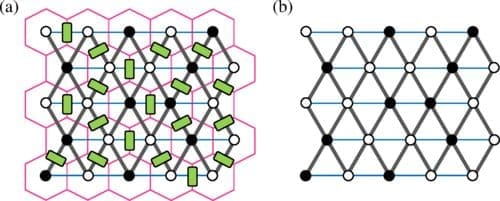
Topological sector optimization (TSO) problems have garnered significant interest in the quantum simulation and many-body physics communities. These problems involve optimizing a system’s properties within specific topological sectors, which are characterized by frustration-induced topology.
The TSO problem is particularly challenging. Its intrinsic obstruction prevents traditional methods like QA from approaching the ground state. This difficulty extends beyond the gaplessness of the problem. It also arises from the topological nature of the optimization model itself. In other words, the topological properties of the system are often ignored in previous analyses. These properties contribute significantly to the challenges faced by TSO.
What is Quantum Imaginary Time Evolution and How Does it Address Topological Sector Optimization Problems?
Quantum imaginary time evolution (QITE) is a computational method that exploits the property of quantum superposition to explore the full Hilbert space. This approach has been proposed as a solution strategy for addressing topological sector optimization problems.
By utilizing QITE, researchers can potentially overcome the challenges associated with traditional methods like QA in tackling TSO problems. The performance of different quantum optimization algorithms on TSO problems has been demonstrated. This demonstrates their distinct capabilities. It takes into account the quantum computational resources required for practical QITE implementations.
What are the Key Findings and Implications of This Research?
This research investigates topological sector optimization problems and demonstrates that they pose significant challenges for traditional methods like QA. The findings suggest that the difficulties with TSO problems go beyond gaplessness. These challenges also arise from the topological nature of the optimization model itself.
The performance of different quantum optimization algorithms on TSO problems has been reported, showcasing their distinct capabilities even when considering the quantum computational resources required for practical QITE implementations. These results have important implications for the development of efficient solution strategies for topological sector optimization problems and highlight the potential of quantum computing in addressing such challenges.
What are the Implications of This Research for Quantum Computing and Optimization Problems?
The research presented here has significant implications for the field of quantum computing and optimization problems. By demonstrating the capabilities of QITE in tackling TSO problems, this work highlights the potential of quantum computing in addressing complex optimization challenges that traditional methods struggle to solve.
Furthermore, the findings of this research underscore the importance of considering the topological nature of optimization models when analyzing their computational complexity. This insight has far-reaching implications for developing efficient solution strategies. These strategies apply to a wide range of optimization problems. It underscores the need for further research into the intersection of quantum computing and optimization theory.
What are the Future Research Directions and Applications of This Work?
The research presented here opens up new avenues for investigation in the fields of quantum computing, optimization theory, and many-body physics. The findings suggest that QITE has significant potential for tackling complex optimization problems, particularly those with topological sector optimization components.
Future research directions include exploring the performance of QITE on a broader range of optimization problems. Another focus is investigating the scalability of this approach to larger problem sizes. Researchers are also developing more efficient algorithms for implementing QITE in practical applications. The implications of this work extend beyond the realm of quantum computing, as they also have significant potential for impacting fields such as materials science, chemistry, and machine learning.
In conclusion, the research presented here has far-reaching implications for the field of optimization theory. It highlights the potential of quantum computing in addressing complex challenges. Traditional methods struggle to solve these challenges.
The findings suggest that QITE is a promising solution strategy for tackling topological sector optimization problems. Further research into this area is likely to yield significant breakthroughs. These breakthroughs will have important applications across various fields of science and engineering.
Publication details: “Exploring the topological sector optimization on quantum computers”
Publication Date: 2024-09-12
Authors: Yi-Ming Ding, Yan-Cheng Wang, Shixin Zhang, Yan Zheng, et al.
Source: Physical Review Applied
DOI: https://doi.org/10.1103/physrevapplied.22.034031