Quantum computing is revolutionizing the field of biomarker discovery, enabling researchers to analyze large volumes of medical data more efficiently and accurately. This technology has the potential to transform healthcare by allowing for proactive precision medicine, where individuals receive personalized treatment based on their unique health status.
However, several challenges must be overcome before quantum computing can be widely adopted in this field. One major hurdle is loading large classical datasets into quantum systems, a problem that researchers are actively working to solve. Novel quantum algorithms, such as those developed by companies like IBM and Google, are also being explored for their potential to enhance biomarker discovery.
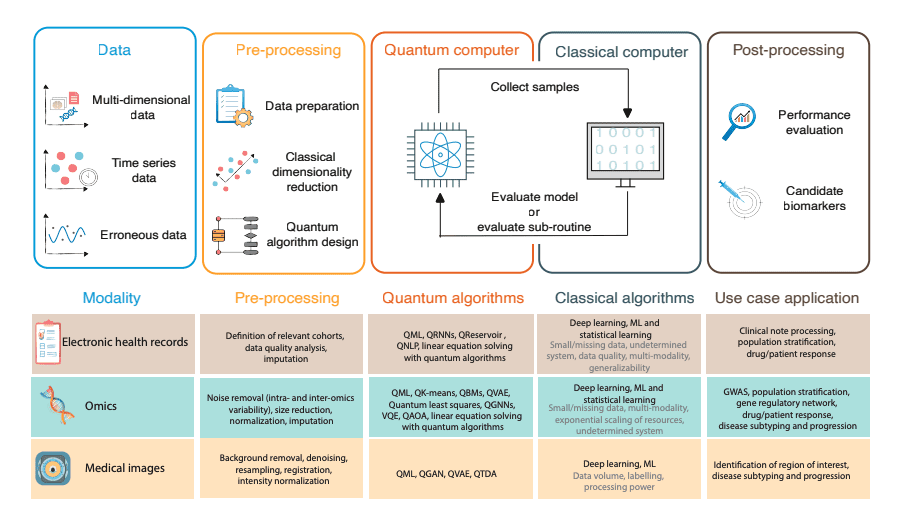
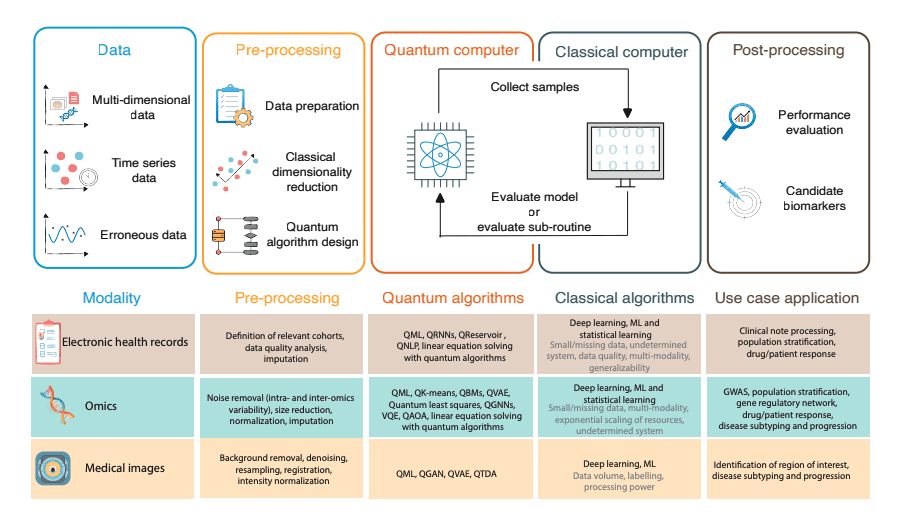
of data and different healthcare data modalities. The top part of the figure focuses on the categories
multi-dimensional, time series, and erroneous data. The bottom part covers the modalities EHRs,
omics, and medical images. Examples are given for pre-processing steps, quantum algorithms, classical
algorithms and their limitations (in gray), and medical use case applications.
Additionally, the use of quantum federated learning, which enables decentralized data analysis, is gaining traction in healthcare research. While significant progress has been made, further breakthroughs are needed to overcome the challenges of data security, explainability, and replicability. As researchers continue to push the boundaries of what is possible with quantum computing, we may soon see a future where personalized medicine becomes a reality.
Quantum-assisted data compression and image reconstruction
Quantum-assisted data compression and image reconstruction
The text highlights the potential of quantum-assisted data compression and machine learning (QML) approaches to compress large medical images without losing critical information. This is particularly important for medical imaging modalities like MRI, where raw imaging data are often deleted shortly after acquisition due to storage constraints.
Quantum algorithms and QML techniques may also be more effective at detecting patterns in medical images, leading to increased capabilities in indicating and resolving erroneous imaging data. This could have significant implications for image reconstruction, which is a complex task that requires robust algorithms to handle noise and mistakes.
Open research challenges
The text outlines several open research challenges in the application of quantum computing in biomarker discovery, validation, and adoption. These include:
- Loading large volumes of classical data: Despite progress with Quantum Random Access Memories (QRAMs), breakthroughs are needed to unlock more applications.
- Novel quantum algorithms: New quantum algorithms are being continually discovered, such as exponential advantage in pathfinding for graphs and quantum federated learning.
- Benchmarks: Demonstrating value from quantum computing is challenging due to unclear classical goalposts that may shift in response to quantum algorithm advances.
- Generalization: Individual biomarker variability resulting from genetic and lifestyle factors requires more granular (quantum) models, which might again require more classical data and novel quantum algorithms.
- Data security: The high sensitivity of medical data requires strict data processing standards, which are not yet compatible with many quantum computing architectures that demand cloud transfer of data across the world.
- Explainability and replicability: Clinical adoption requires trust to be built, which necessitates explainable models and easily replicable results.
Conclusion
Conclusion
The long-term hope is that discovery of better biomarkers will pave the way towards proactive precision medicine. Quantum computing applications are particularly promising for multi-factorial diseases, including Alzheimer’s disease and cancer, and rare conditions for which little data exists.
However, there are still discrepancies in access to advanced forms of computing, such as quantum computing, worldwide. Democratization of these transformative technologies is an important issue that must be considered to realize their full global impact.
Overall, this text highlights the potential of quantum computing to revolutionize biomarker discovery, validation, and adoption but also emphasizes the need for further research and development to overcome the open challenges in this field.
External Link: Click Here For More