In a breakthrough that could revolutionize the field of quantum computing, researchers at the Korea Institute of Science and Technology (KIST) have successfully implemented a quantum computing algorithm that can estimate interatomic bond distances and ground state energies with chemical accuracy using fewer resources than conventional methods.
Led by Dr. Hyang-Tag Lim, the team utilized a higher-dimensional form of quantum information called a qudit, which can have multiple states, to perform accurate calculations without the need for additional quantum error mitigation techniques.
This achievement comes on the heels of the Nobel Prize in Chemistry being awarded to University of Washington Professor David Baker, Google DeepMind CEO Hershavis, and Principal Investigator John Jumper for their work using AI to predict protein structures. The KIST team’s innovation has the potential to be used in various practical fields, such as developing new drugs and improving battery performance, and could also be useful in solving complex problems like climate modeling.
Quantum Computing Breakthrough: Accurate Molecular Simulations without Error Correction
The recent Nobel Prize in Chemistry has highlighted the importance of artificial intelligence (AI) in predicting protein structures, enabling the discovery of new drugs and materials. However, quantum computing technology is emerging as another game-changer in this field. A research team at the Korea Institute of Science and Technology (KIST) has made a significant breakthrough by implementing a quantum computing algorithm that can estimate interatomic bond distances and ground state energies with chemical accuracy using fewer resources than conventional methods.
Overcoming Quantum Error Mitigation Challenges
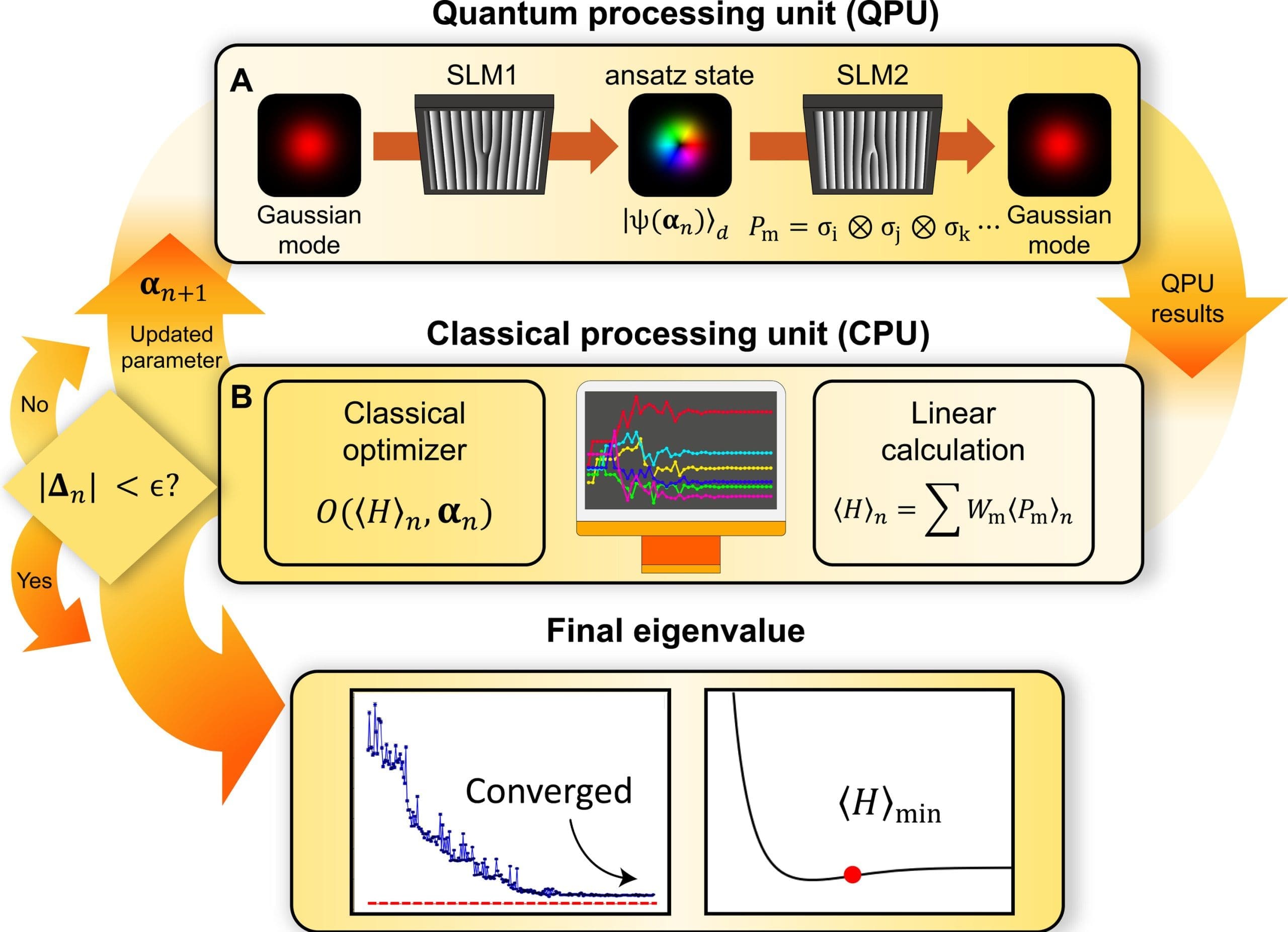
Quantum computers are prone to rapidly increasing errors as the computational space grows, making it challenging to scale up calculations. To overcome this, the Variational Quantum Eigensolver (VQE) method has been developed, which combines the advantages of classical and quantum computers. VQE is a hybrid algorithm designed to use a Quantum Processing Unit (QPU) and a Classical Processing Unit (CPU) together to perform faster computations. However, qubit-based VQE is currently limited by error issues that make it difficult to scale when more qubits and complex computations are required.
Qudit-Based Quantum Computing: A Higher-Dimensional Approach
Instead of using traditional qubits, the KIST team utilized a higher-dimensional form of quantum information called a qudit. A qudit is a quantum unit that can have multiple states, including 0, 1, and 2, in addition to the 0 and 1 that a traditional qubit can represent. This allows for complex quantum computations with reduced errors. In this study, a qudit was implemented by the orbital angular momentum state of a single-photon, and dimensional expansion was possible by adjusting the phase of a photon through holographic images.
Accurate Molecular Simulations without Error Correction
The team used the qudit-based VQE method to perform quantum chemistry calculations to estimate the bond length between hydrogen molecules in four dimensions and lithium hydride (LiH) molecules in 16 dimensions. This is the first time 16-dimensional calculations have been realized in photonic systems. Notably, the KIST team’s VQE achieved chemical accuracy without any error mitigation techniques, demonstrating how high accuracy can be achieved with fewer resources.
Implications for Widespread Application
The qudit-based quantum computing technology has the potential to be used in various practical fields, such as developing new drugs and improving battery performance. By securing this technology, it is expected to have a significant impact on industries where molecular properties are important. Additionally, it is expected to be useful in solving complex problems such as climate modeling.
Institutional Background
The Korea Institute of Science and Technology (KIST) was established in 1966 as the first government-funded research institute in Korea. KIST strives to solve national and social challenges and secure growth engines through leading and innovative research. This research was supported by the Ministry of Science and ICT through the KIST Institutional Program and the Korea Research Foundation Quantum Computing Technology Development Project. The research was published in the international journal Science Advances.
DOI: http://dx.doi.org/10.1126/sciadv.ado3472