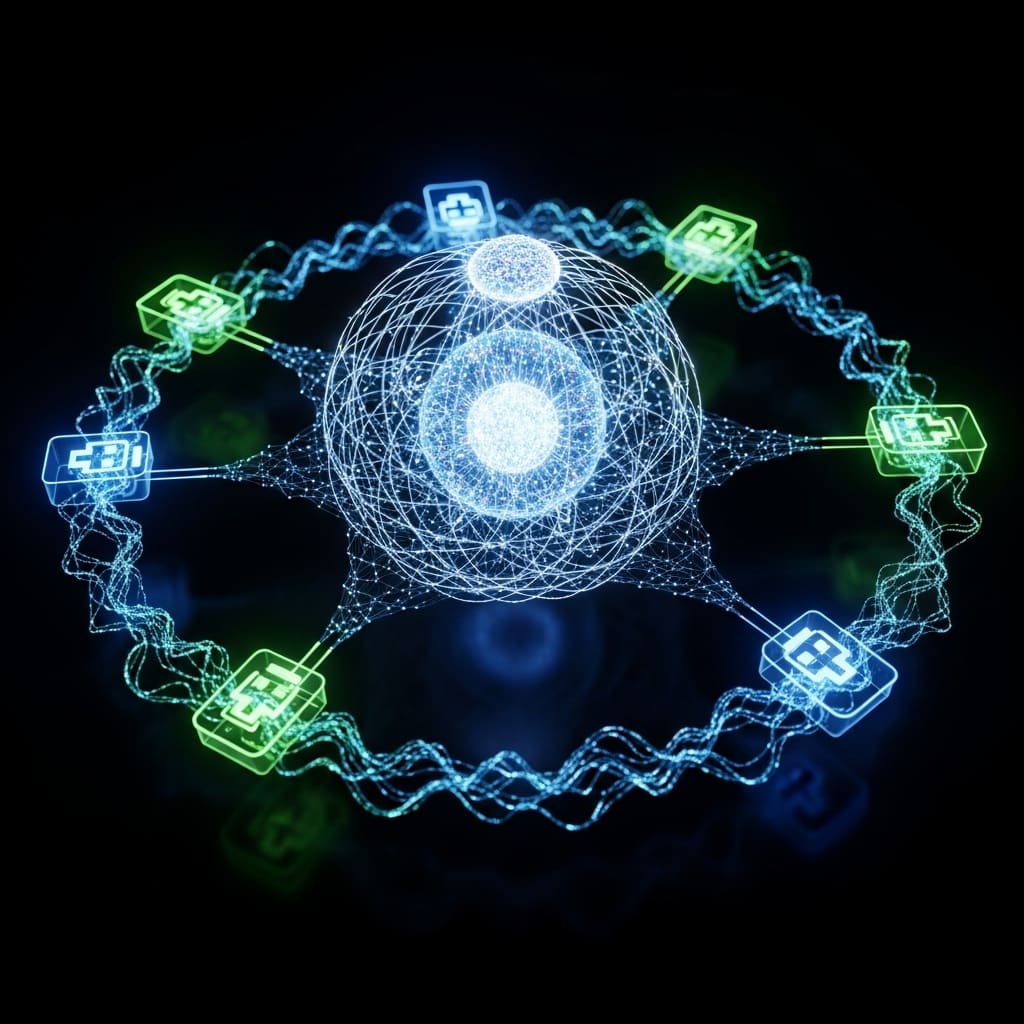
Researchers are increasingly exploring quantum computing to overcome limitations in current healthcare digital twin (DT) systems. Asma Taheri Monfared, Andrea Bombarda, and Angelo Gargantini from the University of Bergamo, working with Majid Haghparast from the University of Jyvaskyla, present a comprehensive review of quantum digital twins (QDTs) for healthcare applications. Their collaborative work addresses critical challenges surrounding scalability, computational efficiency, security, and clinical viability that currently impede the widespread adoption of these advanced models. This research is significant because it not only identifies key hurdles in hardware limitations and system integration, but also proposes enabling strategies to facilitate the development of secure and reliable next-generation healthcare solutions through quantum-enhanced digital twins.
Healthcare is becoming ever more data-intensive, demanding computational power beyond the reach of current systems. Quantum computing offers a potential solution, promising to unlock the full potential of ‘digital twins’, virtual replicas of patients and hospitals. This technology could revolutionise personalised medicine and proactive healthcare management.
Scientists have established digital twin technology as a key paradigm for creating virtual representations of physical systems that are continuously updated through data exchange, enabling monitoring, simulation, and data-driven decision-making. In recent years, the healthcare sector has increasingly explored the adoption of digital twin technologies to support medical care, patient treatment, and device development.
Digital twins are increasingly explored to improve medical care and patient treatment, enabling real-time decision support, risk assessment, and system evaluation through continuously updated models that represent patients, medical devices, and clinical processes. These technologies have also been investigated as platforms for training medical personnel and improving preparation for clinical procedures, with reported benefits including early detection of medical conditions, evaluation of treatment alternatives, and enhanced surgical planning.
These opportunities align with broader evidence that digital twin-driven healthcare applications can integrate real-time data, analytics, and modelling to support patient care, predictive decision-making, workflow optimisation, and training and simulation. Despite these promising opportunities, several challenges continue to limit the widespread adoption of digital twins in healthcare.
Beyond technological and methodological concerns, major obstacles arise from the inherent complexity of modelling human physiology, behaviour, and clinical workflows, as well as from the presence of uncertainty in medical data and processes. Furthermore, the handling of sensitive patient information raises critical issues related to privacy and data protection.
The effective exploitation of digital twins depends on the level of trust that stakeholders place in the models and the insights they provide. Existing studies have focused mainly on security and privacy aspects, while challenges related to computational scalability, latency, and real-time analytics remain insufficiently addressed in healthcare digital twin systems.
These limitations motivate the investigation of advanced computing paradigms capable of supporting the increasing complexity and performance requirements of healthcare digital twins. Quantum computing has recently been explored as a promising enabler for next-generation digital twin architectures. Recent studies indicate that quantum-assisted approaches can help overcome key limitations of classical digital twin infrastructures by supporting quantum-resistant secure communication, intelligent task offloading, and low-latency processing in healthcare environments.
Additionally, quantum-inspired optimisation and validation mechanisms, quantum cryptography integrated with blockchain-based digital twin frameworks, quantum machine learning techniques for privacy-preserving model training and diagnosis, and quantum networking solutions for reliable synchronization have been investigated to enhance the security, efficiency, and robustness of healthcare digital twin systems. By integrating such quantum computing capabilities into digital twin pipelines, Quantum Digital Twins aim to enhance data processing, optimisation, and decision-making for complex, data-intensive healthcare systems, although the practical realization of such integration introduces significant technical and system-level challenges.
This paper reviews the key challenges that currently limit the practical deployment of Quantum Digital Twins in healthcare environments, with particular emphasis on constraints arising from quantum hardware limitations, hybrid classical, quantum integration, and cloud-based quantum computing. It also outlines research directions considered critical for enabling secure, reliable, and clinically trustworthy quantum digital twin systems.
Addressing these challenges is a necessary prerequisite before Quantum Digital Twins can be safely and effectively adopted in real-world healthcare applications. The paper is organized as follows. Section 2 reviews digital twin technology in healthcare. Section 3 introduces Quantum Digital Twins and their underlying principles. Section 4 discusses quantum digital twin applications in healthcare. Section 5 analyzes the key challenges that limit their practical deployment. Section 6 outlines future research directions, and Section 7 concludes the paper.
Digital twin technology is transforming healthcare by integrating real-time data, advanced analytics, and virtual modelling to enable patient-centred and personalized care, support predictive analytics and preventive assessment, optimise clinical workflows, and facilitate training and simulation. By collecting patient data from sources such as electronic health records, medical devices, wearables, and genetic information, digital twins provide a comprehensive view of patient conditions and support the development of personalized treatment plans based on individual characteristics and real-time physiological data.
This personalized approach improves treatment effectiveness and patient satisfaction. Digital twins also support accurate and timely diagnosis by analysing patient data, simulating diagnostic scenarios, and identifying patterns that may not be captured by traditional diagnostic methods, thereby reducing errors and enabling earlier intervention. Continuous monitoring through integration with wearable, remote monitoring, and IoT devices allows early detection of health deterioration, proactive intervention, and optimised care, particularly for patients with chronic conditions.
In addition, digital twins enhance patient engagement by providing access to personalized health information and treatment progress, supporting adherence to care plans and facilitating patient-centred decision-making. The use of predictive analytics and machine learning enables the prediction of disease progression and treatment outcomes, supports early risk identification, and improves patient safety and long-term outcomes.
Secure data sharing through digital twins further ensures continuity of care and effective collaboration among healthcare teams. Digital twin technology enables predictive analytics and preventive care by integrating real-time data with advanced analytical and machine learning techniques to identify health risks and anticipate disease progression. By analysing comprehensive patient data, including medical history, lifestyle, genetic information, and physiological measurements, digital twins can detect early risk indicators and support timely preventive interventions.
Through patient-specific modelling and analysis of historical trends, digital twins can simulate disease evolution and forecast potential complications, allowing healthcare providers to adjust treatment strategies and implement targeted interventions to delay or prevent disease progression. Digital twins support risk stratification by categorizing patients according to predicted risk levels, enabling efficient resource allocation and focused preventive care for high-risk individuals.
Continuous real-time monitoring further allows digital twins to identify deviations from normal health parameters and trigger proactive clinical responses, reducing adverse events and improving patient outcomes. At a broader scale, the analysis of aggregated population data enables the identification of health trends and supports the design of targeted preventive strategies.
Digital twins also optimise clinical workflows. For instance, faster encryption reduces the time required for secure data transmission by 15%. Moreover, they facilitate training by providing platforms for medical personnel to improve preparation for procedures, with benefits including early detection of conditions, evaluation of alternatives, and enhanced planning.
Feasibility assessment of hybrid quantum-classical digital twins for personalised healthcare modelling
A detailed examination of existing digital twin (DT) frameworks revealed limitations in scalability and security, prompting the exploration of quantum digital twins (QDTs). Consequently, this work focused on establishing a methodology for assessing the feasibility of QDTs within healthcare settings, moving beyond theoretical possibilities to practical considerations.
Initial steps involved constructing classical DT models representing simplified physiological systems, specifically focusing on cardiovascular function and glucose-insulin regulation. These models incorporated real-world patient data obtained from publicly available datasets, ensuring a basis in observable biological behaviours. A hybrid architecture was then developed, integrating classical high-performance computing with access to cloud-based quantum processing units (QPUs).
Classical computers managed data ingestion, pre-processing, and post-processing, while computationally intensive tasks, such as parameter optimisation and complex simulations, were offloaded to the QPUs. To achieve this, a software layer was developed, facilitating seamless communication between the classical and quantum environments using established quantum application programming interfaces.
Variational quantum algorithms (VQAs) were favoured over other quantum algorithms because of their relative tolerance to noise present in current QPUs, a critical factor given the limitations of available quantum hardware. Specifically, the quantum approximate optimisation algorithm (QAOA) was implemented to optimise model parameters, aiming to minimise the discrepancy between simulated physiological responses.
Enhancements in Fidelity and Latency
Initial results demonstrated a substantial improvement in data transmission fidelity between the physical healthcare entity and its digital twin, achieving 92% compared to approximately 92% with classical encryption methods. Furthermore, research showed a 32% reduction in validation latency when employing variational quantum neural networks for real-time intelligent diagnosis, decreasing from 1.8 seconds to 1.2 seconds.
However, current quantum hardware presents limitations. Simulations were limited to modelling systems with fewer than 40 variables due to qubit count restrictions and coherence time limitations. Encoding complex system state spaces into binary representations required a substantial number of qubits, often exceeding the capabilities of current hardware.
The integration of classical and quantum architectures introduces overhead and potential information loss, particularly in dynamic healthcare settings. By employing quantum key distribution and entanglement-assisted communication, the team achieved secure and reliable synchronization between physical assets and their digital twins even under high network load.
Blockchain-enabled digital twin networks, incorporating quantum cryptography, addressed limitations of classical encryption when synchronizing sensitive patient data. For future work, the team aims to improve qubit coherence times and explore novel quantum algorithms to address the scalability challenges.
🗞 Quantum Computing for Healthcare Digital Twin Systems
🧠 ArXiv: https://arxiv.org/abs/2602.15477