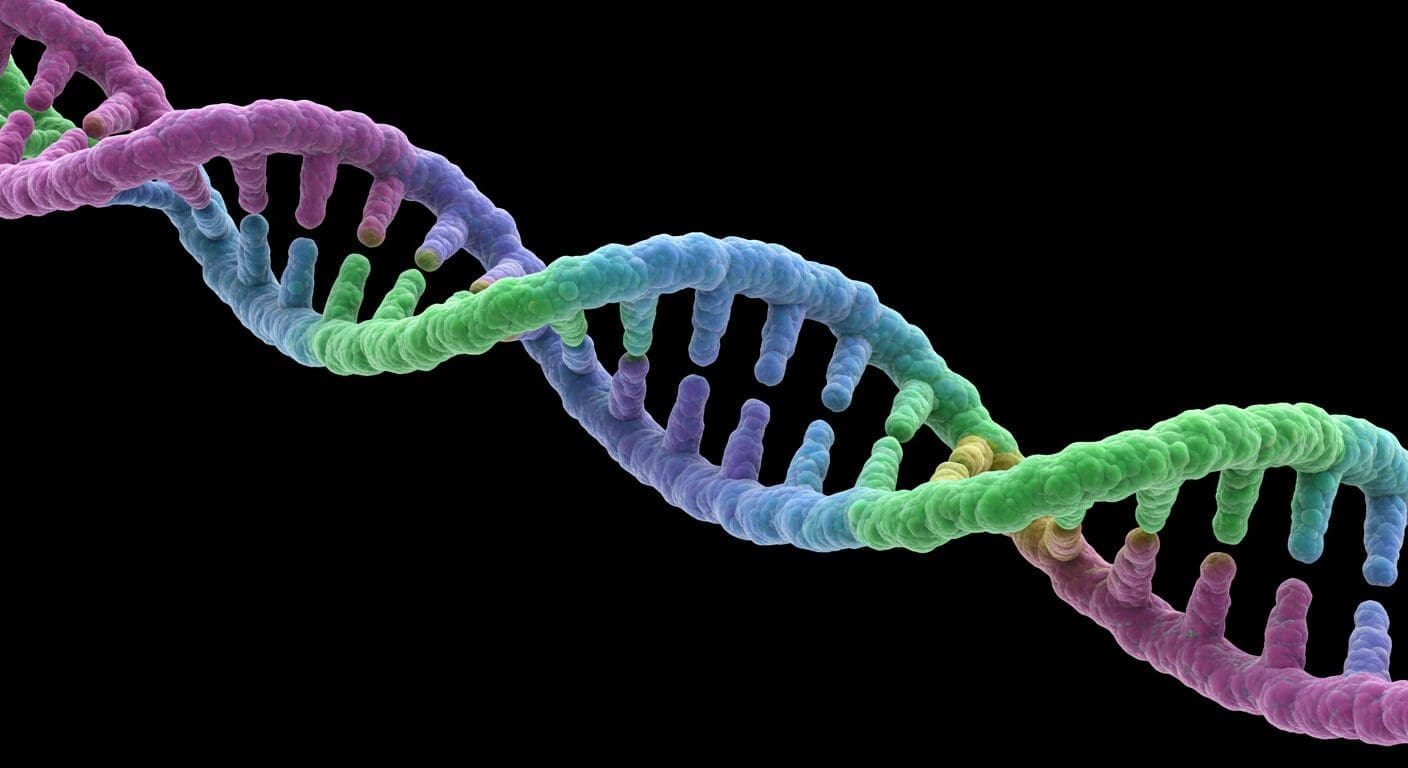
A collaborative research team from IBM Quantum (New York), Moderna (Cambridge), and Fermioniq B.V. (Amsterdam) has developed advanced quantum-centric optimization methods for predicting secondary structures in longer mRNA sequences. This groundbreaking work, led by Vaibhaw Kumar, Dimitris Alevras, and colleagues, demonstrates how strategic integration of quantum and classical computing resources can tackle complex biological optimization problems that have significant implications for both fundamental molecular biology and the development of mRNA-based therapeutics.
The Challenge of mRNA Secondary Structure Prediction
Predicting the secondary structure of messenger RNA represents a substantial computational challenge due to the myriad potential folding configurations and associated energy considerations. The researchers note that mRNA’s structural complexity is amplified by its six backbone torsion angles – compared to only two in proteins – significantly increasing the range of possible structures. Traditional classical methods like the Zuker algorithm and its derivatives use dynamic programming to evaluate thermodynamic stability, but they often rely on approximations such as excluding pseudoknots, which are classified as an NP-complete problem. The authors position quantum computing as a promising path forward for modeling these structures more accurately without such strong approximations.
Innovative Quantum-Classical Hybrid Approaches
The research team introduces two complementary quantum-centric workflows that strategically distribute computational tasks between quantum processors and classical computers. The first approach builds upon a Conditional Value at Risk (CVaR)-based variational quantum algorithm. This method uses a two-local ansatz to prepare parameterized quantum states, with quantum processors generating measurement samples that are then processed by classical nodes to compute the CVaR value. The researchers enhance this approach with gauge transformations on the original Hamiltonian to mitigate noise in hardware samples, improving convergence. They also implement a parameter thresholding scheme where circuit parameters below a certain threshold (θth = 0.06) are set to zero, which substantially improves convergence during circuit executions on quantum hardware.
The second workflow introduces an optimization scheme utilizing parameterized Instantaneous Quantum Polynomial (IQP) circuits. This innovative approach conducts the training of circuit parameters entirely on classical computers using expectation values as the objective metric, while the quantum computer’s role is limited to sampling bitstrings from the circuit containing optimal parameters. The researchers selected IQP circuits specifically because expectation values can be efficiently estimated classically, while sampling from the output distributions is generally considered classically difficult, creating an ideal division of labor between quantum and classical resources.
Technical Achievements and Experimental Results
The IBM-Moderna-Fermioniq team demonstrates remarkable technical achievements in their implementation. They executed quantum circuits with up to 950 non-local gates and circuit depths reaching 112 on IBM’s Eagle and Heron r2 processors (ibm_kyiv and ibm_marrakesh). These experiments successfully examined mRNA sequences of length up to 60 nucleotides, corresponding to problem sizes requiring up to 156 qubits. This represents a significant scaling beyond previous work that had only reached 42 nucleotides on 80 qubits.
To further validate their approach, the researchers employed tensor network simulations to assess the scalability of the CVaR algorithm. By decomposing the wave function into a network of smaller tensors, each with a bond dimension capturing the entanglement present in the quantum state, they successfully simulated problems with up to 354 qubits in noiseless settings. This simulation capability provided essential confirmation that the CVaR VQA scheme could potentially scale successfully to hundreds of qubits on future quantum hardware.
Results from the hardware experiments show that both approaches generate samples remarkably close to the ground state, with the post-processing local search further refining these distributions to find optimal solutions. For the 127, 133, 150, and 156 qubit problems executed on IBM quantum processors, the objective distributions after post-processing successfully identified the optimal solutions as verified by classical CPLEX solver.
Future Implications and Research Directions
This work demonstrates substantial progress toward using quantum-centric workflows for increasingly complex instances of mRNA structure prediction. The researchers acknowledge that due to the heuristic nature of variational schemes, it remains difficult to provide performance guarantees as problems scale, underscoring the need for more extensive testing with larger problem instances.
Looking forward, the team plans to explore non-variational schemes such as Bias Field Counterdiabatic approaches and quantum enhanced MCMC methods that rely on problem-inspired circuits. These advanced techniques will require developing methods for efficiently embedding problem-specific circuits into existing quantum hardware topologies to minimize gate count overhead.
The collaboration between IBM Quantum, Moderna, and Fermioniq highlights the growing practical capabilities of hybrid quantum-classical methods for tackling large-scale biological optimization problems. Their quantum-centric optimization framework provides a robust blueprint for addressing complex challenges that lie beyond the current utility scale of quantum computing, potentially revolutionizing our ability to accurately predict and understand mRNA structures for both scientific discovery and therapeutic development.
👉 More information
🗞 Towards secondary structure prediction of longer mRNA sequences using a quantum-centric optimization scheme
🧠 DOI: https://doi.org/10.48550/arXiv.2505.05782