Scientists are continually seeking methods to enhance the capabilities of linear oscillators, ubiquitous components in fields ranging from memory storage to quantum computing. Alisa D Manukhova, Andrey A Rakhubovsky, and Radim Filip, all from Palacký University, demonstrate a novel approach to achieving this, proposing a method to ‘broadcast’ nonlinearity , a crucial element for universal quantum processing , from one system to another. Their research details how light-mediated interaction with a strongly nonlinear system, such as an optically levitated mechanical oscillator, can impart nonlinear characteristics onto linear oscillators, potentially unlocking more powerful computational possibilities and surpassing the limitations of Gaussian states. This work represents a significant step towards realising more complex and versatile quantum technologies.
Hybrid quantum devices for enhanced nonlinearity offer promising
Scientists require unconditional nonlinear operations for advanced quantum applications with linear bosonic oscillators, to reach the full advantage of nonlinear processing required for universality and fault-tolerant quantum computation. These tasks demand that oscillators preserve linearity while simultaneously requiring specific nonlinear phase gates for complex circuit synthesis. Realising such unique nonlinearities is challenging in linear-oscillator platforms like light pulses, linear optomechanics, and optically controlled spin ensembles. This need opens space for hybrid quantum devices that can broadcast nonlinearity from a nonlinear oscillator to a linear one.
Recent experiments have demonstrated Quantum correlations between atomic ensembles and mechanical oscillators using optical mediation. Quantum optomechanics studies parametric interactions of radiation with mechanical motion, demonstrating control over quantum states including ground-state cooling, squeezed states, and entanglement. Mechanical oscillators couple to various forces, making them applicable in quantum sensing and fundamental science. Another application is transduction of quantum information between light and microwaves, enabling long-distance quantum communication and optical detection of microwave signals.
Hybridisation of optomechanical systems with different systems can be beneficial for both, increasing quantum control and providing capabilities to filter, store, and transduce quantum signals. Coupling optomechanical systems to atoms is particularly interesting, potentially implementing nonlinear operations for linear mechanical or atomic ensembles. Levitated nanoparticles offer access to mechanical motion potentials beyond the quadratic potential of a harmonic oscillator, allowing adjustment of quantum state transformations. There is ongoing effort to achieve and harness the nonlinearity of mechanical oscillations in bulk systems.
Macroscopic atomic ensembles are strong candidates for quantum science, offering prominent room-temperature control, linearity, and long coherence times suitable for quantum information storage and retrieval. Using Bose-Einstein condensates beyond linearization is incompatible with continuous-variable quantum computation based on linear oscillators. This manuscript proposes a hybrid strategy to broadcast a quantum nonlinear transformation onto an otherwise linear system, exemplified by an atomic system complemented by a nonlinear phase transformation from a mechanical oscillator. The method is applicable to nonlinear phase gates on any platform connected to light or microwaves.
Nonlinearity is broadcast from the mechanics via a sequence of pulsed optically-mediated quantum non-demolition (QND) gates, requiring only linear interactions with the atomic cloud without nonlinear feedforward. The quantum state of the atoms inherits a nonlinear phase gate with enhanced nonlinearity. Two operations can be implemented: linear QND-type gates, Uqy(g) = e−igqY/2, or Upx(g) = e−igpX/2, where g is a controllable gain, and a nonlinear transformation UNL(q, γ) = e−iγV(q)/2, where V is a nonlinear function of its argument. For a levitated nanoparticle in a cubic potential, γV(x) ≈ ατx3/3, where γ = ατ, α denotes the stiffness and τ is the evolution duration.
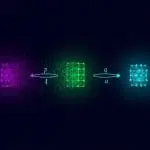
The equality is approximate, disregarding the kinetic term. The possibility of obtaining UNL in a realistic setup is studied elsewhere. Using the Heisenberg picture, the QND-based unitary transformation Uqy(g4)Upx(g3) · UNL(q, γ) · Upx(g2)Uqy(g1) can induce nonlinear transformations of the target system. Figure 1(a) illustrates this, and Figure 1(b) shows a simplified protocol with only two QND interactions. Figure 1(c) presents a concrete implementation with a linear atomic cloud as the target and a levitated nanoparticle as the nonlinearity source, mediated by squeezed light. Figure 1(d) shows the main figures of merit used to evaluate nonlinearity broadcasting, including the nonlinear variance σ(λ) and Wigner function contour plots.
Light-mediated nonlinearity transfer to linear oscillators enables novel
Scientists engineered a hybrid quantum computation strategy to broadcast nonlinear transformations onto linear systems, addressing a fundamental requirement for universal processing with linear oscillators. The study employed a sequence of pulsed optically-mediated quantum non-demolition (QND) gates to broadcast the nonlinearity from the mechanical oscillator to the target system. These QND gates, previously demonstrated in interactions between light, mechanics, and atomic ensembles, require only linear interactions with the atomic cloud, eliminating the need for nonlinear feedforward. Scientists harnessed recent advancements in QND coupling between atomic ensembles and mechanical membranes to facilitate this interaction.
The protocol consists of five Hamiltonian transformations, four linear QND interactions and a local nonlinear transformation of the source system. The team designed a circuit diagram illustrating the sequence of operations, including the application of squeezed light pulses to mediate the QND interactions. To evaluate the nonlinearity broadcasting, researchers quantified the nonlinear variance, σ(λ), for ground, coherent, and post-cubic phase gate states. They then compared these variances against thresholds attainable by classical or Gaussian states, using contour plots of Wigner functions to visualise the quantum state characteristics. This methodology and example pave the way for further efforts in bosonic hybrid systems to broadcast essential nonlinearity to linearized systems, enabling more complex quantum computations.
Nonlinear broadcasting via optically levitated oscillators offers new
The core of the protocol involves five Hamiltonian transformations: four linear QND interactions and a local nonlinear transformation of the source system. Numerical results were obtained using parameters inspired by recent experiments with atomic ensembles and levitated nanoparticles, establishing a strong connection between theory and practical implementation. Measurements confirm the ability to induce nonlinear transformations of the target system using the QND-based protocol, formally described by the operator Uqy(g4)Upx(g3) · UNL(q, γ) · Upx(g2)Uqy(g1). Specifically, the target quadratures transformed as Xi 7→Xf = Xi and Yi 7→Yf = Yi −gγV’(g Xi), where g represents the controllable gain of the Gaussian interaction. Analysis of the nonlinear variance σ(λ), the nonlinear variance (NLV), for the ground state |0⟩, a coherent state |α = 1 + i⟩, and these states after a cubic phase gate exp[−ix3/6] revealed areas reachable only by non-classical and quantum non-Gaussian states. The methodology presented is applicable to arbitrary platforms, offering a versatile approach to harnessing nonlinearity in quantum systems.
Light broadcasts nonlinearity to linear oscillators, inducing complex
Scientists have demonstrated a method for achieving nonlinear operations using linear oscillators, a crucial step towards universal processing with these systems. Analysis of the nonlinear value corresponding to the final atomic state showed displacement consistent with direct application of the nonlinearity, aligning with theoretical predictions. The authors acknowledge that performance is impacted by decoherence parameters, necessitating suppression of optical loss and environmental mechanical heating through techniques like cryogenic cooling or improved vacuum conditions. Increasing the gain associated with the nonlinearity also presents challenges, potentially introducing additional noise or loss, requiring careful optimisation of control parameters. Future work could focus on refining these parameters and exploring the scalability of this approach for more complex quantum processing applications, potentially leveraging stronger optomechanical coupling and weaker opto-atomic coupling for improved performance.
👉 More information
🗞 Broadcasting quantum nonlinearity in hybrid systems
🧠 ArXiv: https://arxiv.org/abs/2601.19610