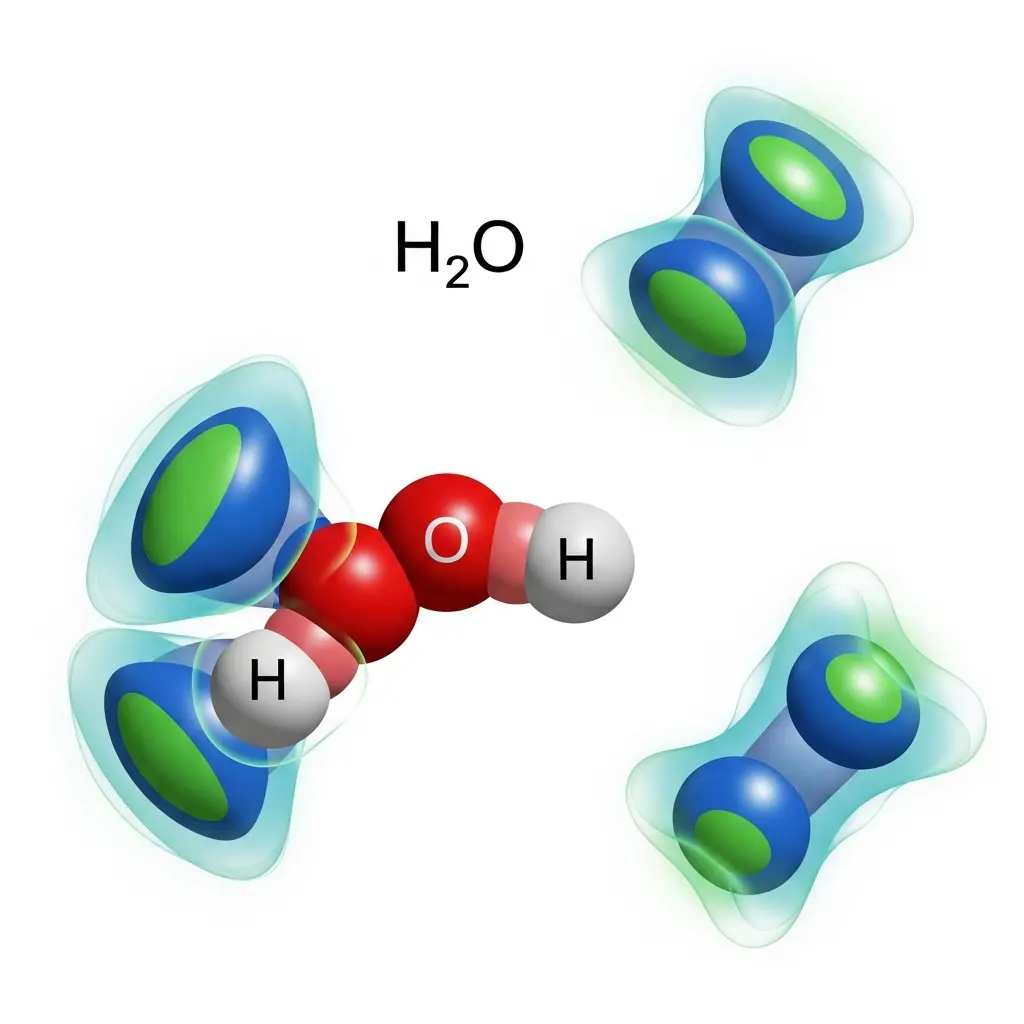
Determining the ground state energy of molecules remains a fundamental problem in quantum chemistry, crucial for understanding material properties and chemical reactions. Luca Ion from the School of Physics and Astronomy, University of Nottingham, along with Adam Smith, now advances this field by applying a variational quantum eigensolver to complex molecular systems. Their work successfully computes the ground state energies of molecules like helium hydride and water, utilising both quantum computer simulations and actual quantum hardware from IBM. This achievement demonstrates a promising pathway towards employing quantum computers to accurately model molecular behaviour, potentially revolutionising fields from drug discovery to materials science by overcoming the limitations of classical computational methods.
Quantum Simulation of Molecular Ground State Energies
Scientists achieved significant results in simulating molecular systems using quantum computing techniques, focusing on the helium hydride (He-H+) and water (H2O) molecules. The work demonstrates the application of the variational quantum eigensolver (VQE) algorithm, executed on both a quantum computer simulator and an IBM quantum device, to determine ground-state energies. Researchers benchmarked these quantum computations against exact ground-state energies obtained through classical methods, providing a crucial validation step for the quantum approach. This circuit incorporates single-qubit rotation gates, RX and RZ, alongside two-qubit Control-Z (CZ) gates to facilitate interactions between qubits. The number of parameters requiring optimization scales with the number of qubits and circuit layers, specifically defined as 2N(M+1), where N represents the number of qubits and M denotes the number of layers. Parameters were initialized randomly, and the VQE algorithm employed gradient descent methods to minimize the energy expectation value, seeking the lowest possible ground-state energy.
Experiments with the He-H+ molecule revealed that the parameter-shift and second-order finite difference methods exhibited the best convergence in optimizing the circuit. The team also investigated various gradient descent approximation schemes, including first-order finite difference, stochastic approximation, and the parameter-shift method, to refine the optimization process. For the H2O molecule, the study assessed the performance of VQE on a larger system, demonstrating the potential of this quantum approach to tackle increasingly complex molecular simulations and paving the way for advancements in quantum chemistry and materials science.
Variational Quantum Eigensolver for Molecular Energies
This research successfully demonstrates the application of the variational quantum eigensolver to approximate the ground-state energies of both the He-H+ molecule and the more complex H2O molecule. By implementing the algorithm on both a quantum computer simulator and real quantum hardware, the team validated the approach against established classical methods, achieving promising results even with the inherent noise present in current quantum devices. The study highlights the performance of different optimization methods within the algorithm, finding that the parameter shift rule generally performed best while the simultaneous perturbation stochastic approximation algorithm offered potential speed advantages, particularly when accounting for the time required to access quantum hardware. The team acknowledges that optimization can become unstable, failing to converge within the allotted computational steps, and suggests that improved tuning of algorithm parameters and repeated optimization runs could address this limitation. Future work, they propose, should investigate initializing the quantum system with low entanglement, exploring the energy of the H2O molecule as a function of bond length, and expanding the model to include a more realistic representation of the molecule by increasing the number of active orbitals. These advancements promise to further refine the accuracy and efficiency of quantum computations for increasingly complex chemical systems, paving the way for more detailed molecular simulations.
The He-H+ molecule served as a simpler test case, and the algorithm was also performed on a real IBM machine to highlight the noisy nature of current quantum devices. For the more complex H2O molecule, the HPC was used to benefit from parallelism. The H2O system was initially represented by an eight-qubit Hamiltonian, and the lowest ground-state energy occurred for specific geometric parameters, differing slightly from typical literature values due to approximations in the model. The team tested ansatz circuits with varying numbers of layers, finding that even a single layer produced good approximations.
For the He-H+ molecule, the parameter-shift method generally performed best, while the stochastic approximation method performed worst under the settings tested. The number of circuit evaluations was consistently set to 8192 throughout the experiments. The team found that the parameter-shift method offered the most stable convergence, while the stochastic approximation method could potentially offer speed advantages.
🗞 Variational quantum eigensolver for chemical molecules
🧠 ArXiv: https://arxiv.org/abs/2512.22572