
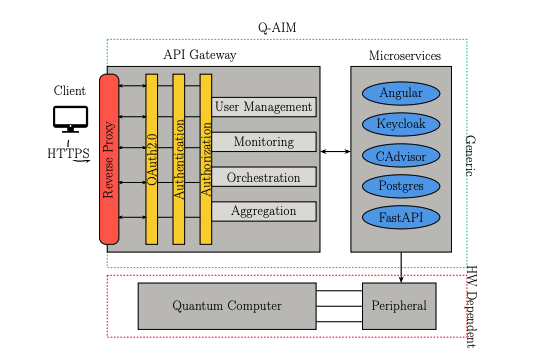
Quantum Access Infrastructure Management, or Q-AIM, presents a vendor-independent, open-source software framework simplifying access to quantum computing hardware. Its dockerized micro-service architecture enables portable, scalable deployment across diverse infrastructures, from personal devices to cloud servers, reducing operational costs and technical redundancies for research groups.
The burgeoning field of quantum computing requires more than just advanced hardware; a robust and adaptable software infrastructure is essential to fully realise its potential. Currently, integrating diverse quantum resources presents significant challenges, hindering research and development. Researchers at Johannes Gutenberg University Mainz and Goethe University Frankfurt, including Zhaobin Zhu, Cedric Gaberle, Sarah M. Neuwirth, Thomas Lippert, and Manpreet S. Jattana, address this need with their development of Q-AIM (Access Infrastructure Management), a unified, portable workflow designed for seamless integration of quantum resources. Their work, detailed in the article “Q-AIM: A Unified Portable Workflow for Seamless Integration of Quantum Resources”, presents a vendor-independent and open-source framework utilising a dockerised micro-service architecture, capable of operating across a spectrum of hosting environments from personal devices to cloud servers, and intended to simplify the entire lifecycle of quantum hardware, from procurement to operation.
The current quantum computing landscape presents a significant challenge due to the lack of a unified infrastructure for accessing and managing the diverse range of available hardware. This has prompted the development of Q-AIM (Quantum Access Infrastructure Management), a software framework designed to address this critical need. Q-AIM functions as a vendor-independent and open-source solution, streamlining interaction with various quantum systems and simplifying the process from hardware procurement to ongoing operation.
Q-AIM employs a dockerized micro-service architecture, prioritising portability, customisation, and efficient resource utilisation. This enables deployment across a spectrum of hosting environments, ranging from personal computing devices to cloud servers and dedicated infrastructure. This offers a flexible and scalable solution for diverse computational needs, benefiting from a minimal memory footprint which proves particularly advantageous for cost-effective deployment on smaller server instances while maintaining the capacity for seamless scalability. Dockerisation involves packaging software into standardised units called containers, ensuring consistent operation across different environments.
The research centres on the Variational Quantum Eigensolver (VQE) algorithm, demonstrating Q-AIM’s ability to streamline hardware access for complex quantum computations. VQE, a key algorithm for quantum computation, particularly in quantum chemistry and materials science, approximates the ground state energy of a molecule or material. It allows researchers to focus on algorithm development rather than hardware integration. Researchers actively investigate improvements to VQE, including quasidynamical evolution and hybrid approaches leveraging quantum annealers to accelerate computation and enhance performance. Quantum annealers are a type of quantum computer particularly suited to optimisation problems.
The software infrastructure underpinning Q-AIM proves robust and comprehensive, utilising standard technologies such as Docker and Kubernetes for containerisation and orchestration, ensuring scalability and efficient resource management. Kubernetes automates the deployment, scaling, and management of containerised applications. It integrates with cloud computing platforms like Google Cloud, enabling deployment on both small-scale personal devices and large-scale server infrastructure. Tools like Node.js, Angular, and Nginx facilitate the development of a user-friendly interface, simplifying interaction with the quantum hardware and improving the user experience.
Researchers developed a QASM (Quantum Assembly Language) parser, allowing for the manipulation of quantum circuits and streamlining the process of translating algorithms into executable instructions for the hardware. QASM is a human-readable language used to describe quantum circuits. This equips research groups and facilities with a tool that simplifies the entire hardware lifecycle, fostering research productivity.
Q-AIM actively exposes a single, unified entry point for interacting with the underlying hardware infrastructure, simplifying complex interactions and providing a consistent interface regardless of the specific quantum computing system being utilised. By consolidating access and management, the framework reduces the operational burden associated with maintaining and integrating diverse quantum hardware resources, allowing researchers to focus on scientific discovery. Future work will likely focus on expanding the framework’s compatibility with an even wider range of quantum hardware and developing advanced features for resource allocation and job scheduling.
The project acknowledges and addresses the pervasive issue of errors in quantum computations, dedicating resources to developing and implementing scalable error mitigation techniques, ensuring the reliability and accuracy of quantum computations. The framework’s design considers the economic implications of cloud deployment, referencing Google Cloud compute instance pricing to inform design choices and optimise cost-effectiveness.
The software architecture utilises Git, a version control system, facilitating collaborative development and ensuring code maintainability, promoting transparency and reproducibility. The use of Nginx as a web server and reverse proxy further enhances the system’s performance and scalability, providing a robust and reliable interface for accessing the quantum computing infrastructure. Container monitoring tools, such as Cadvisor, track resource usage and identify potential bottlenecks, ensuring optimal performance and efficient resource allocation.
By providing a readily deployable and adaptable infrastructure solution, Q-AIM empowers research groups and facilities to efficiently procure, operate, and scale their quantum computing resources, ultimately accelerating progress in the field.
👉 More information
🗞 Q-AIM: A Unified Portable Workflow for Seamless Integration of Quantum Resources
🧠 DOI: https://doi.org/10.48550/arXiv.2506.13436