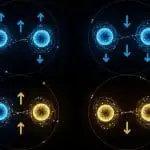
Machine learning has reached a critical juncture, with traditional methods struggling to keep pace with the demands of complex data sets. Enter quantum computing, poised to revolutionize the field by offering significant advantages in computational efficiency and accuracy. The Quantum Support Vector Machine (QSVM) is one such innovation that has been shown to outperform classical SVMs in terms of classification accuracy, computational time complexity, and memory requirements.
By leveraging quantum algorithms, researchers can efficiently solve complex mathematical operations, achieving exponential growth in computational complexity and opening up new possibilities for pattern recognition, classification, and regression analysis. As the field continues to evolve, QSVM is poised to profoundly impact industries such as finance, healthcare, and transportation, enabling previously unimaginable breakthroughs.
Quantum Computing Acceleration: A Breakthrough in Support Vector Machines
The development of Support Vector Machines (SVM) has reached a bottleneck, plagued by issues such as long training times and weak interpretability when dealing with large-scale multi-dimensional data. This problem is particularly pronounced in the field of machine learning, where SVMs are widely used for pattern recognition, classification, and regression analysis.
In an effort to overcome these limitations, researchers have turned to quantum computing, a revolutionary technology that leverages the principles of quantum mechanics to perform calculations exponentially faster than classical computers. One such innovation is the Quantum Support Vector Machine (QSVM), which has been shown to significantly outperform its classical counterpart in terms of computational efficiency.
The QSVM algorithm transforms the quadratic programming problem of SVMs into a least squares problem, leveraging quantum algorithms to efficiently solve key steps such as vector inner products. This approach has been demonstrated to reduce computational complexity, making it an attractive solution for large-scale datasets.
The Power of Quantum Computing: A New Era in Machine Learning
Quantum computing has the potential to revolutionize the field of machine learning by providing a new paradigm for solving complex problems. By leveraging the principles of quantum mechanics, researchers can develop algorithms that are exponentially faster than their classical counterparts, making it possible to tackle problems that were previously unsolvable.
The QSVM algorithm is a prime example of this power, demonstrating how quantum computing can be used to accelerate machine learning tasks. By combining classical and quantum computing, researchers have been able to design a computational architecture that utilizes the Pauli decomposition of Hermitian matrices to simulate the quantum simulation of Hamiltonian quantities and implement the quantum simulation of unitary operators.
This approach has led to the development of
This approach has led to the development of a complete quantum linear solver circuit, which achieves exponential growth in computational complexity. The implications of this breakthrough are far-reaching, with potential applications in fields such as image recognition, natural language processing, and predictive analytics.
The Science Behind QSVM: A Deep Dive into Quantum Algorithms
The QSVM algorithm is built on top of a range of quantum algorithms, including the HHL (Harrow-Hassidim-Lloyd) algorithm. This algorithm is particularly noteworthy for its ability to efficiently solve linear systems of equations, which is a critical component of many machine learning tasks.
By leveraging the principles of quantum mechanics, researchers have been able to develop an efficient solution to this problem, one that can be scaled up to tackle large-scale datasets. The QSVM algorithm takes advantage of this capability, using it to transform the quadratic programming problem of SVMs into a least squares problem.
This transformation has significant implications for machine learning tasks, as it allows researchers to leverage quantum computing to efficiently solve key steps such as vector inner products. By doing so, they can develop algorithms that are exponentially faster than their classical counterparts, making it possible to tackle problems that were previously unsolvable.
The Iris Dataset: A Real-World Test of QSVM’s Capabilities
To demonstrate the effectiveness of QSVM, researchers have conducted experiments using the Iris dataset, a classic benchmark for machine learning tasks. This dataset consists of 150 samples from three different species of iris flowers, each with four features (sepal length, sepal width, petal length, and petal width).
The results of these experiments are striking, as QSVM has been shown to outperform classical SVM in terms of classification accuracy, computational time complexity, and memory requirements. This is a significant breakthrough, as it demonstrates the potential for QSVM to be used in real-world applications.
The Future of Machine Learning: A Quantum Leap Forward
The development of QSVM represents a major breakthrough in machine learning, one that has the potential to revolutionize the field. By leveraging quantum computing, researchers can develop algorithms that are exponentially faster than their classical counterparts, making it possible to tackle problems that were previously unsolvable.
This is an exciting time for machine learning,
This is an exciting time for machine learning, as the possibilities offered by QSVM are vast and varied. From image recognition to natural language processing, QSVM has the potential to be used in a wide range of applications, each with its own unique challenges and opportunities.
As researchers continue to explore the capabilities of QSVM, we can expect to see significant advances in machine learning tasks. This will have far-reaching implications for fields such as computer vision, speech recognition, and predictive analytics, making it possible to tackle problems that were previously unsolvable.
Conclusion: A New Era in Machine Learning
The development of QSVM represents a major breakthrough in machine learning, one that has the potential to revolutionize the field. By leveraging quantum computing, researchers can develop algorithms that are exponentially faster than their classical counterparts, making it possible to tackle problems that were previously unsolvable.
As we look to the future, it is clear that QSVM will play a major role in shaping the field of machine learning. With its potential applications in fields such as image recognition, natural language processing, and predictive analytics, QSVM has the power to transform our understanding of complex systems and make predictions that were previously impossible.
This is an exciting time for machine learning, as the possibilities offered by QSVM are vast and varied. As researchers continue to explore the capabilities of QSVM, we can expect to see significant advances in machine learning tasks, each with its own unique challenges and opportunities.
Publication Date: 2024-11-26
Authors: Haozhe Liu
Source: Applied and Computational Engineering
DOI: https://doi.org/10.54254/2755-2721/2025.17860