The quest for unlocking secrets of quantum gravity has led researchers to explore the realm of lattice holography. This innovative approach discretizes spacetime into a lattice, enabling the application of statistical mechanics and numerical techniques to study strongly coupled quantum field theories. The AdS/CFT correspondence, a theoretical framework proposing a duality between a strongly coupled CFT on the boundary and a weakly coupled quantum theory of gravity in the bulk, has been extensively studied. However, simulating these systems using classical computers becomes increasingly challenging as the volume increases.
Can Quantum Computers Unlock Secrets of Lattice Holography?
In recent years, the field of lattice holography has gained significant attention due to its potential to unlock secrets of quantum gravity. The concept of lattice holography is based on the idea that a strongly coupled bulk theory can be studied by discretizing spacetime into a lattice. This approach enables the application of statistical mechanics and numerical techniques to explore strongly coupled quantum field theories.
Researchers have been exploring the AdS/CFT correspondence, which proposes a duality between a strongly coupled CFT on the boundary of ad+1-dimensional space with hyperbolic isometries and a weakly coupled quantum theory of gravity in the bulk. This correspondence suggests that studying quantum field theories via their gravitational duals can provide valuable insights into the behavior of strongly coupled systems.
However, simulating these systems using classical computers becomes increasingly challenging as the volume increases, especially when large amounts of entanglement are involved. This limitation has stifled classical simulations of such systems in higher-dimensional spacetime.
AdS/CFT Correspondence: A Key to Unlocking Quantum Gravity
The AdS/CFT correspondence is a theoretical framework that proposes a duality between a strongly coupled CFT on the boundary of ad+1-dimensional space with hyperbolic isometries and a weakly coupled quantum theory of gravity in the bulk. This correspondence has been extensively studied, and its implications for our understanding of quantum gravity are significant.
The AdS/CFT correspondence suggests that studying quantum field theories via their gravitational duals can provide valuable insights into the behavior of strongly coupled systems. This approach has been used to study various aspects of quantum gravity, including black hole entropy and the behavior of matter in extreme environments.
Lattice Field Theory: A Powerful Tool for Studying Quantum Gravity
Lattice field theory is a powerful tool for studying quantum gravity. By discretizing spacetime into a lattice, researchers can apply statistical mechanics and numerical techniques to explore strongly coupled quantum field theories.
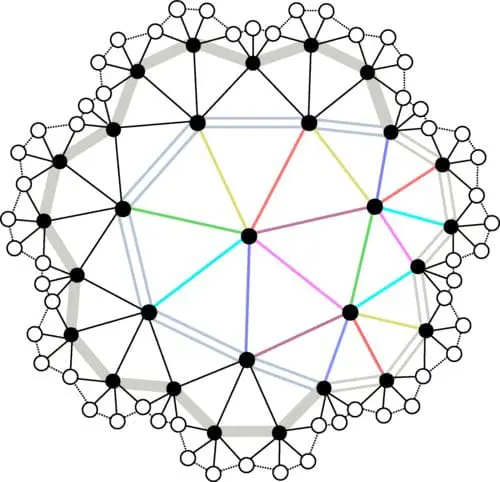
The application of lattice field theory to the AdS/CFT correspondence has revealed that even coarse hyperbolic lattices, where only a subset of the original continuous symmetries remain, exhibit power-law correlations supporting an approximate CFT on the lattice’s boundary. This suggests that lattice holography can be used to study strongly coupled systems in higher-dimensional spacetime.
Quantum Computers: A Game-Changer for Lattice Holography
Quantum computers have the potential to revolutionize our understanding of lattice holography. By leveraging the power of quantum computing, researchers can simulate strongly coupled systems that are currently inaccessible using classical computers.
In a recent study, researchers used adiabatic evolution to compute the ground state of a spin system on a 2+1-dimensional hyperbolic lattice and measured the spinspin correlation function on the boundary. Notably, they observed that with achievable resources for coming quantum devices, the correlation function demonstrates an approximate scale-invariant behavior aligning with the pivotal theoretical predictions of the AdS/CFT correspondence.
The Future of Lattice Holography: Unlocking Secrets of Quantum Gravity
The future of lattice holography holds much promise. With the development of more powerful quantum computers and advances in numerical techniques, researchers will be able to simulate strongly coupled systems that are currently inaccessible using classical computers.
The study of lattice holography has the potential to unlock secrets of quantum gravity, including the behavior of matter in extreme environments and the nature of black hole entropy. As researchers continue to explore the AdS/CFT correspondence and develop new numerical techniques, we can expect significant advances in our understanding of quantum gravity.
Conclusion
In conclusion, lattice holography has the potential to unlock secrets of quantum gravity. By discretizing spacetime into a lattice and applying statistical mechanics and numerical techniques, researchers can study strongly coupled quantum field theories that are currently inaccessible using classical computers.
The AdS/CFT correspondence is a powerful tool for studying quantum gravity, and the application of lattice field theory to this correspondence has revealed valuable insights into the behavior of strongly coupled systems. With the development of more powerful quantum computers and advances in numerical techniques, we can expect significant advances in our understanding of quantum gravity.
Publication Date: 2024-08-06
Authors: Yingying Li, Muhammad Omer Sajid and Judah Unmuth-Yockey
Source: Physical review. D/Physical review. D.
DOI: https://doi.org/10.1103/physrevd.110.034507