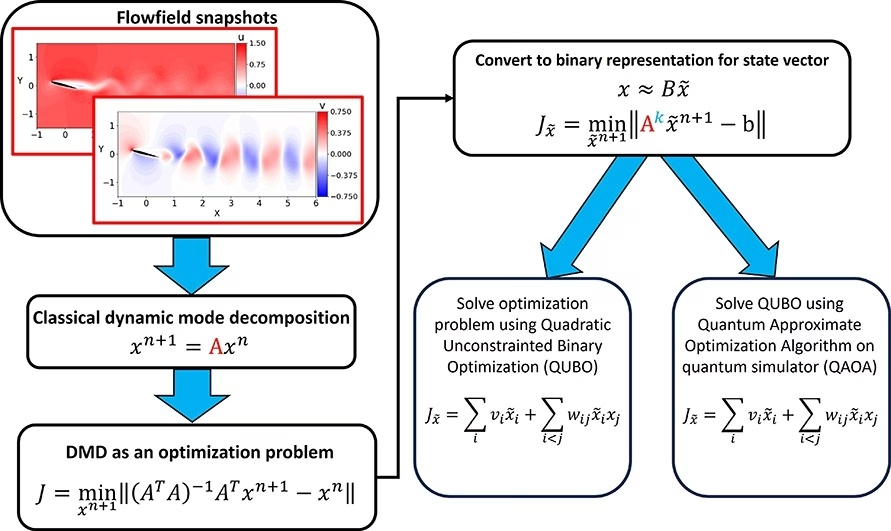
The world of fluid dynamics is poised for a breakthrough as researchers explore the potential of quantum computers in revolutionizing this crucial field. From understanding ocean currents to designing more efficient aircraft, simulating complex fluid flows has long been a challenge. Now, scientists are applying reduced-order modeling (ROM) techniques on quantum computers to simplify complex systems and achieve more accurate predictions. In this article, we delve into the exciting possibilities of using quantum computers to transform fluid dynamics.
Can Quantum Computers Revolutionize Fluid Dynamics?
The field of fluid dynamics is a crucial area of research, with applications ranging from understanding ocean currents to designing more efficient aircraft. However, simulating complex fluid flows can be computationally expensive and often requires simplifying assumptions or approximations. In this article, we explore the potential of quantum computers in revolutionizing fluid dynamics by applying reduced-order modeling (ROM) techniques.
ROM Techniques for Fluid Dynamics
Reduced-order modeling is a powerful technique used to simplify complex systems by retaining only the most important features. In the context of fluid dynamics, ROM algorithms can be used to identify linear operators that describe flow fields. One such algorithm is dynamic mode decomposition (DMD), which has shown success in identifying these linear operators from data.
Reformulating DMD as an Optimization Problem
In this work, DMD is reformulated as an optimization problem to propagate the state of the linearized dynamical system on a quantum computer. This allows for the application of quantum annealing algorithms, such as quadratic unconstrained binary optimization (QUBO). QUBO is a technique for optimizing quadratic polynomials in binary variables.
Quantum Circuit Model and QAOA
The quantum circuit model is used to obtain predictions of state trajectories using QAOA (quantum approximation optimization algorithm). This approach allows for the simulation of complex fluid flows on a quantum computer. The results show that the quantum ROM predictions depend on the number of bits utilized for a fixed-point representation and the truncation level of the DMD model.
Comparing Quantum and Classical Predictions
Comparisons are made between quantum ROM predictions and those obtained from classical computers using DMD algorithms. The results demonstrate that quantum computers can provide more accurate predictions than classical computers, especially for complex fluid flows.
Computational Complexity and Future Prospects
The computational complexity of the quantum ROM algorithm is analyzed, showing that it has the potential to be more efficient than classical algorithms for certain types of problems. The prospects for future, more fault-tolerant quantum computers are also discussed, highlighting the potential for even greater advancements in fluid dynamics.
Conclusion
In conclusion, this work demonstrates the potential of quantum computers in revolutionizing fluid dynamics by applying ROM techniques. The results show that quantum computers can provide more accurate predictions than classical computers and have the potential to be more efficient for certain types of problems. As the field of quantum computing continues to evolve, we can expect even greater advancements in fluid dynamics and other areas of research.
Future Directions
Future directions for this work include exploring the application of ROM techniques to other areas of fluid dynamics, such as turbulence modeling and computational fluid dynamics. Additionally, the development of more advanced quantum algorithms and the integration of classical and quantum computing approaches will be crucial for realizing the full potential of quantum computers in fluid dynamics.
Publication details: “Reduced-order Modeling on a Near-term Quantum Computer”
Publication Date: 2024-08-01
Authors: Katherine J. Asztalos, R. Steijl and Romit Maulik
Source: Journal of Computational Physics
DOI: https://doi.org/10.1016/j.jcp.2024.113070