

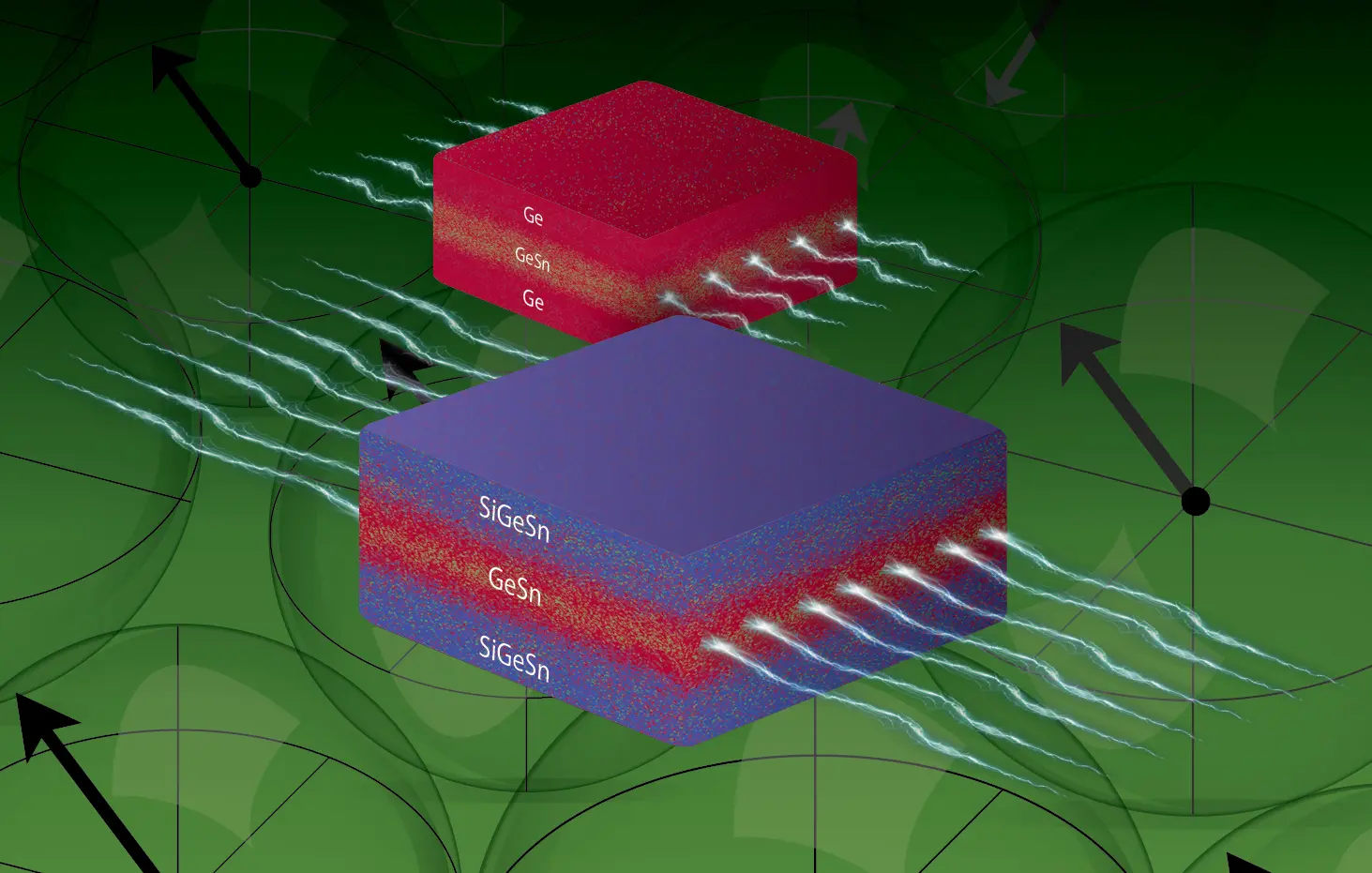
Chris Allemang from Sandia National Laboratories, alongside teams from the University of Arkansas and Dartmouth College, has demonstrated improved electrical current flow through quantum wells—specialized semiconductor devices increasingly used in advanced computing systems. The collaborative research, published in Advanced Electronic Materials, details how incorporating small amounts of tin and silicon into the outer barriers of these quantum wells increased the mobility of charge carriers. This counterintuitive material tweak, supported by a Department of Energy grant and initiated in 2022, aims to enhance the efficiency and scalability of quantum information transmission and overall semiconductor technologies.
Quantum Wells and Electrical Current
Researchers discovered an unexpected improvement in electrical current flow through quantum wells by adding tin and silicon impurities to the outer barriers. Previous studies focused on pure germanium barriers, but this team found that the addition of these elements increased mobility—a measure of how easily charge carriers move. This challenges the assumption that impurities always hinder electrical flow, suggesting that atomic-level arrangements play a crucial role in performance.
The increase in mobility is potentially linked to “short-range order”—the non-random arrangement of silicon and tin atoms within the material. Dartmouth College’s analysis revealed these trace elements don’t scatter randomly, but relate to the main material’s structure. This ordering could explain the higher mobility observed in the silicon-germanium-tin barriers, offering a new method for manipulating material properties beyond traditional alloying and strain techniques.
This discovery has implications for both conventional microelectronics and emerging quantum information systems. The Sandia team, in collaboration with the University of Arkansas and Dartmouth College, demonstrated that even at the nanometer scale—with millions of atoms present—atomic arrangements can significantly enhance performance. Further research may unlock new avenues for designing advanced semiconductor materials with improved functionality.
Unexpected Impact of Tin and Silicon
Researchers discovered an unexpected improvement in the performance of quantum wells by adding tin and silicon impurities to the barriers. Contrary to expectations that impurities would hinder electrical flow, the team observed higher mobility of charge carriers. This challenges previous assumptions about semiconductor behavior, suggesting that these added elements don’t simply slow down electricity, but can actually enhance it. The study, published in Advanced Electronic Materials, indicates a potential for more efficient quantum computing systems.
The boost in mobility is believed to be linked to “short-range order” – a pattern in how atoms arrange themselves within the material. Trace elements like silicon and tin don’t scatter randomly, but instead organize in relation to the main material. This ordering could be the key to enhancing current flow in the quantum well, providing “an additional control knob” for engineering material properties. Dartmouth College and other institutions contributed to understanding this atomic-level behavior.
This discovery has implications for both traditional microelectronics and emerging quantum technologies. Sandia National Laboratories, the University of Arkansas, and Dartmouth College collaborated on the research, exploring silicon-germanium-tin barriers to optimize performance. The findings suggest new avenues for manipulating atomic arrangements—even at the nanometer scale—to dramatically improve the efficiency of semiconductor materials and advance quantum information science.
Short-Range Order in Semiconductor Alloys
Researchers discovered that adding small amounts of tin and silicon to the outer barriers of quantum wells—specialized semiconductor devices—surprisingly increased electrical current mobility. Previous studies focused on pure germanium barriers, but this team found mixing in these impurities didn’t hinder flow as expected. This boost challenges assumptions about impurities slowing electricity and suggests tiny patterns in atomic arrangement, called short-range order, may be playing a beneficial role in the silicon-germanium-tin system.
This finding is significant because it points to a new way to engineer material properties. The increased mobility was measured in experimental devices built at Sandia National Laboratories using materials produced by the University of Arkansas. Dartmouth College examined the atomic short-range ordering within the silicon-germanium-tin barriers, contributing to the understanding of the observed electrical behavior. This could allow for more efficient quantum computers and improved semiconductor technologies.
The research, part of the Manipulation of Atomic Ordering for Manufacturing Semiconductors initiative, builds on recent discoveries showing trace elements like silicon and tin don’t scatter randomly, but exhibit short-range order. This arrangement—where atoms relate to the main material—could explain the enhanced mobility. Researchers believe this provides “a new degree of freedom for device engineering,” offering potential for dramatically improved performance in both conventional and quantum computing systems.
The unexpected high mobility result hints at short-range order effects in the Group-IV silicon-germanium-tin system, which is particularly exciting due to the system’s optical properties and its potential for monolithic integration with conventional silicon CMOS.
Chris Allemang
Enhancing Quantum and Microelectronic Systems
Researchers have discovered a counterintuitive method for improving quantum computer performance by tweaking the materials used in quantum wells. By adding small amounts of tin and silicon to the outer barriers of these wells—devices used to confine electrical current—the team observed increased electrical current mobility. This challenges previous assumptions that impurities would hinder flow, and suggests that short-range order in atomic arrangement may be playing a beneficial role in enhancing performance.
This improvement in mobility was measured in quantum wells constructed with silicon-germanium-tin barriers. The University of Arkansas produced the material used to build experimental devices, and Sandia National Laboratories analyzed the electrical performance. The discovery suggests a new “control knob” for engineering material properties, going beyond traditional methods like alloying and strain. This could have significant impacts on both microelectronics and quantum information science.
The research, supported by a Department of Energy grant and involving collaboration between Sandia, the University of Arkansas, and Dartmouth College, points to the importance of atomic short-range order. Even at the nanoscale—on the order of a nanometer—the arrangement of atoms can significantly impact material properties. This provides new avenues for manipulating materials to dramatically enhance performance in both conventional and emerging technologies.


