Researchers are tackling the scaling limitations of superconducting qubits, a promising technology for large-scale quantum computing, by developing methods for efficient microwave-to-optical conversion. Thomas Werner, Erfan Riyazi, and Samarth Hawaldar, all from the Institute of Science and Technology Austria (ISTA), alongside Rishabh Sahu et al., have now demonstrated the generation and characterisation of single microwave photons originating from a superconducting qubit, which are subsequently upconverted to telecom wavelengths. This achievement represents a significant step forward because superconducting circuits lack direct optical transitions, and conversion of a non-classical photon state had previously remained elusive. By achieving this conversion with low added noise and a high signal-to-noise ratio, this work establishes a pathway towards distributed quantum computing architectures and the potential for heralded entanglement distribution and gate teleportation, ultimately enabling superconducting devices to integrate into broader quantum technologies.
This work addresses a significant scaling bottleneck inherent in superconducting quantum computing, which currently requires millikelvin operating temperatures that limit long-range communication and networking.
Bridging Superconducting Nodes with Optical Fibers
Bridging Cryogenic Gaps with Optical Conversion
Researchers successfully upconverted a non-Gaussian microwave photon at 8.9GHz to a telecom photon at 193.4THz, a critical step towards bridging separate cryogenic nodes with optical fiber links. The demonstrated electro-optic conversion process exhibits a signal-to-noise ratio of up to 5.1±1.1, validating the viability of this approach for distributing quantum information.
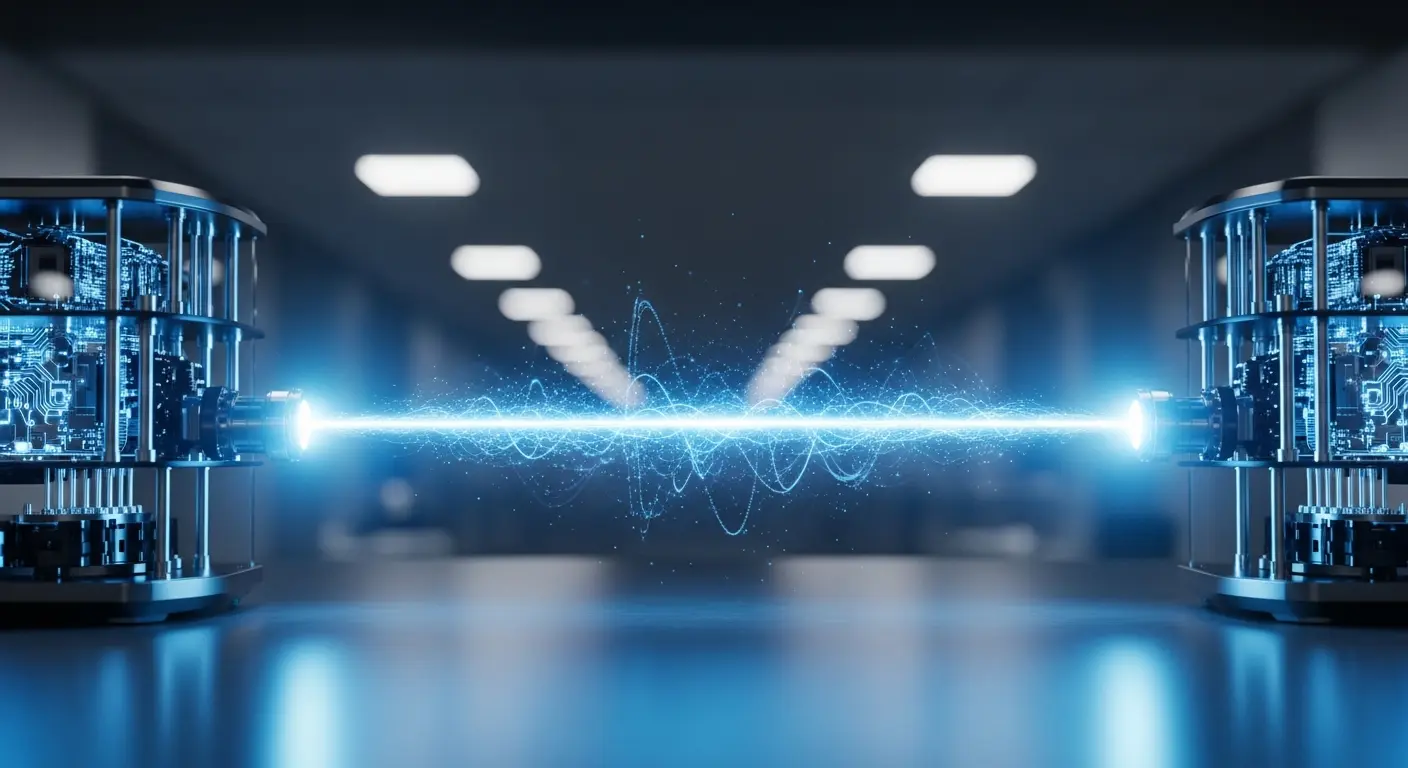
This achievement hinges on the creation of an integrated system where a transmon qubit generates a single microwave photon within a three-dimensional aluminum resonator. Following emission, this photon propagates to an electro-optic transducer, where it is upconverted to the optical frequency range.
State tomography in the microwave domain confirms the nonclassical nature of the generated photon, while optical detection quantifies the conversion efficiency. Crucially, the conversion process does not disturb the superconducting qubit itself, establishing a pathway for scalable quantum interconnects.
Advanced Mechanisms for Efficient Microwave Conversion
Engineering the Conversion Using Pockels Effect
The transducer utilizes the Pockels effect within a lithium niobate optical whispering gallery mode resonator, enhanced by a strong optical pump. This design, featuring thin-film aluminium electrodes and centre-clamping, minimises losses and improves reproducibility, achieving an internal conversion efficiency of approximately 1.6 × 10⁻³ and a total efficiency of 2.2.
By operating in a low-cooperativity regime, researchers mitigated thermal heating and quasiparticle generation, ensuring stable and reliable performance. These results establish a viable path toward heralded entanglement distribution and gate teleportation, empowering superconducting devices to play a key role in distributed quantum technologies and heterogeneous quantum systems. The ability to efficiently convert microwave photons to the telecom band enables the integration of superconducting quantum processors into existing photonic quantum networks, paving the way for more powerful and versatile quantum computing architectures.
Superconducting Qubit System and Microwave-to-Optical Conversion Setup are now operational
Scaling Progress Using Large Qubit Processors
Scaling Breakthroughs with 72-Qubit Processors
A 72-qubit superconducting processor forms the foundation of this work, enabling the on-demand generation and tomographic reconstruction of itinerant single microwave photons at 8.9GHz. Researchers upconverted these non-Gaussian states using an electro-optic transducer, achieving a noise level below 0.012 quanta.
The converted telecom photons at 193.4THz were then detected with a signal-to-noise ratio of up to 5.1 1.1, demonstrating efficient microwave-to-optical conversion. All microwave components were placed inside a dilution refrigerator (Bluefors LD-250) to maintain millikelvin operating temperatures. Signal conditioning incorporated Eccosorb, lowpass filters (K&L Microwave 6L250-12000/T26000-O/O6L250-00089), bandpass filters (Keenlion 8-12GHz Band Pass Filter), switches (Radiall R573423600, Radiall R570443000), directional couplers (KRYTAR 120420), circulators (LNF 8-12GHz Single Junction Circulator), cryogenic 50 Ω terminations (Amphenol XMA 2001-6117-00-CRYO), and attenuators (Amphenol XMA 2682-6460-dB-CRYO, Amphenol XMA 2082-6340-dB-CRYO).
The output line featured a double-junction circulator (LNF 8-12GHz Dual Junction Circulator), a Dimer Josephson Junction Array Amplifier (JPA), and a HEMT amplifier (LNF-LNC4 16B). Optical measurements utilized a 1550nm laser with a 10kHz linewidth and a 3 photons/s/Hz noise floor. Before entering the transducer, the pump tone underwent cleaning via a series of three Fabry, Perot cavities aligned in free space, forming a pump filter bank locked on resonance with the pump frequency.
Quantum Machines OPX+ and Octave generated and analyzed microwave pulses, triggering both optical pulses and the SNSPD (Photon Spot) readout electronics (PicoQuant TimeHarp 260). The electro-optic transducer operated with a resonance frequency of 193THz, an optical cavity linewidth of 11.4MHz, and an optical coupling efficiency of 0.68.
The study characterized the trade-offs between throughput and noise, establishing a viable path toward heralded entanglement distribution and gate teleportation, with an internal conversion efficiency of 1.6 × 10⁻³ and an external conversion efficiency of 2.2 × 10⁻⁴. The qubit-cavity system exhibited a resonance frequency of 8.9076GHz, a dispersive shift of -3.5MHz, and a linewidth of 1.43MHz, alongside qubit relaxation and dephasing times of 19μs and 14μs respectively.
On-demand microwave-to-optical photon conversion from a superconducting qubit enables efficient qubit readout and long-distance quantum communication
Superconducting qubits represent a promising avenue for scalable computing due to their rapid gate speeds and continually improving error rates. The necessity of millikelvin operating temperatures, however, presents a considerable obstacle to scaling these systems. Architectures employing optical fiber links could potentially connect separate cryogenic nodes, but superconducting circuits lack inherent coherent optical transitions and microwave-to-optical conversion has not yet been demonstrated for any non-classical photon state.
This work details the on-demand generation and tomographic reconstruction of itinerant single microwave photons at 8.9GHz originating from a superconducting qubit. The generated non-Gaussian state was upconverted with a transducer exhibiting added noise below 0.012 quanta. Converted telecom photons at 193.4THz were then detected with a signal-to-noise ratio reaching up to 5.1±1.1.
Characterization of the trade-offs between throughput and noise was performed, establishing a viable pathway towards heralded entanglement distribution and gate teleportation. These results demonstrate the conversion of a non-classical state to the optical domain with a high signal-to-noise ratio, overcoming a significant hurdle in quantum interconnects for superconducting circuits.
A transmon qubit, encased within a three-dimensional aluminum resonator, was utilized to generate a single microwave photon within the resonator. Following leakage from the resonator and propagation through an output waveguide, the photon was directed towards an electro-optic transducer for upconversion to the optical domain.
State tomography performed in the microwave domain verified the non-classical nature of the generated single photon. The signal-to-noise ratio of the conversion process was quantified using single-photon detection in the optical domain. The experimental setup centers on an electro-optic transducer based on the Pockels effect, enhanced by an optical pump.
The EO interaction is described by a Hamiltonian that assumes a coupling between three resonant modes, resulting in a beam-splitter interaction between the microwave cavity mode and the optical mode with an enhanced vacuum coupling rate. The transducer comprises a 3D superconducting microwave cavity embedding a disk-shaped lithium niobate optical whispering gallery mode resonator, tuned to a free spectral range of 8.9006GHz to achieve both energy conservation and phase matching.
Microwave to optical conversion validates quantum limited performance and channel capacity for long-distance communication
Scientists have demonstrated the generation and reconstruction of single microwave photons emitted from a superconducting qubit, subsequently upconverting them to the optical domain. This achievement establishes a direct correlation between prepared qubit states and detected optical photons, representing a crucial step towards integrating superconducting circuits into larger quantum systems.
The upconversion process was achieved with a transducer introducing minimal additional noise, below 0.012 quanta, and the converted telecom photons were detected with a signal-to-noise ratio reaching up to 5.1. Characterisation of the system revealed trade-offs between data throughput and noise levels, with optical fibre noise and upconverted thermal photons identified as primary limitations at low and high repetition rates respectively.
Analysis indicates the device operates within the quantum limit, possessing a positive quantum channel capacity, and suggests potential for significant signal-to-noise ratio improvements through refined filtering and reduced optical losses. Calculations estimate an upper bound for the fidelity of an entangled state between the superconducting qubit and the travelling optical photon to be 87.6 percent, given the current maximum signal-to-noise ratio.
The authors acknowledge that the signal-to-noise ratio and throughput represent a key performance trade-off, quantifiable through the quantum channel capacity. Future research directions include reducing optical noise with narrower filters and mitigating losses between the qubit and the electro-optic cavity via optimised cabling and pulse shaping, potentially yielding a combined signal-to-noise ratio improvement factor of up to seven without requiring transducer improvements. These results empower existing superconducting devices to participate in distributed quantum technologies and heterogeneous systems, paving the way for scalable quantum computing architectures.
🗞 Electro-optic conversion of itinerant Fock states
🧠 ArXiv: https://arxiv.org/abs/2602.00928