Scientists from Lawrence Livermore National Laboratory (LLNL), the InQubator for Quantum Simulations, and the University of Trento have developed an algorithm enabling quantum computers to accurately simulate particle scattering. This breakthrough could revolutionize our understanding of fundamental particles, their interactions, and the forces governing the cosmos.
The new algorithm, published in Physical Review C, focuses on nonrelativistic elastic scattering, a process where particles collide without losing energy. As the number of particles in a simulation increases, classical computers struggle to keep pace due to the exponential growth in computational resources required. Quantum computers, however, can handle more significant amounts of information, making them ideal for such simulations.
The algorithm takes the particle system’s initial state and the interactions between the two particles as input. It then simulates the scattering process step by step, measuring the shift in the wave position of the scattered particles using a detector and a variational “trick.” This method was tested on both classical computers and IBM quantum processors, demonstrating its resilience against quantum hardware noise.
The robustness of this algorithm against quantum hardware noise, coupled with its scaling primarily driven by the dynamics of real-time evolution, represents a significant advancement in the field of quantum simulations. While the method was demonstrated on the simplest scattering process in the simplest scenario, it can be extended to more complex processes that currently elude classical high-performance computing for all but the smallest number of particles.
Sofia Quaglioni from LLNL, Kyle Wendt from LLNL,
Sofia Quaglioni from LLNL, Kyle Wendt from LLNL, and others from the InQubator for Quantum Simulations and the University of Trento are among the researchers involved in this study. Their work paves the way for future discoveries about the universe’s fundamental particles and interactions.
From billiard balls in bars to the nuclei of atoms powering stars, scattering is ubiquitous across scales in the universe. Understanding these interactions can shed light on the fundamental forces that govern our cosmos. In a groundbreaking development, researchers from Lawrence Livermore National Laboratory (LLNL), the InQubator for Quantum Simulations, and the University of Trento have devised an algorithm for quantum computers that accurately simulates scattering processes.
The team focuses on nonrelativistic elastic scattering, where particles collide without losing energy. As the number of particles in a simulation increases, classical computers struggle to keep pace due to the exponential increase in computational resources required. Quantum computers, however, can process larger amounts of information, making them ideal for such simulations.
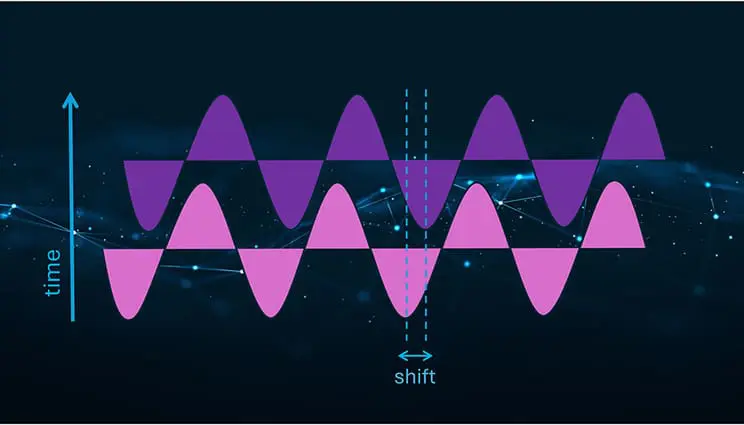
The researchers’ algorithm takes the initial state of the particle system as input, along with details about the interactions between the particles. It then simulates the scattering process in steps, tracking the collision’s impact using a detector and a variational “trick.” In quantum mechanics, particles also behave like waves, and when they scatter, their wave position shifts. At each step, the algorithm measures this shift by creating and varying a detector wave until it matches the particles’ wave.
The team first emulated the algorithm on a
The team first emulated the algorithm on a classical computer to ensure reliability. Once confidence was established, they ran simulations on IBM quantum processors. The variational trick employed to measure the shift in the wave of scattered particles proved resilient against the noise sources that challenge current advancements in quantum computing hardware.
The proposed algorithm’s robustness against quantum hardware noise, coupled with its scaling primarily driven by the dynamics of real-time evolution, represents a significant advancement in the field of quantum simulations. This method demonstrated on the simplest scattering process in the simplest scenario, can be extended to more complex processes that currently elude classical high-performance computing for all but the smallest number of particles.
The ability to simulate such scattering processes could lead to breakthroughs in understanding the behavior of matter at a microscopic level and the forces that govern the universe. As quantum computers continue to advance, we can expect to see more applications of this technology in scientific research, pushing the boundaries of our knowledge and potentially revolutionizing industries from materials science to drug discovery.
External Link: Click Here For More