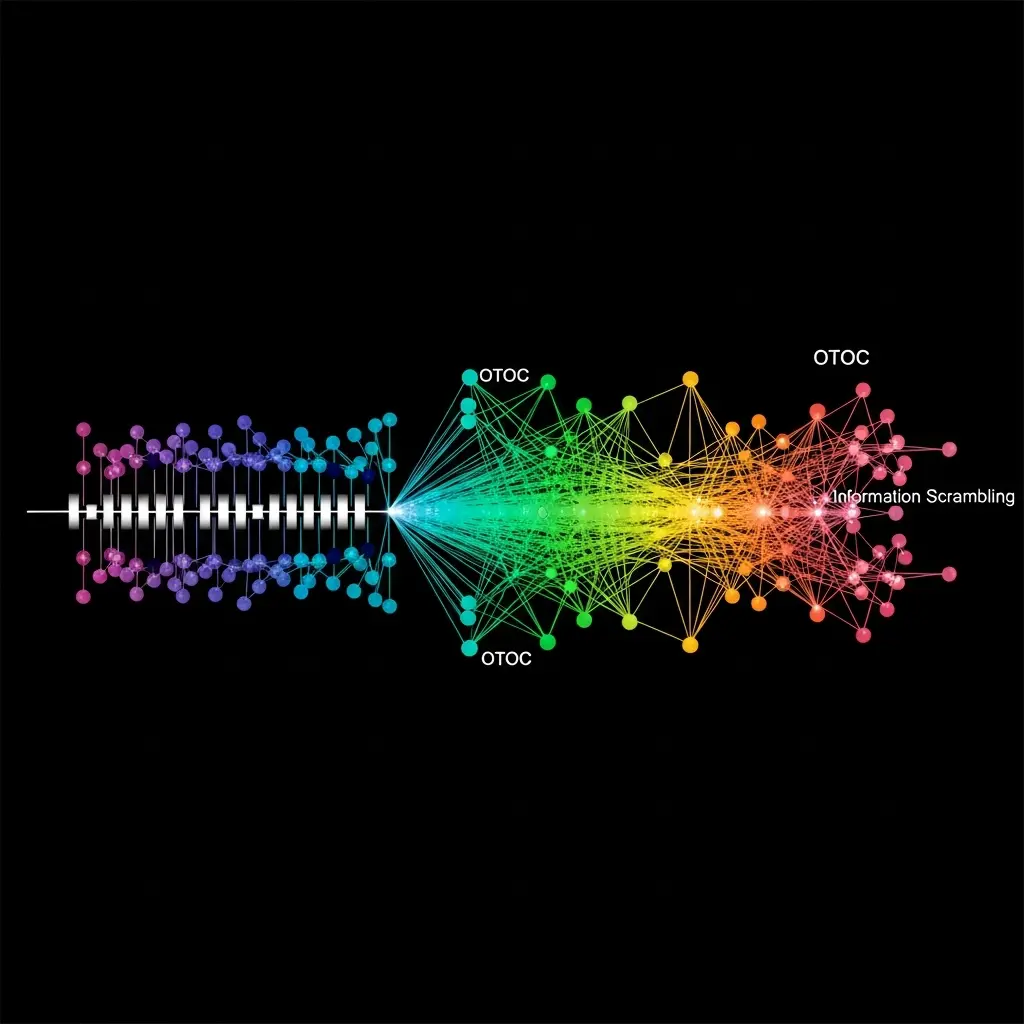
Information scrambling, the process by which information disperses and becomes inaccessible, lies at the heart of understanding chaotic systems, and scientists now have new tools to investigate it on quantum computers. Haruki Emori from Hokkaido University and RIKEN, alongside Hiroyasu Tajima from Kyushu University and JST, FORESTO, and their colleagues, demonstrate a method for measuring out-of-time-ordered correlators, a key indicator of this scrambling effect, using a quantum computer. Measuring these correlators is exceptionally difficult because it requires reversing the flow of time in a quantum system, a feat the team achieves with a novel approach called the irreversibility-susceptibility method, alongside comparisons with established techniques. This work represents the first experimental validation of this method on the reimei trapped-ion computer, and provides a crucial framework for future exploration of quantum chaos on emerging hardware, offering valuable insights into the behaviour of complex quantum systems.
Measuring the OTOC experimentally is challenging, requiring the simulation of time-reversed evolution, but recent work details an experimental evaluation of the OTOC on a quantum computer. Researchers employed three distinct protocols, including the rewinding time method and the weak-measurement method, to facilitate the observation and characterisation of quantum scrambling dynamics, offering insights into complex quantum systems and demonstrating a pathway for utilising quantum computers to investigate quantum chaos and information processing.
Quantum Thermodynamics, Fluctuation and Resource Theories
A comprehensive review of recent research reveals a vibrant field encompassing quantum thermodynamics, quantum simulation, and experimental implementations of these concepts. Core themes include quantum fluctuation theorems, exploring thermodynamic behaviour at the quantum level, and resource theories, quantifying quantum asymmetry and its potential for performing classically impossible tasks. Research also focuses on non-asymptotic quantum information theory, analysing quantum information processing in finite-size systems, and the design of quantum heat engines and refrigerators. Significant effort is dedicated to quantum simulation and many-body physics, including studies of out-of-equilibrium dynamics, Floquet systems, and time crystals.
Random quantum circuits serve as benchmarks for quantum computers and tools for understanding many-body phenomena, while researchers also investigate quantum phase transitions. A substantial body of work focuses on building and improving quantum computers, encompassing quantum error correction, algorithm development, and demonstrations of quantum supremacy or advantage, alongside advancements in quantum metrology and sensing. Key researchers driving these advancements include H. Tajima, M. Ozawa, and K.
Saito, who lead investigations into quantum thermodynamics and asymmetry. Google Quantum AI and Quantinuum are prominent companies developing superconducting and trapped-ion quantum computers, respectively, while researchers such as P. Zoller, C. Monroe, and B. Gadway contribute significantly to quantum simulation using trapped ions and neutral atoms.
This research can be broadly categorized into quantum thermodynamics, quantum simulation, quantum computing, quantum sensing, experimental implementations, and theoretical quantum information. Recent trends indicate a surge in research involving larger-scale quantum computers and continued focus on quantum thermodynamics. Earlier work established the foundational concepts in quantum thermodynamics and quantum information theory, paving the way for current investigations into increasingly complex quantum systems and technologies.
Information Scrambling Measured via Irreversibility-Susceptibility Method
Scientists have achieved the first experimental demonstration of the irreversibility-susceptibility method (ISM) for quantifying the out-of-time-ordered correlator (OTOC), a key measure of information scrambling. The work, conducted on a trapped-ion quantum computer, investigates the dynamics of an XXZ spin-1/2 chain prepared in a thermal state, providing new insights into how information spreads within a quantum system. Experiments directly access the OTOC, a notoriously difficult measurement requiring techniques to effectively reverse the flow of time in a quantum calculation. The team implemented three distinct protocols, the rewinding time method (RTM), the weak-measurement method (WMM), and the newly demonstrated ISM, to evaluate the OTOC and compare their performance.
Results demonstrate that each method exhibits unique behaviours when measuring the OTOC, offering a practical framework for future investigations. The ISM reframes the OTOC as the difficulty of recovering an initial quantum state, offering a novel perspective on information scrambling. Measurements confirm the ability to accurately assess the OTOC using the computer’s numerical emulator, reproducing results with high fidelity. Detailed analysis reveals crucial insights into the advantages and limitations of each method, validating their use as practical tools for exploring quantum chaos on near-term hardware. This research confirms the viability of quantum computers for studying fundamental concepts in quantum chaos and establishes a framework for future experimental investigations into information scrambling and operator spreading.
Experimental OTOC Measurement Validates Quantum Chaos
Researchers have conducted a comprehensive experimental evaluation of the out-of-time-ordered correlator (OTOC), a key measure of information scrambling, using a quantum computer. They successfully implemented and compared three distinct protocols, the rewinding time method, the weak-measurement method, and the irreversibility-susceptibility method, to overcome the challenges of measuring the OTOC, which requires simulating time-reversed evolution. These experiments focused on the dynamics of an XXZ spin-1/2 chain prepared in a thermal state, and importantly, demonstrate the first experimental realization of the irreversibility-susceptibility method. The team’s work validates these protocols as viable tools for investigating quantum chaos on current quantum hardware and provides valuable insights into the strengths and weaknesses of each approach.
Results reveal that each method exhibits unique characteristics: the rewinding time method benefits from conceptual simplicity, the weak-measurement method offers a connection to quasiprobability, and the irreversibility-susceptibility method directly links scrambling to irreversibility. Researchers identified previously unreported method-dependent behaviour in the measured OTOC, suggesting avenues for further investigation. Future research will focus on understanding the origins of the observed method-dependent behaviour, scaling these experiments to larger systems, and applying these techniques to different quantum models to broaden understanding of quantum dynamics. Improving the preparation of the initial quantum state and incorporating error mitigation strategies are also crucial steps toward achieving more accurate OTOC measurements on near-term quantum computers.
🗞 Measuring out-of-time-order correlators on a quantum computer based on an irreversibility-susceptibility method
🧠 ArXiv: https://arxiv.org/abs/2512.22643