

The behaviour of interacting quantum spins in geometrically frustrated systems continues to present a significant challenge to condensed matter physics. Muhammad Ahsan, from the University of Engineering and Technology Lahore, and colleagues now demonstrate a computational determination of the ground-state energy of a 125-site flat Kagome lattice, a particularly frustrated two-dimensional magnetic structure, using quantum computation. Their research utilises the Falcon and Hummingbird quantum processors to model the antiferromagnetic Heisenberg model (KAFH), where neighbouring spins prefer to align in opposite directions, leading to complex, non-magnetic ground states. By combining a hybrid variational eigensolver (VQE) approach – a quantum algorithm for finding the lowest energy state of a system – with a novel Hamiltonian engineering strategy, the team achieves a per-site ground-state energy estimate of -0.417J, closely approaching the established thermodynamic value of -0.438J, and demonstrating a pathway towards scalable quantum simulation of frustrated magnetism.
Estimating Magnetic Material Energy with Hybrid Quantum-Classical Computation
Recent research details a scalable approach to estimating the ground-state energy of a 125-site spin-1/2 Kagome Antiferromagnetic Heisenberg model (KAFH) using IBM’s Falcon and Hummingbird quantum processors. The Kagome lattice, named after a traditional Japanese basket weaving pattern, presents unique challenges in condensed matter physics due to its geometrically frustrated magnetic interactions. The Heisenberg model, a fundamental framework in quantum magnetism, describes the interactions between electron spins. Achieving a per-site ground-state energy estimate of -0.417J, which closely approaches the established thermodynamic value of -0.438J after open-boundary corrections, the study introduces a hybrid quantum-classical variational quantum eigensolver (VQE) framework.
VQE is a quantum algorithm that combines the strengths of both quantum and classical computation. It uses a quantum computer to prepare a trial wave function and estimate its energy, then employs a classical computer to optimise the parameters of the wave function to minimise the energy. This approach partitions computation into local (classical) and global (quantum) components, efficiently optimising a 103-qubit ansatz. An ansatz is a trial wave function used in VQE, and its complexity dictates the computational resources required.
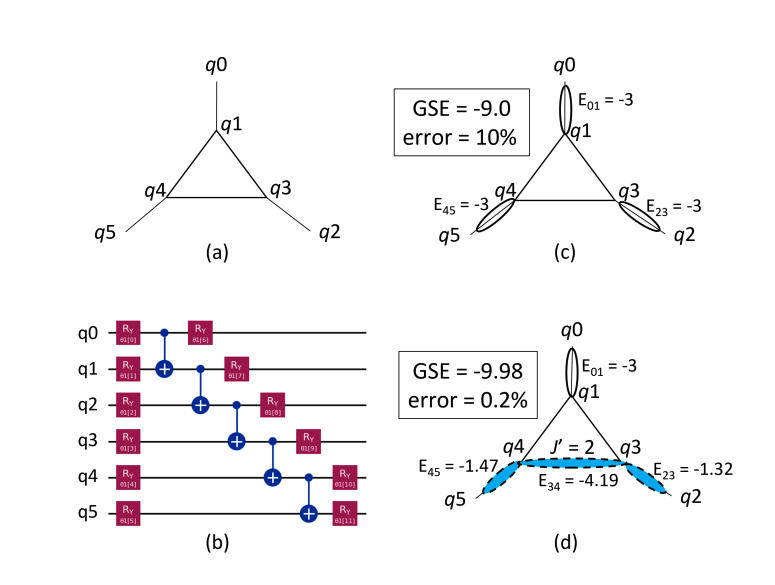
A key innovation lies in the application of Hamiltonian engineering, specifically modifying local exchange couplings to mimic loop-flip dynamics. This technique enhances the performance of a hardware-efficient ansatz by inducing quantum fluctuations and promoting a superposition of dimer covers, reminiscent of a resonating valence bond (RVB) spin-liquid state. By preserving the full 2D topology of the Kagome lattice, and employing localised Hamiltonian calibration, this work represents a step towards utility-scale quantum computation for frustrated magnetic systems.
Future research will likely focus on extending this methodology to larger lattices and exploring deeper ansatz circuits to capture more complex entanglement patterns. Investigating the potential of this approach for simulating other frustrated systems and characterising emergent topological phases represents a promising avenue for further exploration. The combination of Hamiltonian engineering with hybrid quantum-classical algorithms offers a viable pathway towards addressing challenging problems in condensed matter physics and materials science.
More information
Experimental Ground-State Energy of a 125-Site Flat Kagome Antiferromagnet via Hamiltonian Engineering on Quantum Computer
DOI: https://doi.org/10.48550/arXiv.2507.06361


