

Determining the precise three-dimensional structure of molecules remains a fundamental challenge in chemistry and materials science, yet conventional methods often struggle with complex systems. Now, researchers led by C. Zhang, R. G. Cortiñas, and A. H. Karamlou, alongside colleagues including N. Noll and J. Bausch, are pioneering a new approach that leverages the principles of quantum computation to extract structural information from molecular systems. The team demonstrates that measurements of subtle quantum correlations, known as out-of-time-ordered correlators, can be used to refine molecular models and accurately predict key structural features, such as bond lengths and angles, with precision comparable to traditional spectroscopic techniques. Crucially, they achieve this by performing the complex calculations required to interpret these quantum signals on a superconducting quantum processor, paving the way for a potentially scalable method to unlock the structures of increasingly complex molecules and materials.
NMR Reveals Molecular Distances and Angles
Scientists achieved a breakthrough in determining molecular structure using nuclear magnetic resonance (NMR) spectroscopy, demonstrating a novel method for extracting structural information that is challenging to obtain through conventional means. The research team measured out-of-time-ordered correlators (OTOCs) from two organic molecules suspended in a nematic liquid crystal, revealing how these measurements can augment molecular dynamics models and refine underlying force fields. Experiments demonstrated that OTOCs accurately estimate the mean ortho-meta H-H distance of toluene, achieving a value of 2. 47 ±0.
01 Å, and the mean dihedral angle of 3′,5′-dimethylbiphenyl, with comparable accuracy and precision to independent spectroscopic measurements. The team engineered a Time-Accurate Reversal of Dipolar InteractionS (TARDIS) pulse scheme to propagate information between spins within the molecule, effectively creating a “butterfly” effect that allows for the mapping of molecular connectivity. Measurements of the Loschmidt Echo and OTOCs revealed that the decay rate of the OTOC signal is sensitive to the distances between atoms, providing a means to infer structural parameters. Specifically, the research showed that a 0.
5 Å stretch or contraction of the molecule between the ortho- and meta- positions shifts the OTOC signal by up to 20%, demonstrating a strong correlation between molecular geometry and the measured signal. To translate this sensitivity into a practical tool for structure determination, scientists constructed a cost function to minimize error between experimental data and simulations, allowing them to estimate the ortho-meta H-H distance in toluene. The resulting estimate of 2. 47 ±0. 01 Å agrees with a reference value of 2.
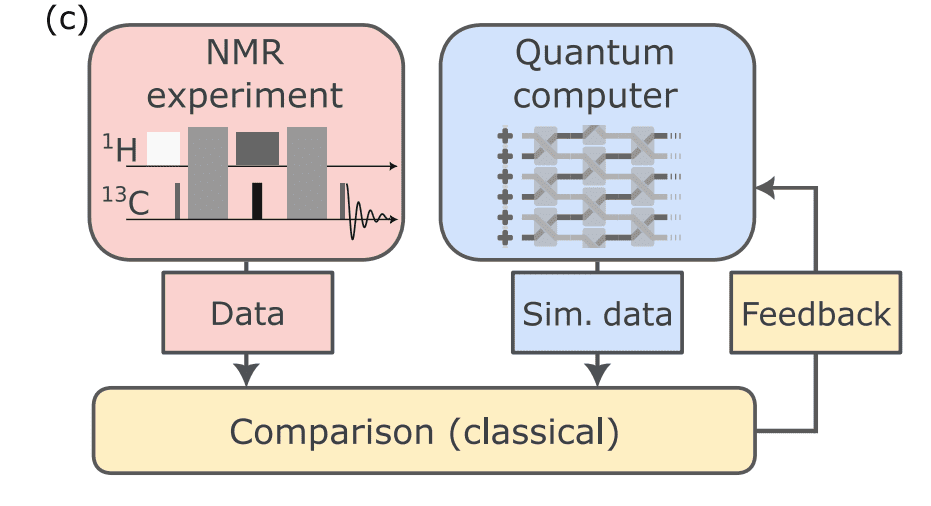
46 ±0. 01 Å, demonstrating comparable precision. To address the computational challenges of simulating OTOCs for larger molecules, the team implemented the scheme on a Willow superconducting processor, utilizing AlphaEvolve-optimized circuits and arbitrary-angle fermionic simulation gates. This work highlights a computational protocol for interpreting many-body echoes from nuclear magnetic systems using low-resource computation, paving the way for more efficient and accurate molecular structure determination.
OTOCs Refine Molecular Dynamics Simulations Precisely
This work demonstrates a novel approach to determining molecular structure and properties by leveraging out-of-time-ordered correlators (OTOCs) measured through nuclear magnetic resonance spectroscopy. Researchers successfully applied OTOC data to refine molecular dynamics models, improving the accuracy of estimations for key molecular characteristics such as interatomic distances and dihedral angles in toluene and dimethylbiphenyl. These estimations achieved precision comparable to independent spectroscopic measurements, highlighting the potential of this technique as a complementary method for structural analysis. To address the computational demands of interpreting OTOC data, the team implemented simulations on a superconducting quantum processor, utilizing optimized circuits and advanced error mitigation techniques, including novel zero-noise extrapolation methods. These techniques enabled accurate calculations despite the inherent challenges of quantum computation, paving the way for interpreting complex many-body echoes from nuclear magnetic systems with reduced computational resources.
👉 More information
🗞 Quantum computation of molecular geometry via many-body nuclear spin echoes
🧠 ArXiv: https://arxiv.org/abs/2510.19550

