Understanding how complexity arises in physical systems represents a major challenge in modern physics, and recent work by Meghadeepa Adhikary, Nishan Ranabhat, and Mario Collura from the International School for Advanced Studies and the University of Maryland, Baltimore County, sheds new light on this question. The team investigates the behaviour of key indicators of complexity, the Schmidt gap, von Neumann entanglement entropy, and non-stabiliserness, within a one-dimensional model exhibiting a classical phase transition. By employing a sophisticated computational technique based on tensor networks, they generate thermal states and reveal that these measures of complexity exhibit clear signatures even as the system approaches a classical thermal transition, demonstrating that complexity emerges as a fundamental characteristic near thermal criticality. This finding highlights the deep connection between complexity and thermal behaviour, offering valuable insights into the nature of physical systems approaching critical points.
Leveraging the time-dependent variational principle within a tensor-network formulation, the team simulated thermal states using purified tensor-network representations. The results demonstrate that these observables, typically considered hallmarks of quantum criticality, exhibit pronounced and coherent signatures even at a classical thermal transition, highlighting the emergence of quantum complexity as the system nears thermal criticality.
Long-Range Interactions and Quantum Many-Body Systems
This research focuses on understanding quantum many-body systems, particularly those with long-range interactions, and how these systems behave as they undergo phase transitions. The study explores the role of entanglement in these systems, employing various measures to characterize the quantum correlations present. Researchers utilize numerical methods, specifically tensor networks, to simulate these complex systems and gain insights into their properties. The work investigates specific models, including the Ising and Heisenberg models, and explores the behavior of entanglement in random spin chains and the Lipkin-Meshkov-Glick model.
The team also connects these investigations to the field of quantum computation, exploring how entanglement can be used as a resource for quantum information processing. They examine the creation of “magic states” and utilize resource theory to quantify the potential of entanglement for quantum computation. Furthermore, the research delves into the dynamical properties of quantum systems, studying their behavior after a sudden change or perturbation, and investigates dynamical deconfinement transitions. The study also explores topological phases of matter, identifying and characterizing these phases and examining the connection between entanglement and topological order.
Complexity Emerges at Classical Thermal Transitions
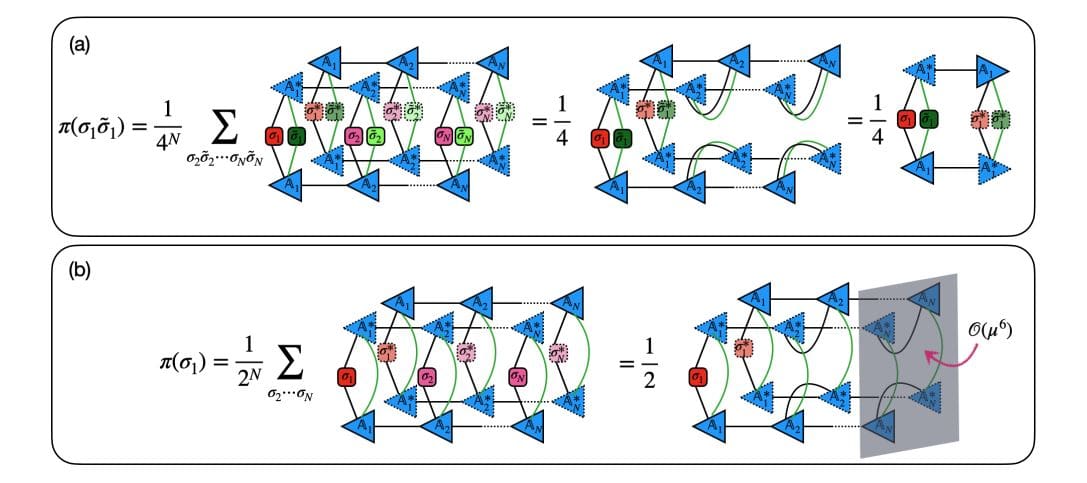
Scientists investigated the Schmidt gap, von Neumann entanglement entropy, and non-stabilizerness in the one-dimensional long-range transverse-field Ising model as it undergoes a classical phase transition. Employing the time-dependent variational principle within a tensor-network formulation, the team generated purified thermal states represented as Matrix Product Density Operators. Results demonstrate that these quantum observables, traditionally associated with criticality, exhibit pronounced signatures even at a classical thermal transition, revealing the emergence of complexity as the system approaches thermal criticality. The research focused on finite-size systems, scanning temperature to cross the paramagnetic-to-ferromagnetic transition for specific transverse fields and interaction exponents.
The team obtained Matrix Product States representations of the purified states, enabling direct evaluation of entanglement and quantum complexity measures. Measurements confirm that pronounced peaks in non-stabilizerness emerge at the thermal phase transition, signaling a sharp increase in quantum complexity precisely at criticality. Specifically, the study demonstrates that even classically describable mixed states exhibit rich quantum structure when represented in a purified form. The team’s analysis reveals that the Schmidt gap, a measure of entanglement spectrum separation, displays distinct behavior near the transition, indicating changes in the entanglement structure. Furthermore, calculations of stabilizer Rényi entropies, quantifying non-stabilizerness, show a significant increase in “magic”, the resources required for universal quantum computation, at the critical point. These findings bridge classical statistical mechanics, quantum information theory, and experimental quantum simulation platforms, providing a unified picture of how classical phase transitions can manifest quantum complexity.
Quantum Signatures in Classical Thermal Transitions
This research demonstrates that hallmarks of quantum criticality, specifically the Schmidt gap and non-stabilizerness, exhibit pronounced signatures even at a classical thermal transition in the long-range transverse-field Ising model. By representing thermal states as purified quantum states within a tensor network framework, the team reveals that these quantum measures capture genuine correlations not readily apparent in classical descriptions of the system. The findings suggest that classical thermal states can possess nontrivial quantum features at criticality, offering new avenues for exploring the interplay between classical statistical phenomena and quantum complexity. The study successfully computed the Schmidt gap of the entanglement spectrum and measures of quantum complexity, such as non-stabilizerness, to characterize the quantum resources inherent in thermal states. While acknowledging that entanglement alone does not guarantee quantum computational advantage, the research highlights the potential of stabilizer Rényi entropies as a rigorous tool for quantifying the complexity of quantum states. The authors note limitations in extrapolating results to systems with different interaction exponents and suggest future work could focus on exploring the behavior of these quantum probes across a wider range of parameters and system sizes to further refine understanding of the connection between classical and quantum criticality.
👉 More information
🗞 Quantum complexity across thermal phase transition in the transverse field Ising chain with long-range couplings
🧠 ArXiv: https://arxiv.org/abs/2511.13667