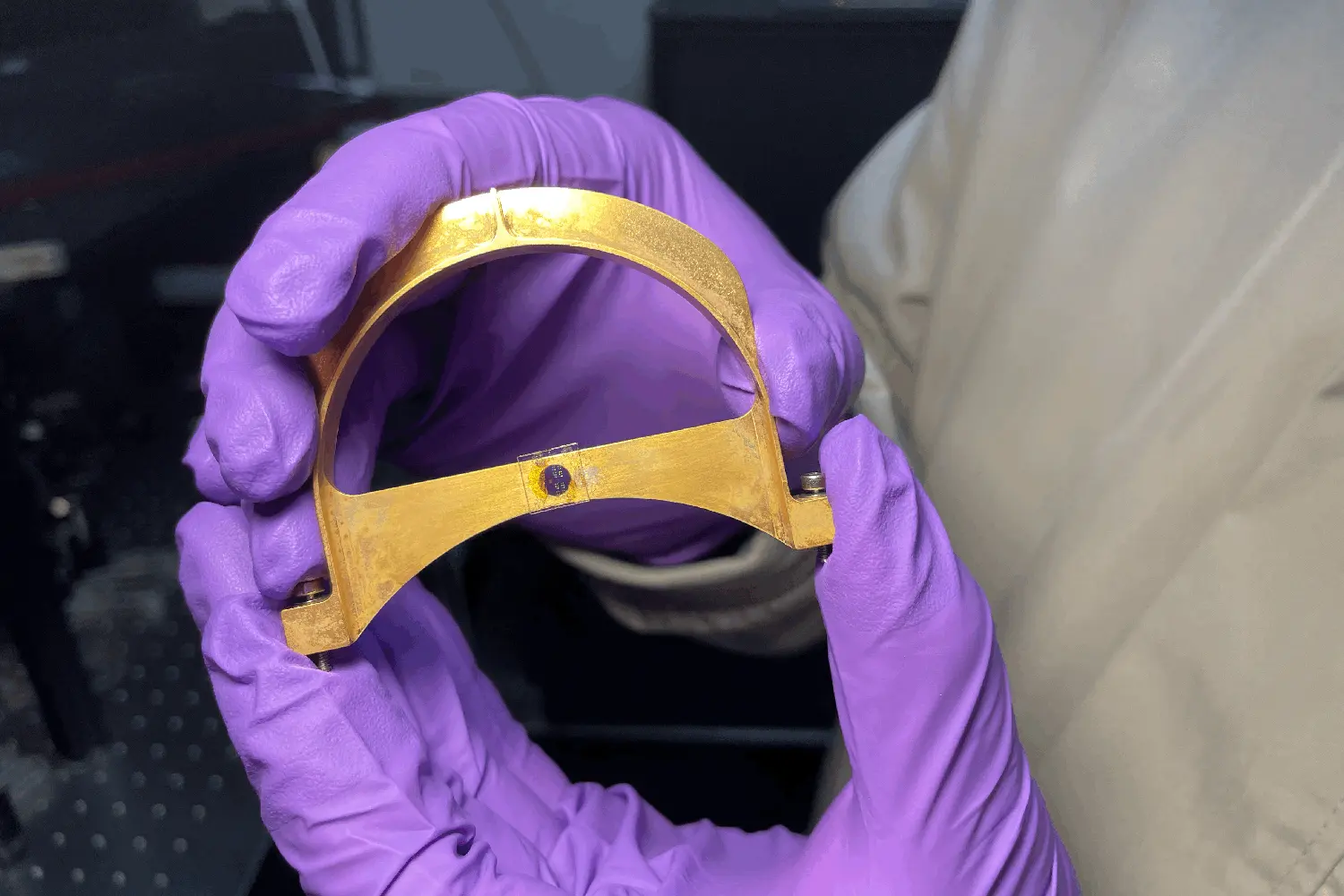
Materials scientists at Stanford University, led by Professor Jennifer Dionne and postdoctoral scholar Feng Pan, have developed a nanoscale optical device capable of achieving quantum communication at room temperature. The device utilizes twisted light generated from a patterned layer of molybdenum diselenide (MoSe2) atop a silicon substrate to entangle the spin of photons and electrons. This innovative approach stabilizes quantum states—essential for effective communication—without the need for super-cooling, potentially overcoming a major limitation of current quantum systems which require operation near absolute zero. The breakthrough paves the way for smaller, simpler, and more cost-effective quantum components.
Room-Temperature Quantum Communication Device Developed
Researchers at Stanford University have developed a room-temperature quantum communication device, a significant advancement as traditional quantum systems require extremely low temperatures—near absolute zero (-459°F)—to operate. This new device utilizes a nanoscale optical system made of molybdenum diselenide (MoSe₂ ) layered on a silicon substrate. By manipulating light—creating “twisted light”—researchers can entangle photons and electrons, stabilizing quantum states necessary for communication without the need for super-cooling, potentially reducing cost and complexity.
The device leverages transition metal dichalcogenides (TMDCs), specifically molybdenum diselenide, for its favorable optical properties. Silicon nanostructures enable the creation of twisted light, imparting spin to electrons which are essential for quantum computing. This “twisting” allows for entanglement, creating qubits—the foundational unit of quantum communication—and overcoming a major limitation of previous systems where electrons quickly lost their spin, hindering useful communication.
This breakthrough has the potential to reshape fields like cryptography, computing, and artificial intelligence. The researchers are currently working to refine the device, explore other materials, and integrate it into larger quantum networks. Their ultimate goal is to miniaturize these quantum systems, envisioning a future where quantum computing could potentially be embedded in everyday devices like cell phones, though this remains a long-term (10+ year) plan.
Key Materials and Device Functionality
Utilizing a thin layer of molybdenum diselenide (MoSe₂) placed atop a silicon substrate, the device achieves quantum communication. This material, a transition metal dichalcogenide (TMDC), possesses favorable optical properties. Crucially, patterned nanostructures within the silicon enable “twisted light” – photons spun in a corkscrew fashion. This twisted light imparts spin to electrons, a vital component of quantum computing, creating a stable spin connection necessary for quantum communication.
The innovation lies in achieving this entanglement at room temperature, bypassing the need for super-cooling to near absolute zero (-459°F). Traditional quantum systems require extreme cold to prevent the loss of qubit stability – or “decoherence.” The MoSe₂ and silicon combination efficiently confine and enhance light twisting, stabilizing the quantum state and enabling practical quantum communication. This advancement addresses a significant hurdle in developing cost-effective and accessible quantum technologies.
This device’s functionality relies on manipulating photons and electrons at the nanoscale. The silicon nanostructures are imperceptible to the human eye, approximately the size of visible light wavelengths. By precisely controlling the spin of photons, researchers can entangle them with the spin of electrons to create qubits – the foundational unit of quantum communication. Further refinement aims to integrate the device into larger quantum networks, potentially enabling quantum computing in everyday devices within a decade or more.
It provides a very versatile, stable spin connection between electrons and photons that is the theoretical basis of quantum communication. Typically, however, the electrons lose their spin too quickly to be useful.
Jennifer Dionne
Overcoming Challenges in Quantum Computing
Researchers are addressing challenges in quantum computing by developing a device that operates at room temperature, eliminating the need for super-cooling—traditionally requiring temperatures near -459 degrees Fahrenheit. This nanoscale optical device utilizes molybdenum diselenide (MoSe2) and patterned silicon to entangle photons and electrons. This innovation aims to stabilize quantum states, crucial for effective communication, and overcome a major obstacle to building practical quantum systems that are currently large, expensive, and impractical due to extreme cooling requirements.
The device achieves entanglement through “twisted light,” where photons spin in a corkscrew fashion, imparting spin onto electrons. This process creates qubits—the foundational unit of quantum communication and computation—without the energy demands of super-cooling. The team targeted transition metal dichalcogenides (TMDCs) like MoSe2 for their favorable optical properties, efficiently confining and enhancing light twisting to create a strong coupling between photons and electrons, which stabilizes the quantum state.
Currently, researchers are refining the device and exploring other TMDC combinations to further improve quantum performance. The long-term vision involves miniaturizing these quantum systems for integration into everyday devices, potentially enabling quantum computing in a cell phone—though this is considered a 10+ year plan. Developing better light sources, modulators, detectors, and interconnects are key next steps for building larger quantum networks.
Potential Applications and Future Research
Researchers are currently working to refine the nanoscale optical device and explore other transition metal dichalcogenides (TMDCs) and material combinations to achieve even greater quantum performance. The goal is to potentially reveal additional quantum functionalities not currently possible at room temperature. Additionally, the team is investigating ways to integrate the device into larger quantum networks, requiring improvements in light sources, modulators, detectors, and interconnects for broader application.
The device utilizes a thin layer of molybdenum diselenide (MoSe₂) atop a silicon substrate to manipulate photons—specifically, twisting them to impart spin onto electrons. This process is key to creating qubits, the foundational unit of quantum communication and computation. By efficiently confining and enhancing this twisting of light, the device stabilizes the quantum state necessary for communication, overcoming the need for extreme super-cooling traditionally required for qubit stability.
The ultimate vision is to miniaturize these quantum systems to the point of embedding them into everyday devices, with a long-term goal of quantum computing potentially being achievable in a cell phone – though researchers estimate this is still more than ten years away. This advancement could reshape fields like cryptography, sensing, computing, and artificial intelligence, by offering a pragmatic and low-cost alternative to existing quantum technologies.