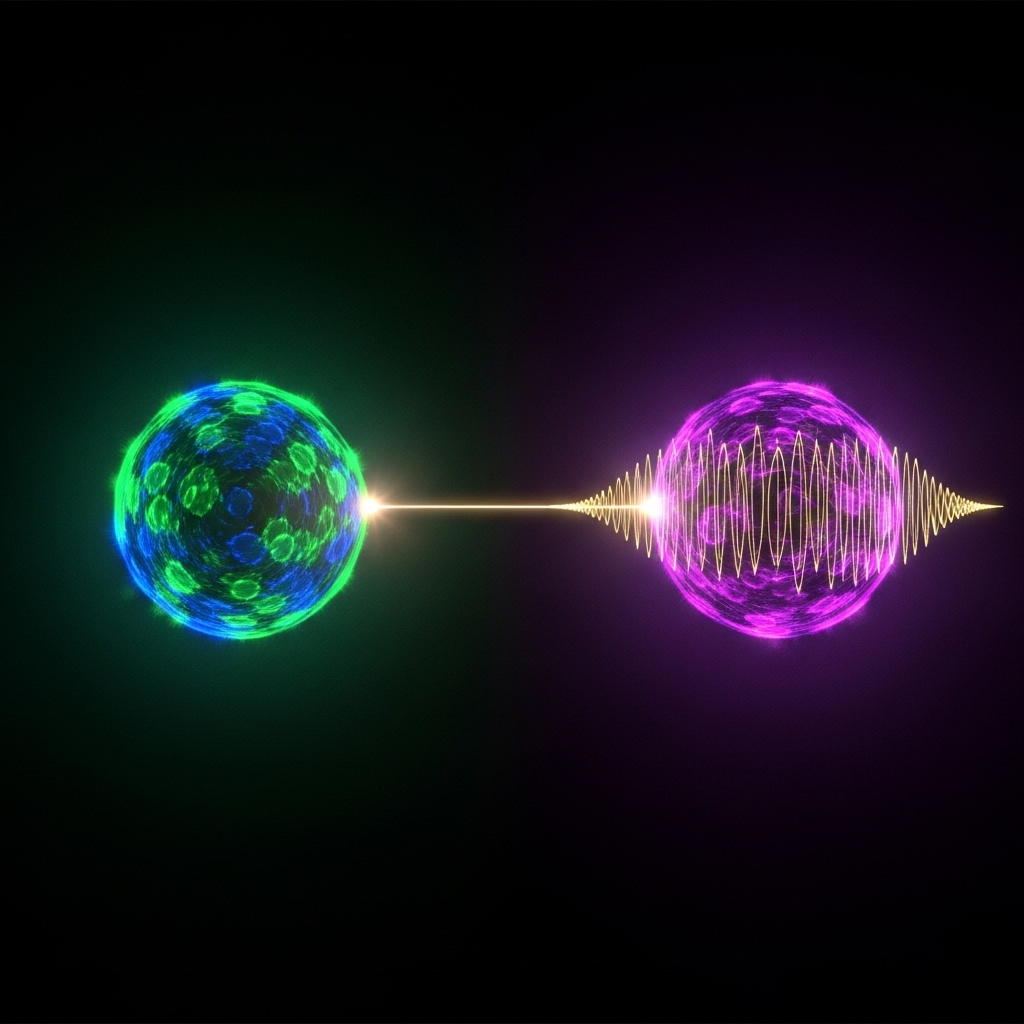
Scientists are continually seeking methods to transmit quantum information with greater efficiency and resilience, and a new study details a significant advance in high-dimensional quantum coherence teleportation. Long Huang and Cai-Hong Liao, both from the School of Information Engineering at Jiangxi University of Science and Technology, alongside Yan-Ling Li and Xing Xiao working with colleagues at the School of Physics and Electronic Information, Gannan Normal University, present a resource-efficient protocol that substantially reduces the classical communication overhead typically associated with teleporting complex quantum states. Their research demonstrates a 50% reduction in classical bits and scales measurement complexity, paving the way for practical implementation of high-dimensional quantum networks. By employing initial phase engineering and carefully designed measurement schemes, the team shows that near-perfect coherence teleportation is achievable, even in the presence of operational errors and various noise models, highlighting the expanding advantages of utilising higher-dimensional quantum systems for secure and efficient communication.
Scientists are pioneering a new approach to quantum teleportation that dramatically reduces the resources needed to transmit information via high-dimensional quantum states, addressing a critical bottleneck in scaling up quantum networks due to the exponential increase in complexity as dimensionality increases. Researchers have developed a resource-efficient high-dimensional coherence teleportation (REHDCT) protocol that cuts the classical communication overhead in half and simplifies measurement requirements from scaling with the square of the dimension (O(d²)) to scaling linearly (O(d)). By designing measurement bases and employing initial phase engineering, the team demonstrates the potential for theoretically perfect coherence transfer for any quantum state. The study establishes a pathway toward practical, hardware-friendly quantum communication networks capable of transmitting information more reliably and efficiently by focusing on teleporting quantum coherence, the property enabling superposition, rather than the complete quantum state, significantly reducing demands on physical resources. Quantitative analysis reveals the protocol maintains over 99.6% efficiency even with minor operational errors, specifically a 0.1 radian phase deviation for a 16-dimensional system. Furthermore, the research confirms that high-dimensional systems inherently offer greater resilience to noise, expanding the operational window where quantum advantages are maintained. Under specific noise conditions, such as dit-flip noise, the protocol can even restore perfect coherence teleportation through strategic selection of the measurement basis. These findings position REHDCT as a viable framework for building future high-dimensional quantum networks, offering a substantial improvement over existing methods in terms of resource efficiency and robustness. The innovation lies in a shift from resolving a quadratic number of Bell states to leveraging a carefully crafted set of positive operator-valued measure (POVM) bases, streamlining the process and reducing the burden on detection systems. By designing specialised positive operator-valued measure (POVM) bases, the research achieves a 50% reduction in classical communication overhead, scaling measurement complexity from O(d²) to O(d) in high-dimensional systems. This simplification is crucial as standard teleportation protocols suffer from quadratic growth in measurement complexity with increasing dimensionality. The protocol utilizes initial phase engineering to align the target qudit with the measurement basis, theoretically enabling perfect teleportation of coherence for arbitrary qudit states. Quantitative analysis demonstrates high resilience to operational errors, maintaining a coherence teleportation efficiency above 99.6% even with a 0.1 rad phase deviation for a d-dimensional system. The study rigorously evaluates coherence teleportation efficiency for arbitrary qudit states under amplitude damping, phase flip, depolarizing, and dit-flip noise models, revealing that increasing the dimensionality, ‘d’, shifts noise thresholds towards higher regimes, confirming the inherent advantages of high-dimensional systems for noise-tolerant tasks. Specifically, the research establishes that perfect coherence teleportation can be restored under dit-flip noise through optimal selection of the POVM basis, achieved by partitioning the standard d² high-dimensional Bell state measurements into d composite elements, effectively reducing the number of measurement outcomes. The l1-norm of coherence, used to quantify the quantum coherence teleported, adheres to constraints ensuring a valid coherence measure within quantum resource theory, exhibiting zero coherence for incoherent states and non-increase on average under selective incoherent operations. Calculations demonstrate that Bob’s received state collapses to a density matrix ρΠyx B, where the coherence is directly related to the initial state ρT and the measurement operator Πy.
A set of positive operator-valued measure (POVM) bases underpins the resource-efficient high-dimensional coherence teleportation (REHDCT) protocol, reducing the classical communication overhead inherent in high-dimensional systems. This reduction is achieved by leveraging one of the designed POVM sets during the measurement process, offering a significant advantage over conventional approaches. To further enhance coherence transfer, initial phase engineering aligns the target qudit, a quantum digit analogous to a qubit but existing in higher dimensions, with the selected measurement basis. The study employs a novel method for calculating the final state received by Bob, the recipient of the teleported coherence, applicable to both ideal and noisy conditions. This approach represents quantum noise and measurement processes as distinct mappings, denoted as G and J∗E, providing a framework for analysing the impact of imperfections. Crucially, the research demonstrates that when dealing with a maximally entangled shared state, bilateral noise mapping can be converted into an equivalent one-sided mapping, simplifying the analysis. The work utilizes the widely adopted Kraus operator formalism, which describes the evolution of quantum states under various disturbances, allowing for the precise representation of different noise environments through specific Kraus operators. The protocol’s performance is then assessed by examining the effects of four representative noise models, amplitude damping, phase flip, depolarizing, and dit-flip, on the teleported coherence. Furthermore, the study introduces a detailed analysis of measurement mapping, J∗E, corresponding to each POVM element, Πyx, essential for determining the final state of the teleported qudit, accounting for both the initial quantum state and the effects of noise. By combining these mappings, the research establishes a robust method for quantifying the efficiency of coherence teleportation under diverse noise conditions, revealing an expanding advantage window as the dimensionality of the qudit increases. Scientists have long recognised that increasing the dimensionality of quantum systems offers a pathway to more robust information processing, but the escalating resource demands as complexity grows have presented a challenge, specifically the difficulty of reliably ‘teleporting’ quantum states between locations without introducing errors. This new work offers a significant step towards overcoming that hurdle, demonstrating a method for high-dimensional coherence teleportation that substantially reduces the classical communication overhead typically associated with the process. The implications extend beyond fundamental quantum mechanics, as practical quantum networks, essential for distributed quantum computing and secure communication, require the ability to transfer quantum information over significant distances, and reducing the classical signalling needed to verify that transfer is crucial. This research suggests a viable architecture for such networks, one that doesn’t demand an impractical amount of classical data processing. The demonstrated resilience to operational errors and various noise models is encouraging, but real-world devices will inevitably exhibit more complex and unpredictable behaviour. Furthermore, the focus remains on coherence teleportation, transferring the quantum ‘oscillation’ of a state, rather than the full quantum state itself, which presents a separate set of challenges. Looking ahead, the next logical step is to integrate this resource-efficient protocol into a functioning quantum network demonstrator, and beyond that, exploring how this approach can be combined with error correction techniques and extended to teleportation of more complex quantum states will be vital, as the field moves towards harnessing the power of higher dimensions, and this work provides a valuable tool for building the infrastructure to do so.
👉 More information
🗞 Resource-Efficient Teleportation of High-Dimensional Quantum Coherence via Initial Phase Engineering
🧠 ArXiv: https://arxiv.org/abs/2602.11869