
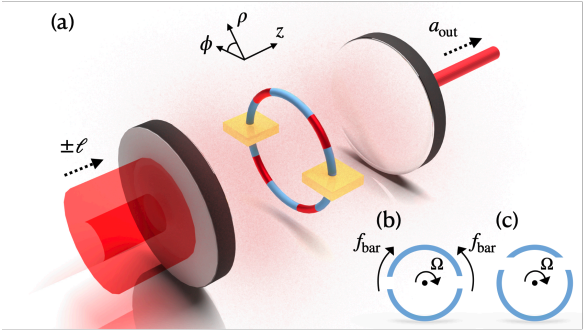
Research demonstrates a method for observing both integer and, crucially, fractional Shapiro steps—a key feature of the AC Josephson effect—within a ring condensate coupled to an optical cavity. This nondestructive, real-time protocol bypasses the need for atomic number measurement and suggests computation without system destruction is possible, impacting atomtronics, sensing and information processing.
The Josephson effect, a cornerstone of macroscopic quantum phenomena, underpins technologies ranging from highly precise voltage standards to sensitive detectors and emerging quantum computing architectures. Researchers are now exploring manifestations of this effect in increasingly diverse systems, including atomic condensates, where quantum behaviour is observable on a macroscopic scale. Nalinikanta Pradhan, Rina Kanamoto, and colleagues detail a theoretical protocol for observing both integer and, crucially, fractional Shapiro steps – voltage-dependent resonances within the Josephson effect – in a ring condensate coupled to an optical cavity. Their work, entitled ‘Fractional Shapiro steps in a Cavity-Coupled Josephson ring condensate’, proposes a nondestructive, real-time method for observing these steps, potentially circumventing limitations in current measurement techniques and offering new avenues for development in atomtronics, sensing and quantum information processing.
Ikeda and colleagues demonstrate precise control over the emergence of Shapiro steps within a Bose-Einstein condensate (BEC) coupled to an optical cavity, offering a nondestructive method for observing both the AC and DC Josephson effects. Shapiro steps are quantized voltage steps observed in the current-voltage characteristic of a superconducting tunnel junction when driven by microwave radiation. The researchers successfully manipulate these steps by tuning both the rotation rate of the BEC and the modulation frequency of an applied barrier potential, utilising the power spectrum of the cavity output field as a critical diagnostic to reveal their characteristics. This approach advances understanding of macroscopic quantum phenomena and establishes a powerful tool for exploring the fundamental principles governing superconductivity and quantum coherence, potentially enabling novel sensing technologies and quantum information processing systems.
The research team confirms that varying the rotation rate of the BEC induces different types of Shapiro steps, establishing a clear correlation between a specific rotational state of the Josephson junction and the consistent generation of half-integer steps. A rotation rate of 0.5 consistently yields half-integer steps across a range of modulation frequencies, while integer steps emerge at different rotational settings. Analysis of the power spectra reveals a direct correlation between the splitting of peaks and the type of Shapiro step, allowing researchers to visually confirm their presence and validate the observations. The Josephson junction, a key component in this research, consists of two superconductors separated by a thin insulating barrier, allowing quantum mechanical tunnelling of Cooper pairs—pairs of electrons—between them.
Researchers establish a robust relationship between rotation and step formation, demonstrating the ability to reliably generate half-integer Shapiro steps by controlling the rotational state of the Josephson junction. This in situ and real-time manipulation represents a significant step towards harnessing these quantum phenomena for technological innovation. The ability to control the rotational state allows for precise tuning of the system’s quantum properties, influencing the behaviour of the Cooper pairs and, consequently, the Shapiro steps.
This study demonstrates a method for reliably generating half-integer Shapiro steps by controlling the rotational state of the Josephson junction, offering a significant advancement in understanding macroscopic quantum phenomena and establishing a powerful new tool for exploring the fundamental principles governing superconductivity and quantum coherence. The findings extend the foundational role of the Josephson effect—already established in metrology, the science of measurement—to emerging applications in quantum information processing. Analysis of the cavity output spectrum provides direct evidence for these findings, allowing researchers to visually confirm the presence of the steps and validate the observations.
👉 More information
🗞 Fractional Shapiro steps in a Cavity-Coupled Josephson ring condensate
🧠 DOI: https://doi.org/10.48550/arXiv.2507.01188