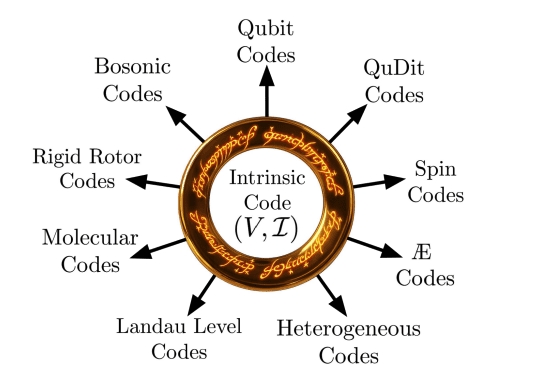
The pursuit of robust quantum error correction represents a major challenge in building practical quantum computers, and researchers continually seek more efficient and versatile coding strategies. Eric Kubischta from Florida State University and Ian Teixeira from University of California, San Diego, now present a fundamentally new approach to quantum coding, defining what they term ‘intrinsic codes’ based on the mathematical relationship between intrinsic and extrinsic geometry. This work establishes that a single, underlying code can dictate the properties of all its physical realisations, effectively unifying diverse coding schemes under a common symmetry and offering a powerful new lens through which to understand and design quantum error correction. By identifying one intrinsic code, scientists gain insight into the behaviour of all its possible physical implementations, potentially streamlining the development of fault-tolerant quantum computation.
By identifying a single intrinsic code, researchers simultaneously uncover properties applicable to all its physical realizations. This approach unifies diverse fault-tolerant schemes across different platforms through a single underlying symmetry. Quantum error correction typically specifies a code within a particular physical system and analyses its robustness against specific errors. However, recent developments suggest that error-protection properties reflect deeper algebraic and symmetry structures.
Intrinsic Codes and Group Representation Mapping
The study pioneers a novel approach to quantum error correction, framing codes not as specific hardware implementations, but as intrinsic geometric structures within group representations. Researchers define an intrinsic code as a subspace within a group representation, establishing that any physical realization of this code inherently possesses specific error-correcting properties. This allows for the simultaneous determination of properties across diverse code realizations through identification of a single intrinsic code. The team demonstrates this principle using a minimal intrinsic code within SU(2), revealing its presence in seemingly disparate systems.
To explore this concept, scientists investigated several physical systems, meticulously mapping the code onto each. In diatomic molecules, the code appears within the rotational Hilbert space, specifically in the l=2 sector, forming logical states defined by spherical harmonics. This embedding detects first-order rotational errors and momentum kicks, effectively suppressing perturbations. A similar approach was applied to rigid rotors, where the code resides within the l=2 manifold, yielding a generalized absorption-emission code that protects against both left and right rotations, as well as orientation perturbations.
Further investigations extended to molecules with rotational symmetry, such as sulfur dioxide, where the code’s presence in the l=2 sector generates a family of molecular codes. Researchers also explored Landau level systems, demonstrating the code’s appearance with integral monopole charge, resulting in codewords defined by monopole harmonics. In each case, the team rigorously established that the intrinsic code structure dictates the types of perturbations suppressed by the physical embedding. This work demonstrates that diverse quantum error correction schemes are simply different manifestations of a single underlying geometric structure, offering a compactified approach to fault-tolerant quantum computation.
Schur-Bootstrap Links Abstract and Physical Quantum Codes
This work introduces a novel framework, termed the “Schur-Bootstrap”, that establishes a direct link between intrinsic and extrinsic quantum codes, fundamentally altering how error protection can be understood and implemented. Scientists demonstrate that by defining a code within an abstract mathematical space, an “intrinsic code”, they simultaneously uncover properties applicable to any physical realization of that code, an “extrinsic code”. This breakthrough delivers a powerful method for “bootstrapping” error protection from the abstract to the physical realm, leveraging the mathematical principle of Schur’s lemma. The core of this achievement lies in defining an intrinsic code as a subspace within a group representation, allowing researchers to analyze error-correcting properties independent of any specific physical system.
Experiments reveal that if an intrinsic code satisfies the Knill-Laflamme (KL) condition within a specific mathematical sector, then any physical realization of that code will also satisfy the KL condition in the corresponding sector. This means that the abstract properties of the intrinsic code are automatically inherited by its physical manifestation. Further strengthening this framework, the team proves that if the intrinsic code possesses a certain symmetry, specifically if it is “G-covariant”, then the resulting physical code will also exhibit that symmetry, enabling the implementation of logical operations. To illustrate the power of this approach, scientists examined a 5-dimensional intrinsic code within SU(2), defining codewords as linear combinations of basis states. Measurements confirm that this intrinsic code, defined by just two codewords, provides error protection against specific types of errors, and this protection is automatically transferred to any physical realization of the code. This work dramatically generalizes previous results and opens new avenues for designing and implementing robust quantum error correction schemes.
Symmetry Unifies Quantum Error Correction Schemes
This research establishes a new, representation-theoretic formulation of quantum error correction, defining a quantum code as a subspace within a group representation, termed an ‘intrinsic code’. The team demonstrates that identifying a single intrinsic code simultaneously reveals the properties of all its physical implementations, unifying diverse coding schemes under a common symmetry principle. This approach effectively links codes through underlying symmetries, offering a powerful framework for understanding and designing fault-tolerant quantum systems. The findings demonstrate a form of ‘compactification’ for error correction, where the same level of error suppression achievable with larger qubit systems can be realised using fewer, higher-dimensional sites, or even single, multi-level systems, without compromising logical gate structures.
This interpolation between architectures suggests that designing effective quantum codes can be reduced to a tractable, representation-theoretic problem focused on lower-dimensional spaces, potentially accelerating the discovery of new codes and transversal gate structures applicable across various quantum platforms. The authors acknowledge that this work focuses on the theoretical framework and does not yet address the practical challenges of implementing these codes in physical hardware. Future research directions include exploring specific physical realisations of these intrinsic codes and investigating their performance in realistic noise environments. The team also intends to further investigate the connection between intrinsic codes and the development of novel, efficient quantum gate structures.
👉 More information
🗞 Intrinsic Quantum Codes: One Code To Rule Them All
🧠 ArXiv: https://arxiv.org/abs/2511.14840