

Understanding how to protect quantum information from errors remains a central challenge in building practical quantum computers, and recent work suggests viewing this protection as a dynamic process rather than a fixed code. Arthur Pesah, Austin K. Daniel, Ilan Tzitrin, and colleagues at Xanadu Quantum Technologies Inc., alongside institutions including University College London and the Perimeter Institute for Theoretical Physics, now present a new mathematical framework for analysing and transforming these error-correcting codes, known as spacetime codes. Their approach uses concepts from chain complexes to characterise codes and demonstrate how to convert between them while preserving crucial properties like the number of protected qubits and the code’s ability to withstand errors. This advancement extends the construction of powerful cluster states, essential for measurement-based quantum computation, beyond traditional codes, enabling the creation of these states from a wider range of quantum error correction schemes and logical operations, and represents a significant step towards robust and scalable quantum technologies.
This research investigates fault-tolerant transformations of spacetime codes, focusing on performing logical operations without compromising encoded quantum information. The team introduces a framework for analysing and constructing these transformations, based on the concept of ‘code surgery’, where the code structure is locally modified to implement desired operations. Specifically, they develop techniques to perform logical qubit rotations and controlled-NOT gates using these transformations, demonstrating their feasibility and efficiency. This approach leverages the inherent structure of spacetime codes to minimise the resources required for fault-tolerant computation, offering a potential pathway towards practical quantum computation.
Spacetime Codes and Circuit-Level Error Correction
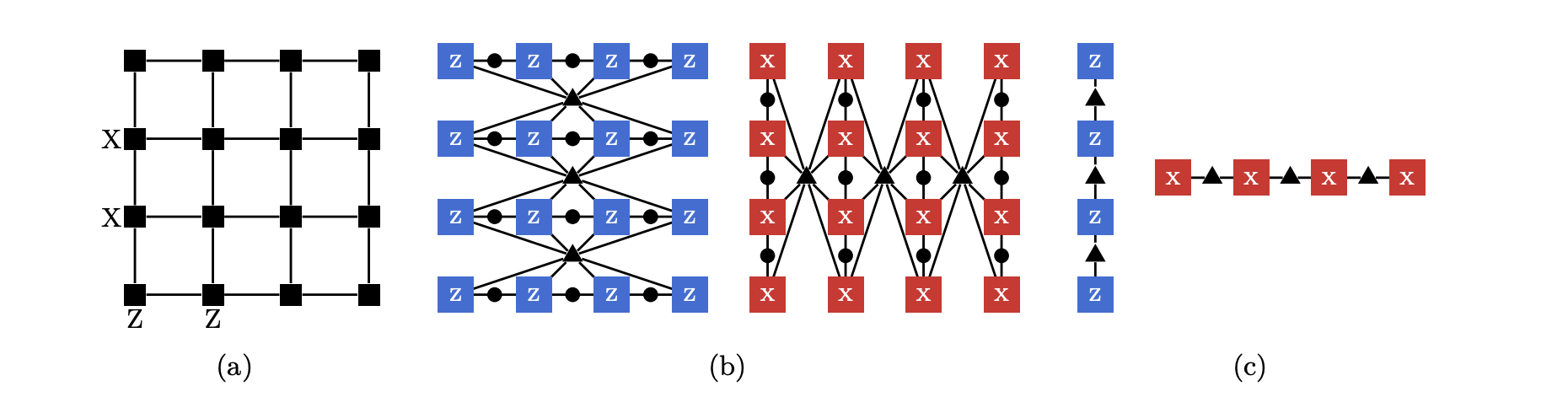
This research presents a circuit-level approach to quantum error correction, framing it as a dynamic process involving redundant measurements that correct errors. Spacetime codes provide a natural framework for understanding this circuit-level error correction while utilising established quantum error correction techniques. The team introduces a framework based on chain complexes and chain maps to model spacetime codes and transformations between them, demonstrating that stabiliser codes, quantum circuits, and decoding problems can all be described using these mathematical tools. The equivalence of two spacetime codes is characterised by fault-tolerant maps between chain complexes, which preserve the number of encoded qubits, fault distance, and the minimum-weight decoding problem. As an application, the researchers extend the construction of foliated cluster states from stabiliser codes to encompass any spacetime code, showing that any Clifford circuit can be transformed into a measurement-based protocol retaining the same fault-tolerant properties.
Early Quantum Error Correction Foundations Established
The field of quantum error correction has seen substantial development, with research establishing core principles and exploring advanced techniques to protect quantum information and build fault-tolerant quantum computers. Initial research, including the work of Steane, Laflamme, and Shor, introduced the fundamental concept of quantum error correction, while Nielsen explored measurement-based error correction. Calderbank and Shor, along with Steane, developed CSS codes, a fundamental class of error-correcting codes, and Bacon introduced operator quantum error-correcting subsystems, important for self-correcting memories. Current research focuses on topological codes and surface codes, considered the most promising approaches for large-scale quantum computation.
Raussendorf and Briegel introduced one-way quantum computation and cluster states, while Hastings and others explored long-range entanglement and topological fault tolerance. Horsman and colleagues developed lattice surgery for manipulating surface code qubits, and Bombin introduced gauge color codes, offering potentially improved performance. Yoder and colleagues explored concatenated stabiliser codes, and Bombin developed topological quantum distillation for improving code quality. Further research concentrates on code construction and optimisation, designing better codes with lower overhead and higher thresholds.
Reichardt and Paetznick explored transversal gates, simplifying fault tolerance, while Chamberland and Beverland developed flag codes as a promising alternative to surface codes. Higgott and Breuckmann developed subsystem codes with high thresholds and explored hyperbolic and semi-hyperbolic Floquet codes. Zhang and colleagues developed the X-cube Floquet code, while Dua and colleagues engineered 3D Floquet codes. Bauer explored topological error correcting processes, and Cowtan and Burton developed CSS code surgery as a universal construction. Ide and colleagues developed fault-tolerant logical measurements, and Poirson and colleagues compiled any CNOT in any code.
A relatively new area explores time-periodic (Floquet) codes for improved performance. Haah and Hastings established boundaries for the Honeycomb Code, while Sullivan and colleagues explored Floquet codes and phases in twist-defect networks. Fahimniya and colleagues developed fault-tolerant hyperbolic Floquet quantum error correcting codes. Research also addresses the practical challenges of decoding codes and implementing them in hardware, with Iyer and Poulin investigating the hardness of decoding, and Higgott and Gidney developing the Sparse Blossom decoder. Derks and colleagues designed fault-tolerant circuits using detector error models, while Backens and colleagues developed circuit extraction techniques.
McElvanney and Backens developed flow-preserving ZX-calculus rewrite rules. Advanced concepts and tradeoffs are also being explored, with Wills and colleagues investigating tradeoff constructions for locally testable codes, and Sabo and colleagues developing weight-reduced stabiliser codes. Liu and colleagues explored subsystem CSS codes and Goursat’s Lemma, while Bauer and Magdalena de la Fuente developed planar fault-tolerant circuits for non-Clifford gates. Key trends include the development of 3D codes, dynamical quantum error correction, subsystem codes, code optimisation, and improved decoding algorithms. Hardware-aware quantum error correction is also gaining prominence. This is a rapidly evolving field, and ongoing research continues to expand our understanding of quantum error correction.
Spacetime Codes Characterise Quantum Circuit Resilience
This work introduces a new mathematical framework for analysing fault-tolerant quantum computing circuits, moving beyond traditional static code-centric approaches. The researchers demonstrate that these circuits can be effectively modelled as ‘spacetime codes’ and described using tools from chain complex theory. This allows them to characterise the properties of a circuit, such as the number of protected qubits and its resilience to errors, in terms of the properties of the corresponding spacetime code. The key contribution lies in establishing a way to determine when two spacetime codes are equivalent, defined by preserving the number of encoded qubits, fault distance, and the decoding process itself. Importantly, the framework extends beyond conventional stabiliser codes, enabling the construction of cluster states from a wider range of codes, including those with dynamic properties.
🗞 Fault-tolerant transformations of spacetime codes
🧠 ArXiv: https://arxiv.org/abs/2509.09603


