Reconfigurable intelligent surfaces represent a promising technology for enhancing wireless communication, but predicting link blockages remains a significant challenge. Shakil Ahmed from Iowa State University and colleagues present a novel quantum-assisted framework to address this problem, integrating quantum base stations, reconfigurable intelligent surfaces, and mobile user nodes. The researchers developed a system that encodes visual and channel state information into quantum states, then processes these inputs using advanced quantum circuits to accurately classify link status. This approach explicitly accounts for the imperfections of current quantum hardware, employing techniques to minimise signal degradation and enhance robustness, and ultimately achieves superior accuracy and stability compared to existing methods in realistic conditions.
Hybrid Quantum Sensing for Wireless Blockage Prediction
This research introduces a new framework for predicting blockage in wireless communication systems, combining Reconfigurable Intelligent Surfaces (RIS), quantum machine learning, and techniques to account for noise. The core idea is to combine visual sensing, using images, and channel information into a hybrid quantum input, improving the accuracy and reliability of blockage prediction, even in noisy quantum environments. This approach leverages the power of quantum computation to enhance wireless communication. The system encodes both image data and channel information into a quantum state, creating a richer representation for machine learning.
RIS are used to manipulate the wireless channel, and the system predicts blockages that might affect RIS-assisted communication. The research explicitly models quantum noise, such as depolarization and phase damping, and incorporates it into the training process, making the model more resilient to real-world hardware limitations. Maintaining the integrity of the quantum state during computation is crucial, and the training process is designed to prevent errors caused by noise. Results demonstrate that combining visual and channel information in a hybrid quantum input significantly improves prediction accuracy and robustness compared to using either type of data alone. The noise-aware training process effectively mitigates the effects of quantum noise, leading to more reliable performance. This research demonstrates the potential of combining quantum machine learning with RIS technology to create more intelligent and robust wireless communication systems.
Quantum Circuits Predict Wireless Link Blockage
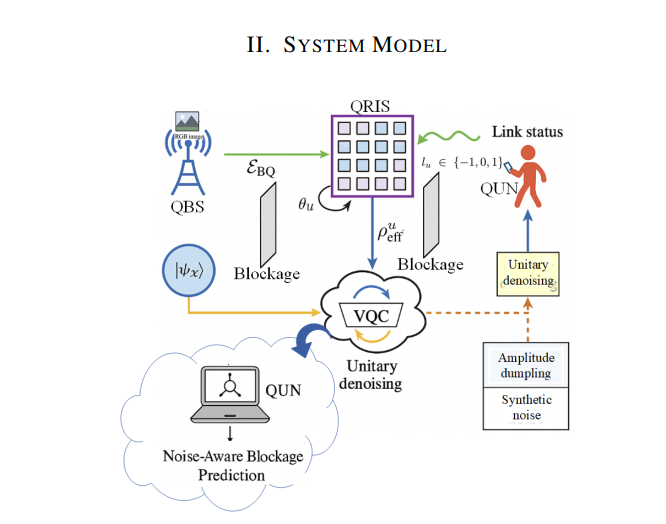
Scientists engineered a quantum-assisted framework for predicting blockage in reconfigurable intelligent surface (RIS)-enabled wireless networks. The system integrates a Quantum Base Station (QBS), a Quantum RIS (QRIS), and a mobile Quantum User Node (QUN). The QBS captures visual information using an onboard camera and encodes this data into quantum states, while simultaneously mapping channel state observations into quantum features, creating a hybrid input for processing. This composite input captures both spatial and channel information, enabling more accurate link status assessment. The study pioneered a method for processing these hybrid inputs through variational quantum circuits (VQC), allowing for classification of the wireless link status, identifying whether a link is blocked, partially obstructed, or clear.
To address limitations of current quantum hardware, the team modeled depolarizing and dephasing channels along both direct and QRIS-assisted signal paths, simulating realistic quantum noise conditions. They incorporated amplitude damping into the encoding process and introduced a loss function during training that enhances robustness and prevents overfitting to noisy data. Experiments used a quantum-adapted version of a visual and wireless information dataset to rigorously evaluate the model’s performance. The team trained the VQC using a technique that enforces fidelity and damping constraints to maintain quantum state integrity. Simulation results demonstrate that the hybrid noise-aware model achieves superior accuracy and quantum fidelity under realistic noise conditions, consistently outperforming classical methods and single-modality approaches. This work establishes the feasibility and robustness of combining quantum encoding with RIS routing for predictive wireless intelligence in challenging quantum environments.
Hybrid Quantum Model Predicts Wireless Blockage
Scientists have developed a novel quantum-assisted framework for predicting wireless link blockage in networks utilizing reconfigurable intelligent surfaces (RIS). The system integrates a Quantum Base Station (QBS), a Quantum RIS (QRIS), and a mobile Quantum User Node (QUN), enabling intelligent wireless link inference under dynamic conditions. The QBS captures visual data with an onboard camera and measures RIS-assisted signal performance, encoding these observations into hybrid quantum states. Image features are encoded using amplitude, while channel measurements are mapped using rotation gates, creating a composite quantum input that captures both spatial and channel information.
Experiments demonstrate that this hybrid quantum model achieves superior accuracy and stability under realistic noise conditions. The team explicitly modeled depolarizing and dephasing channels along both direct and QRIS-assisted paths to account for imperfections in current quantum hardware. A training objective was employed that jointly minimizes classification error and quantum state degradation, with amplitude damping and synthetic noise injection further enhancing robustness. This noise-regularized loss improves stability and prevents overfitting to noisy training data. Simulation results, conducted on a quantum-adapted version of a visual and wireless information dataset, show the proposed model outperforms classical methods in prediction accuracy and quantum fidelity. The research team achieved a significant breakthrough in noise-resilient RIS-based inference, demonstrating the feasibility of combining quantum encoding with RIS routing for predictive wireless intelligence in realistic quantum environments. The system’s performance represents a substantial advancement in the field, paving the way for more reliable and efficient wireless communication networks.
Quantum Prediction of Wireless Signal Blockage
This research presents a new framework for predicting signal blockage in wireless networks that utilizes reconfigurable intelligent surfaces and quantum computing techniques. By integrating visual information from cameras with channel state observations, the team developed a system capable of classifying link status with improved accuracy and stability. A key achievement lies in the incorporation of quantum noise modelling, specifically addressing depolarization and phase damping, which is crucial for reliable performance with current quantum hardware. The system employs a hybrid quantum input approach and training techniques that maintain quantum state integrity, demonstrating significant improvements in inference, particularly within noisy environments.
Simulation results, conducted using a specialized dataset, confirm the effectiveness of this approach, outperforming both baseline methods and single-modality inputs. The researchers acknowledge that the performance of the system is influenced by the quality of the quantum hardware and the inherent limitations of current quantum devices. This work establishes a strong foundation for the development of quantum-enabled wireless intelligence and offers a promising pathway towards more robust and reliable wireless communication systems.
🗞 Quantum Noise-Aware RIS-Aided Wireless Networks Using Variational Encoding and Signal Stabilization
🧠 ArXiv: https://arxiv.org/abs/2511.03717