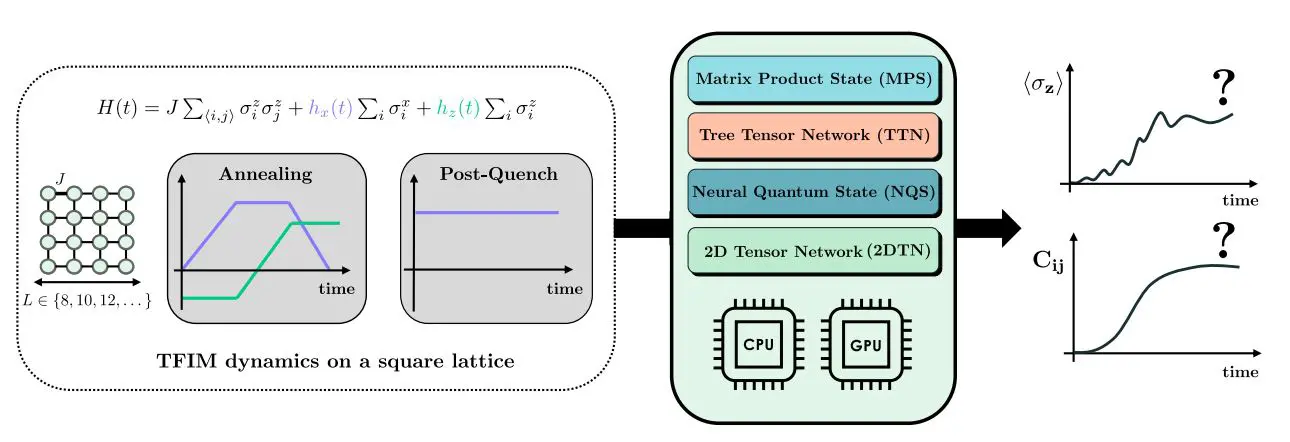
Understanding the behaviour of complex quantum systems presents a significant challenge at the forefront of modern physics, and researchers are continually developing new methods to explore these phenomena. Joseph Vovrosh, Sergi Julià-Farré, Wladislaw Krinitsin, and colleagues at PASQAL SAS and Forschungszentrum Jülich now present a detailed comparative study of classical numerical techniques applied to the two-dimensional transverse-field Ising model, a fundamental system in condensed matter physics. The team rigorously benchmarks several advanced methods, including matrix product states and time-dependent variational Monte Carlo, against two key dynamical processes: quantum annealing and post-quench dynamics. This work establishes crucial quantitative predictions, offering a valuable benchmark for both future numerical investigations and experimental studies involving Rydberg arrays, and ultimately helps connect classical computational limits to the behaviour of genuine quantum systems.
Rydberg Atoms for Quantum Simulation and Beyond
Recent research focuses intensely on quantum simulation, many-body physics, and computational methods applicable to emerging quantum technologies. A prominent theme is the use of Rydberg atom arrays for quantum simulation, optimization, and studying complex physical systems, encompassing optimization problems, critical phenomena through Kibble-Zurek scaling, and simulating spin models. Researchers are also developing efficient emulation and simulation techniques for neutral atom quantum hardware, comparing analog and digital approaches to quantum simulation and mitigating errors to improve the robustness of quantum simulators. Computational methods play a crucial role, with tensor networks being a major focus, including Density Matrix Renormalization Group, Projected Entangled Pair States, and tree tensor networks, used for ground state calculations, time evolution, and simulating quantum circuits.
Researchers are also developing efficient tensor network libraries, such as those implemented in Julia, and exploring Variational Monte Carlo methods, often combined with neural networks to represent quantum states, with dedicated implementations like jVMC. Mean-field theory provides a foundational approach, while Gaussian states are used as variational ansätze for fermionic systems. Many studies centre on spin models, particularly the transverse field Ising model, and critical phenomena like the Kibble-Zurek mechanism. Entanglement entropy is a key quantity for characterizing quantum states, and researchers are investigating methods for simulating both fermionic and bosonic systems.
The integration of neural networks into quantum simulation, through techniques like Neural Quantum States, is a rapidly growing area, with applications in quantum state preparation and machine learning. Several software libraries, including ITensor and Julia-based tools, are being developed to facilitate these simulations. Current research highlights the importance of hybrid quantum-classical algorithms, scalability, and efficiency in simulating large quantum systems, with a particular focus on two-dimensional systems and developing methods for simulating fermionic systems. The growing use of the Julia programming language suggests a trend towards more efficient and versatile quantum simulation tools.
Rydberg Atom Dynamics Benchmarked with Tensor Networks
Scientists have comprehensively benchmarked state-of-the-art numerical methods for simulating many-body quantum dynamics, focusing on systems compatible with Rydberg atom quantum processing units. The research team employed a diverse toolbox of classical simulation techniques, including matrix product states, tree tensor networks, two-dimensional tensor networks, and time-dependent variational Monte Carlo with Neural Quantum States, addressing a critical gap in understanding the boundary between classical and quantum computational capabilities in the study of complex quantum systems. The study focused on two key dynamical protocols, quantum annealing through a critical point and post-quench dynamics, allowing for detailed investigation of various regimes relevant to Rydberg array experiments. Researchers replicated observables such as magnetization and two-point correlations to validate the accuracy of each numerical method, providing a crucial benchmark for future numerical investigations and experimental studies. The team’s work connects classical computational limits to different dynamical regimes, including quasi-adiabatic dynamics, the Kibble-Zurek mechanism, and quantum quenches, all of which are accessible on Rydberg atom platforms. By meticulously comparing the performance of different numerical techniques across these regimes, scientists are establishing a clearer understanding of the limitations and strengths of each approach, delivering a comprehensive framework for evaluating and improving numerical methods used in the study of many-body quantum dynamics.
Quantum Dynamics of the Transverse Field Ising Model
This research presents a comprehensive investigation into the quantum dynamics of the two-dimensional transverse field Ising model, a system relevant to emerging quantum technologies and condensed matter physics. Scientists employed a suite of advanced numerical techniques, including matrix product states, tree-tensor networks, two-dimensional tensor networks, and time-dependent variational Monte Carlo, to simulate the system’s behaviour under quantum annealing and post-quench dynamics, establishing quantitative predictions for various numerical approaches. The results connect classical computational limits to specific regimes observed in quantum dynamics within Rydberg atom arrays, specifically examining quasi-adiabatic dynamics, the Kibble-Zurek mechanism, and quantum quenches, demonstrating the ability to accurately model complex quantum systems and providing valuable insights into the behaviour of interacting qubits and the dynamics of quantum phase transitions. Future research directions include extending these methods to larger systems and longer timescales, as well as exploring the impact of disorder and imperfections on the observed dynamics, ultimately advancing our understanding of complex quantum phenomena and informing the development of quantum technologies.
🗞 Simulating dynamics of the two-dimensional transverse-field Ising model: a comparative study of large-scale classical numerics
🧠 ArXiv: https://arxiv.org/abs/2511.19340