

Superconducting qubits represent a promising pathway to building powerful quantum computers, but accurately characterising the complex energy landscapes these qubits experience remains a significant challenge. Saeed Hajihosseini, Seyed Iman Mirzaei, and Hesam Zandi, from the Iranian Quantum Technologies Research Center and Tarbiat Modares University, alongside Mohsen Akbari, present Trainmon, a novel framework designed to reverse engineer these qubit potentials. Trainmon utilises arrangements of Josephson junctions to mimic a wide range of potential shapes, offering researchers a new tool to analyse and understand qubit behaviour. By successfully recreating the Hamiltonians of established qubit designs like Quarton and Fluxonium, and accurately predicting their performance, this work demonstrates the potential of Trainmon to accelerate the development and optimisation of future quantum technologies.
Trainmon Qubit Design and Josephson Junction Arrays
Researchers have developed Trainmon, a novel superconducting qubit architecture designed to improve coherence and control. This innovative qubit utilizes arrays of Josephson junctions, multiple junctions connected in series, to create specific potential landscapes for the qubit’s energy levels, allowing for precise tailoring of its properties. The analysis focuses on the charge Hilbert space, defining qubit states by the number of Cooper pairs, charge carriers, on superconducting islands, a common approach for analyzing these systems. This design aims to improve qubit performance by carefully controlling the energy levels and minimizing unwanted transitions.
The use of Josephson junction arrays enables fine-tuning of the qubit’s energy levels and anharmonicity, crucial for controlling the qubit. This tailored potential landscape allows for more precise control over the qubit’s state and potentially enhances computational efficiency. Researchers constructed the Hamiltonian, a mathematical description of the qubit’s total energy, based on the Josephson junction energies and external fluxes, representing it as a matrix with elements corresponding to energy couplings between charge states. They utilized QuTiP, an open-source Python library for quantum system simulation, to solve the Hamiltonian numerically.
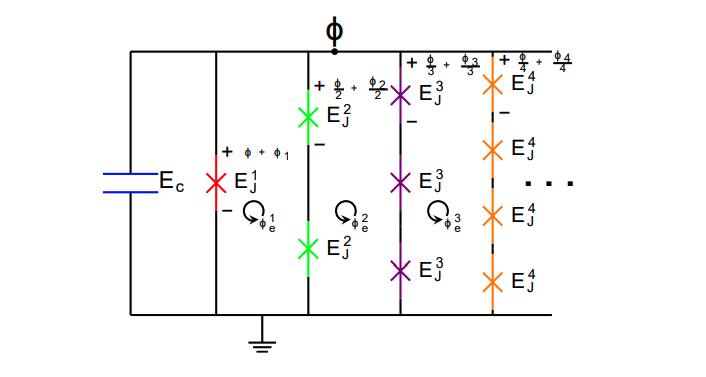
This work represents a sophisticated approach to qubit design, pushing the boundaries of superconducting qubit technology. The Trainmon aims to overcome limitations of existing qubits, potentially leading to improved coherence times, control, and scalability, contributing to the broader effort of building practical quantum computers. The system comprises an array of parallel branches, each containing multiple Josephson junctions connected in series with a shared capacitor, mimicking a discrete cosine transform suitable for replicating various potential landscapes. This design, resembling interconnected “wagons,” gives rise to the name Trainmon, allowing for flexible tailoring of qubit characteristics. To define the potential well, the team harnessed the Hamiltonian of the circuit, a mathematical description of the system’s energy, resembling a Fourier series.
Researchers employed optimization techniques to numerically determine the appropriate Josephson energy coefficients that best approximate the desired potential. A challenge arose because some extracted coefficients were negative, difficult to implement directly in physical circuits. To overcome this limitation, scientists innovatively applied external magnetic flux to each superconducting loop within the circuit, effectively shifting the phase and generating the necessary negative Josephson energy coefficients. This technique leverages the fluxoid quantization condition, ensuring circuit stability. Researchers validated the framework by applying it to well-known qubits, including the Quarton and fluxonium, successfully solving the Hamiltonian for the Trainmon-based versions and confirming accuracy.
Trainmon Reconstructs Qubit Potentials with High Fidelity
Researchers have developed Trainmon, a novel framework for reverse-engineering quantum potential wells using parallel branches of Josephson junctions, offering a new approach to qubit design. This innovative system mimics various potentials through a Hamiltonian resembling a discrete cosine transform, and the team successfully applied it to well-known qubits like the Quarton and Fluxonium. Experiments demonstrate that even with a limited number of branches, Trainmon accurately reconstructs the desired potential with a remarkably small relative error in both potential and eigenenergies. The team’s method differs from previous approaches through its unique circuit design and ability to handle negative Josephson energies, a significant challenge in superconducting qubit fabrication.
To address this, researchers cleverly utilize external magnetic flux to effectively generate these negative energies, satisfying fluxoid quantization conditions within the circuit. By stacking branches of Josephson junctions, each contributing to the overall potential well, the team created a system aptly named Trainmon, drawing an analogy to the connected wagons of a train. Testing the framework with the highly anharmonic Quarton qubit, researchers reconstructed the potential using configurations with one, two, and four-junction branches. Results show a close overlap between the Quarton and Trainmon potentials, achieving a maximum relative error of only 0.
02%. Furthermore, analysis of the first three eigenenergies confirms that the potential range of [-π, π] is appropriate for quantum computation, effectively encompassing the necessary quantum states for a quartic potential. This breakthrough delivers a promising new avenue for designing and fabricating advanced superconducting qubits with enhanced performance and control.
Tailoring Qubit Potential With Trainmon Framework
This research introduces Trainmon, a framework for reverse-engineering the quantum potential well of superconducting qubits. The method utilizes parallel branches of Josephson junctions to precisely shape the qubit’s potential, offering a versatile approach to qubit design and optimisation. Applying Trainmon to established qubit types, such as Quarton and Fluxonium, successfully reproduces their key characteristics, including transition frequencies and coherence times, demonstrating the framework’s accuracy and potential. The ability to tailor the quantum potential well provides opportunities to enhance qubit performance, specifically by improving resilience to noise along particular channels. The framework’s flexibility allows researchers to explore designs that minimise the impact of specific noise sources, potentially leading to more stable and reliable qubits. This research provides a valuable tool for researchers seeking to optimise qubit designs and improve the performance of superconducting quantum computers.
🗞 Trainmon: a framework for reverse engineering potentials in superconducting Qubits
🧠 ArXiv: https://arxiv.org/abs/2509.00819


