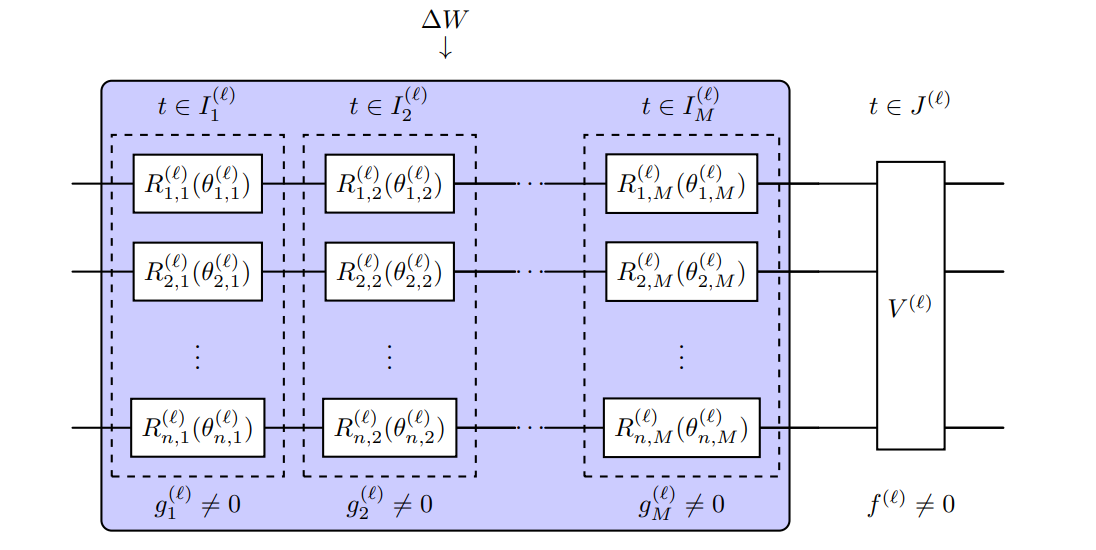
Optimising quantum circuits for complex calculations remains a significant challenge, yet achieving robust and accurate control is crucial for unlocking the full potential of quantum chemistry. Peyman Najafi, Aarón Villanueva, and Hilbert Kappen, from Radboud University, present a new adaptation of Path Integral Quantum Control, tailored for optimising parametrised quantum circuits. Their work demonstrates that circuits can be effectively randomised using a process mirroring the behaviour of quantum systems evolving over time, allowing for a more efficient search for optimal control parameters. By benchmarking this ‘Gate-based PiQC’ against established methods on molecules ranging from simple hydrogen to more complex systems, the team reveals greater robustness to changes in molecular structure and, crucially, superior performance, particularly when calculations rely on less accurate starting points. This advancement promises to improve the reliability and accuracy of quantum simulations for increasingly complex chemical problems.
Originally designed for pulse-based control, PiQC estimates optimal controls by averaging over many possible quantum trajectories, bypassing the need for iterative optimisation procedures. This method utilizes the path integral formalism, a powerful tool from quantum mechanics, to efficiently explore different control strategies. By averaging over all possible quantum paths, PiQC smooths the control landscape and identifies robust control solutions less susceptible to noise and imperfections. This proves particularly valuable for complex quantum systems where traditional optimisation methods struggle. Researchers demonstrate PiQC’s effectiveness in simulating and controlling quantum chemical reactions, showcasing its potential for designing and optimising molecular processes.
Rydberg Atoms Enhance Variational Quantum Algorithms
Research focuses on improving variational quantum algorithms (VQAs) and addressing challenges like barren plateaus and optimisation difficulties. The work explores techniques to enhance VQAs for applications in quantum chemistry, materials science, and optimisation problems, investigating noise-assisted optimisation and stochastic control to improve algorithm training. Rydberg atom quantum computers are also considered as a potential hardware platform. Key concepts include the Variational Quantum Eigensolver (VQE), used to find the ground state energy of molecules and materials. Researchers explore intentionally adding noise to the optimisation process to escape local minima and overcome barren plateaus, using techniques like action noise and stochastic noise.
Stochastic control, employing random control signals to guide optimisation, is also investigated, linking to principles from optimal control theory. Pulse-based optimisation, using shaped pulses to control quantum systems and optimise algorithm parameters, is a central theme. The Simultaneous Perturbation (SP) algorithm, a stochastic optimisation technique for estimating gradients and updating parameters, is also explored. Rydberg atom quantum computing, utilising highly excited Rydberg atoms as qubits, offers strong interactions and potential scalability. Experiments benchmarked GB-PiQC and pulse-based PiQC against the Eigensolver (VQE) method, optimised using the Simultaneous Perturbation Stochastic Approximation (SPSA) optimiser, across a suite of molecular Hamiltonians. Results demonstrate that both PiQC methods exhibit greater robustness than SPSA to variations in the target Hamiltonian induced by changes in molecular bond distances. Specifically, PiQC consistently outperformed SPSA, particularly at stretched bond lengths where the Hartree-Fock solution becomes less accurate. The research establishes that PiQC, in both pulse-based and gate-based forms, presents a compelling alternative to variational methods for quantum chemistry applications, offering a robust and accurate approach to ground state preparation.
Gate-Based PiQC Improves Molecular Energy Calculations
Researchers successfully adapted the Path Integral Control (PiQC) algorithm, originally developed for pulse-based control systems, to optimise variational quantum eigensolvers. This adaptation, termed Gate-based PiQC (GB-PiQC), demonstrates compelling advantages over conventional optimisation techniques such as the Simultaneous Perturbation Stochastic Approximation (SPSA) method. Results indicate that PiQC algorithms exhibit greater robustness than SPSA when faced with changes in the target Hamiltonian induced by varying molecular bond distances. Specifically, GB-PiQC consistently outperformed SPSA across all bond distances for lithium hydride and beryllium hydride, achieving lower median errors.
While SPSA demonstrated comparable performance to PiQC at shorter bond distances for hydrogen, its accuracy diminished as bond lengths increased. Importantly, both PiQC variants maintained errors below the threshold for chemical accuracy throughout the tested range of bond distances. This research establishes PiQC as a promising new approach for tackling complex optimisation problems in quantum chemistry and potentially other fields requiring robust and accurate solutions.
🗞 Path Integral Quantum Control for Quantum Chemistry Applications
🧠 ArXiv: https://arxiv.org/abs/2509.24104