
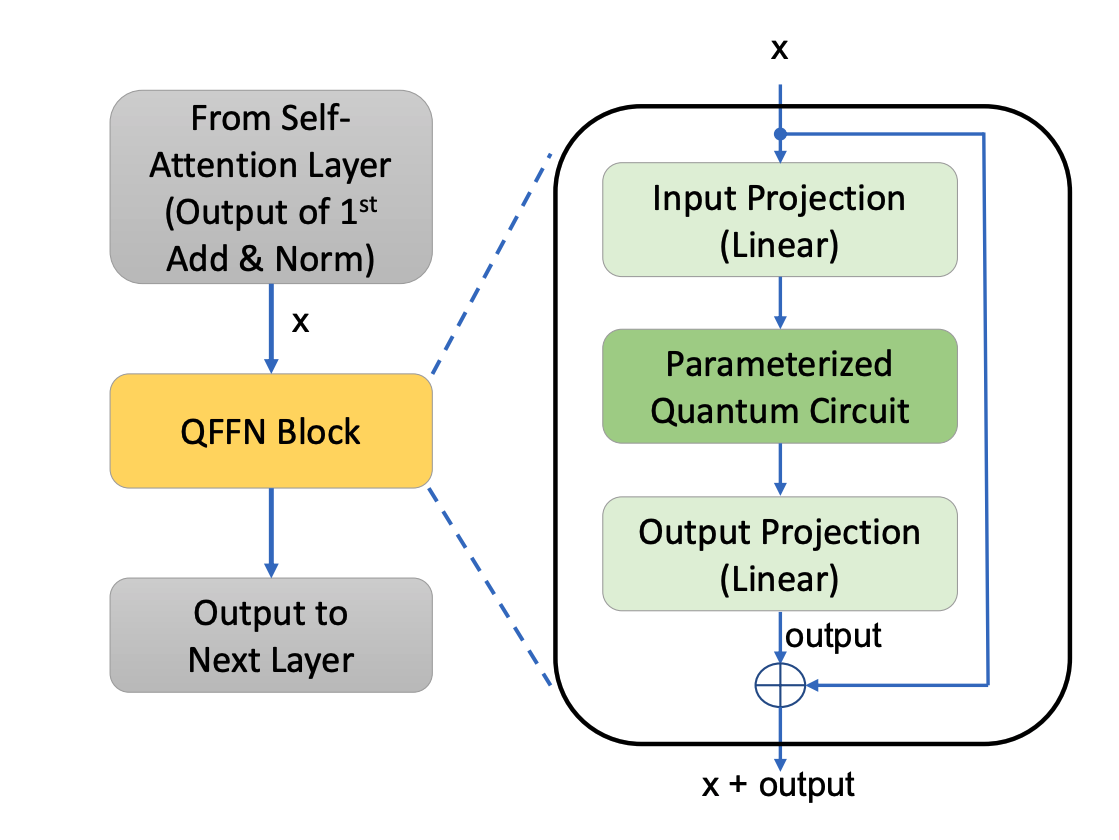
The integration of quantum computation with established machine learning paradigms represents a developing area of research, with potential benefits in model efficiency and data utilisation. Recent work explores the application of parameterized quantum circuits (PQCs), quantum systems whose behaviour is modified by adjustable parameters, within the architecture of transformer networks, a cornerstone of modern natural language processing. Pilsung Kang and colleagues present a novel hybrid quantum-classical transformer, termed QFFN-BERT, in which the computationally intensive feedforward network (FFN) modules are replaced with PQC-based layers. Their research, detailed in the article “QFFN-BERT: An Empirical Study of Depth, Performance, and Data Efficiency in Hybrid Quantum-Classical Transformers”, investigates the interplay between quantum circuit depth, model expressibility, and the ability to train these complex systems, demonstrating improved performance and data efficiency on benchmark datasets.
The convergence of quantum computing and deep learning presents a rapidly evolving field with the potential to advance artificial intelligence significantly. QFFN-BERT, a novel hybrid classical-quantum transformer, substitutes the feedforward network (FFN) modules within a compact BERT variant with parameterised quantum circuits (PQCs), representing a progression towards realising this potential. This architectural choice is motivated by the observation that FFNs comprise approximately two-thirds of the parameters within standard Transformer encoder blocks, creating a scalability and efficiency bottleneck in large language models. By strategically replacing these classical layers with quantum counterparts, the aim is to unlock substantial gains in both computational performance and model parameter efficiency.
Contemporary deep learning models, while successful in numerous tasks, often exhibit limitations in scalability and data efficiency, particularly when confronted with complex datasets and resource constraints. Harnessing the unique properties of quantum mechanics, such as superposition and entanglement, could alleviate these limitations and facilitate the development of more powerful and efficient AI systems. Current research focuses on exploring the feasibility of integrating quantum circuits into core components of modern neural networks, explicitly targeting the FFN layer within the Transformer architecture, a foundational element of many state-of-the-art language models. This approach allows for the investigation of the potential benefits of quantum computation without necessitating a complete restructuring of existing deep learning frameworks.
Unlike prior research primarily focused on integrating PQCs into self-attention mechanisms, this work targets explicitly the FFN layer and systematically investigates the interplay between PQC depth, expressibility, and trainability. Simply substituting classical layers with quantum circuits is insufficient to achieve optimal performance; careful consideration must be given to the design and optimisation of the quantum circuits themselves. Research delves into the critical parameters governing PQC performance, including the number of layers, the selection of quantum gates, and the optimisation algorithms employed to train the quantum circuits. This systematic investigation identifies key factors influencing PQC performance and develops guidelines for designing effective quantum-enhanced deep learning models.
The final PQC architecture incorporates several key features to ensure stable training and maximise expressibility, addressing the challenges inherent in training quantum circuits. Residual connections facilitate gradient flow during training, mitigating the vanishing gradient problem that frequently affects deep neural networks. Both rotation and entanglement layers enhance the expressiveness of the PQC, enabling it to capture complex relationships within the data. An alternating entanglement strategy optimises the connectivity of the quantum circuit, maximising its ability to represent and process information.
Experiments conducted on a classical simulator using the SST-2 and DBpedia benchmarks evaluate the performance of QFFN-BERT. These experiments demonstrate that a carefully configured QFFN-BERT achieves up to 102.0% of the baseline accuracy, exceeding the performance of its classical counterpart in a full-data setting. This result highlights the potential of quantum circuits to enhance the accuracy of deep learning models, even when simulated on classical hardware. Importantly, the model achieves this performance improvement while drastically reducing the number of FFN-specific parameters—by over 99%, demonstrating a significant gain in model efficiency.
Furthermore, the model consistently outperforms classical models in scenarios with limited data, positioning QFFN-BERT as a promising solution for real-world applications where data scarcity is a significant challenge. This superior data efficiency reduces the reliance on large datasets and enables the development of more practical AI systems. An ablation study, conducted using a non-optimised PQC that failed to learn, confirms that the specific design choices made in the final QFFN-BERT model are critical for achieving optimal performance. This study demonstrates that simply replacing a classical FFN with a PQC is not sufficient; the PQC must be carefully co-designed with deep learning principles to achieve meaningful results.
These results demonstrate the viability of integrating quantum circuits into the core components of modern neural networks, enabling improved performance and efficiency, and paving the way for a new generation of AI systems. QFFN-BERT represents a progression towards realising the full potential of quantum-enhanced deep learning, offering a promising pathway for developing more powerful, efficient, and data-efficient AI models. Research opens up new avenues for exploration in the field of quantum machine learning, inspiring further investigation into the design and optimisation of quantum-enhanced deep learning architectures.
Current research explores several directions for future work, including the investigation of more advanced quantum algorithms and the exploration of hybrid quantum-classical training strategies. Plans also include investigating the scalability of the approach by exploring the use of larger and more complex quantum circuits, with the ultimate goal of developing a fully functional quantum-enhanced deep learning system that can tackle real-world problems with unprecedented accuracy and efficiency. The integration of quantum computing and deep learning holds immense promise for revolutionising the field of artificial intelligence.
👉 More information
🗞 QFFN-BERT: An Empirical Study of Depth, Performance, and Data Efficiency in Hybrid Quantum-Classical Transformers
🧠 DOI: https://doi.org/10.48550/arXiv.2507.02364