

Researchers developed a circuit obfuscation technique protecting quantum algorithm intellectual property during compilation. By inserting corrective gates, they achieved statistical and functional obfuscation – confirmed by Total Variation Distance and Degree of Functional Corruption metrics – across benchmark algorithms including Shor’s and Grover’s, without relying on complex reversal methods.
The increasing reliance on external compilation services in quantum computing presents a vulnerability: the potential exposure of proprietary circuit designs. To mitigate this risk, researchers are developing techniques to obscure circuit functionality without compromising computational results. A new approach, detailed in ‘Quantum Opacity, Classical Clarity: A Hybrid Approach to Quantum Circuit Obfuscation’, introduces strategically placed gates that distort measurement outcomes, subsequently rectified via a classical post-processing step independent of the compiler used. This method, evaluated on established quantum algorithms including Shor’s and Grover’s, demonstrates a statistically and functionally secure obfuscation. The work is led by Amal Raj and Vivek Balachandran, both of the Singapore Institute of Technology.
Securing A Quantum Circuit Through Obfuscation
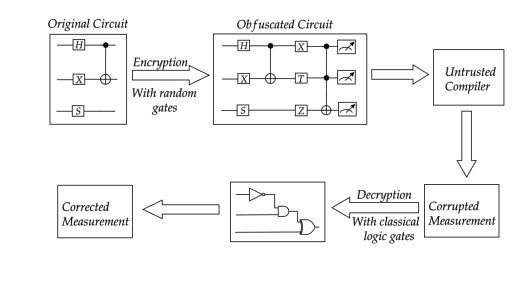
Quantum computing’s transition into the Noisy Intermediate-Scale Quantum (NISQ) era increases reliance on third-party compilation services, creating vulnerabilities to intellectual property theft within quantum circuit designs. Recent research details a novel obfuscation technique to mitigate this risk, actively corrupting circuit measurements with strategically inserted gates, followed by a classical post-processing correction restoring functionality for authorised users.
This method diverges from existing obfuscation techniques by avoiding complex circuit manipulations such as reversals, barriers, or qubit re-mapping, simplifying implementation and reducing computational overhead. Instead, it employs a compiler-agnostic approach. This means the obfuscation relies on classical correction after compilation, rather than modifications within the quantum circuit itself, broadening compatibility across diverse quantum hardware platforms.
Researchers evaluated the technique’s effectiveness using five benchmark quantum algorithms – Shor’s, Quantum Approximate Optimisation Algorithm (QAOA), Bernstein-Vazirani, Grover’s, and the HHL algorithm – implemented within the Qiskit framework. This provides a comprehensive assessment of performance across a range of algorithmic structures.
Results demonstrate a high degree of statistical obfuscation, as measured by Total Variation Distance (TVD) – a metric quantifying the difference between two probability distributions – exceeding 0.5. This indicates significant disruption of the original output distribution, effectively concealing the underlying algorithmic structure. Furthermore, consistently negative Degree of Functional Corruption (DFC) values confirm functional obfuscation. DFC measures the difference between the input-output behaviour of the original and obfuscated circuits; negative values indicate the corrected output remains functionally equivalent to the original, while concealing the circuit’s internal structure.
The corruption introduced is not irreversible. A lightweight classical post-processing step, informed by the structure of the inserted gates, effectively corrects the outcomes, preserving the algorithm’s functionality for the legitimate user. This correction relies on classical computation and does not require access to the original quantum circuit.
This research establishes a practical and effective solution for securing quantum circuit designs in untrusted compilation flows. By prioritising compiler-agnostic classical correction, the technique offers a viable pathway towards protecting intellectual property as quantum computing technology matures and becomes increasingly reliant on external compilation services. Future work will focus on optimising the gate insertion strategy to minimise circuit overhead and further enhance the robustness of the obfuscation against advance attacks, ensuring its continued effectiveness in a rapidly evolving threat landscape.
👉 More information
🗞 Quantum Opacity, Classical Clarity: A Hybrid Approach to Quantum Circuit Obfuscation
🧠 DOI: https://doi.org/10.48550/arXiv.2505.13848


