

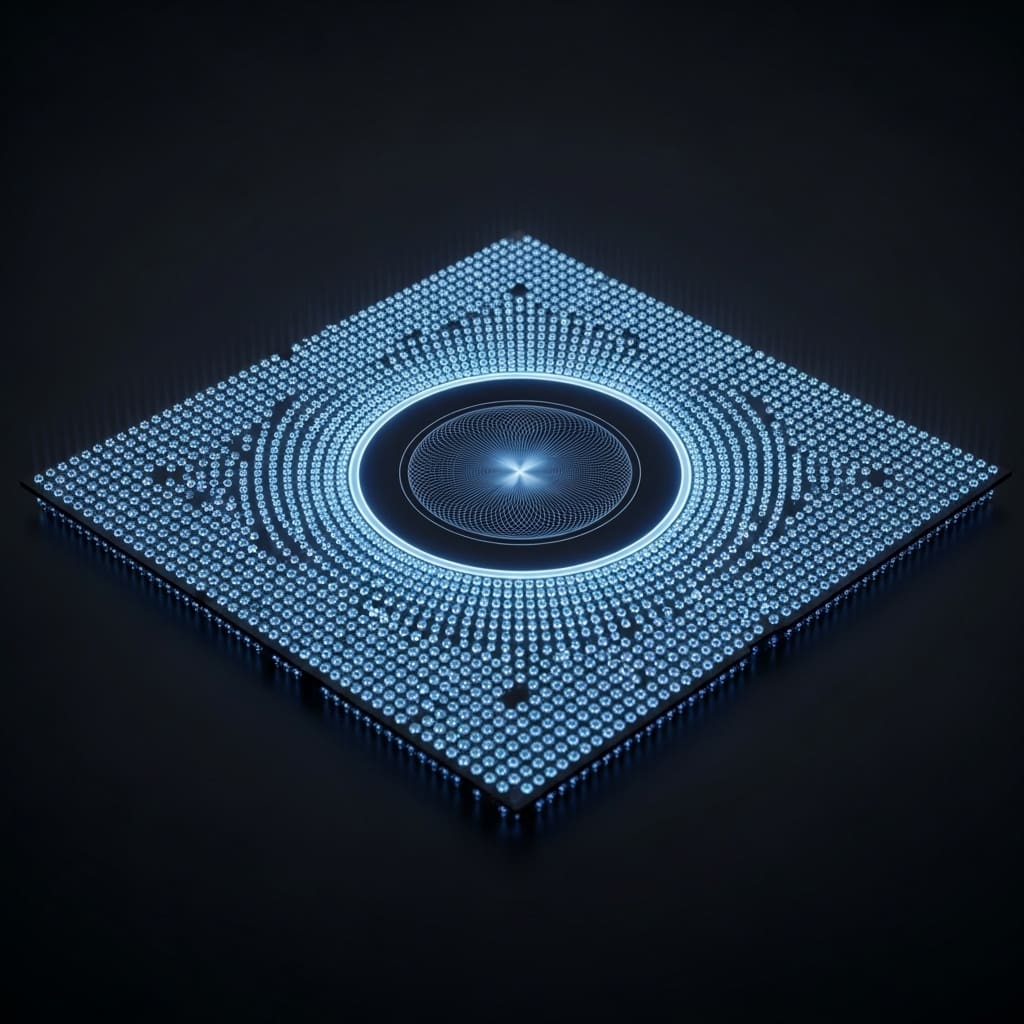
Scientists are increasingly exploring frequency-bin encoding as a promising technique for quantum information processing due to its potential for high dimensionality and compatibility with current telecommunication systems. Sara Congia and Leopold Virot, working with colleagues from Dipartimento di Fisica ”Alessandro Volta”, Universita di Pavia, Italy, Dipartimento di Ingegneria Industriale e dell’Informazione, Universita di Pavia, Italy, and STMicroelectronics, Crolles, France, have now demonstrated the first fully integrated quantum frequency processor fabricated on a silicon chip. This device monolithically integrates a biphoton source, pump-rejection filter, phase modulators, and a pulse shaper, overcoming a significant barrier to scalable deployment. The research, detailed in their recent publication, showcases tunable frequency beamsplitters exceeding 90% success probability and 99.5% fidelity, alongside the generation and coherent manipulation of high-dimensional entangled states, representing a crucial advance towards practical, large-scale frequency-domain processors for both classical and quantum computing applications.
Scientists have created a fully functioning quantum processor on a single silicon chip, bringing practical quantum computing closer to reality. This compact design overcomes a major hurdle by integrating all necessary components for manipulating quantum information using light, promising faster, more scalable quantum systems compatible with existing fibre optic networks.
This advance represents a significant step in manipulating quantum information using the frequency of light, consolidating a quantum light source, spectral filters, and programmable controls onto a single platform to overcome a key obstacle to scaling up frequency-bin quantum information processing. Frequency-bin encoding, utilising different frequencies of light to represent quantum bits, offers advantages such as high dimensionality and compatibility with existing telecommunication networks.
The newly developed processor monolithically integrates a microresonator-based source of entangled photon pairs, a filter to eliminate unwanted light, high-speed phase modulators, and a four-channel pulse shaper capable of precise spectral control. Demonstrations include tunable frequency beamsplitters achieving success probabilities exceeding 94% and fidelities above 99.9%, alongside the ability to create versatile single-qubit gates.
Researchers successfully generated and coherently manipulated high-dimensional frequency-bin entangled states directly on the chip, demonstrating control over two-photon quantum walks and performing the first on-chip quantum state tomography of a Bell-state with a fidelity of 95.7%. This achievement marks a crucial step towards building large-scale frequency-domain processors suitable for both classical and quantum applications.
By integrating all key functional elements onto a 4×7 mm² chip, the research team has created a pathway for scaling to a larger number of modes and unlocking the potential of frequency-bin encoding for advanced quantum technologies. The processor’s ability to generate, manipulate, and measure quantum states entirely on-chip promises to accelerate the development of practical quantum communication and computation systems.
Monolithic silicon photonics demonstrate high-fidelity quantum frequency processing
A silicon photonic quantum frequency processor has been monolithically integrated on a chip, incorporating a microresonator-based biphoton source, pump-rejection filter, high-speed phase modulators, and a four-channel line-by-line pulse shaper within an approximate area of 4 × 7 mm². The integrated circuit is fabricated on a 300mm Si300nm photonics platform and utilizes on-chip heater elements for reconfiguration, controlled by external electronics and thermally stabilised with a Peltier cell.
The microresonator source, designed for spontaneous four-wave mixing, emits a biphoton quantum frequency comb with a free spectral range of ≃15.34GHz, achieving critical coupling through an interferometric coupler. Tunable frequency beamsplitters demonstrate success probabilities exceeding 0.8 and fidelities above 0.9, indicating efficient and precise control over frequency bin manipulation.
The processor is capable of synthesizing single-qubit gates, and high-dimensional frequency-bin entangled states are generated and coherently manipulated entirely on-chip. These states exhibit control over two-photon quantum walks, showcasing both ballistic and strongly confined energy transport. Furthermore, the first on-chip frequency-bin quantum state tomography (QST) of a Bell-state was performed, achieving a fidelity of 95.7%.
Each line-by-line waveshaper unit incorporates cascaded pairs of add, drop microring resonators, designed with a quality factor (Q) of 3 × 10⁶ to ensure a flat channel response across the frequency comb modes. Calibration of the phase of a waveshaper channel is achieved by measuring the time-dependent intensity at the output and computing the real part of the Fourier transform at a specific frequency, allowing for precise spectral phase control. The amplitude of this Fourier transform, measured at 2(ΩM + ΩD), provides a clear signal for calibration purposes.
Microresonator-based quantum frequency comb generation and on-chip manipulation
This work underpins a silicon photonic frequency processor, fabricated on a 300nm silicon-on-insulator platform at STMicroelectronics. The chip, measuring approximately 4 × 7 mm², integrates all essential components for a quantum frequency processor, including a microresonator-based biphoton source, a pump-rejection filter, high-speed phase modulators, and a four-channel line-by-line pulse shaper.
Optical signals are coupled to and from the chip using grating couplers, with pump laser excitation at the IN-1 port and signal extraction from the OUT-1 and OUT-2 ports. Thermal stabilisation via a Peltier cell ensures consistent operational conditions throughout experimentation. Following pump laser excitation, a microresonator generates a biphoton quantum frequency comb via spontaneous four-wave mixing, possessing a free spectral range of approximately 15.34GHz.
This resonator operates in the critical coupling regime, achieved through precise tuning with an interferometric coupler. An asymmetric Mach, Zehnder interferometer then functions as a pump rejection filter, attenuating the pump laser and preventing unwanted photon-pair generation elsewhere in the circuit. The resulting frequency comb is directed towards the core quantum frequency processor.
The processor’s architecture resembles previously demonstrated designs, employing a line-by-line waveshaper positioned between an input and output fast phase modulator. Each frequency bin undergoes coherent mixing with its neighbours via the input phase modulator, followed by the application of independent spectral phases by the waveshaper, and a second mixing process at the output phase modulator.
This process, analogous to a frequency-domain generalisation of MZI meshes, leverages the high-dimensionality inherent in the mode mixing performed by the phase modulators. Specifically, p-n travelling-wave carrier depletion modulators, each driven by a radio frequency signal matching the comb’s free spectral range, implement this on-chip mode mixing.
The line-by-line waveshaper comprises four cascaded pairs of add, drop microring resonators. These units operate in three distinct configurations: PHASE, where a specific channel wavelength is targeted for phase control; DEMUX, where a wavelength is dropped for phase shifting; and PASS, allowing the wavelength to continue unperturbed. Each ring resonator is designed with a quality factor of 3 × 10⁶ to ensure a flat spectral response across all comb modes, enabling precise and independent control over each frequency bin.
Integrated silicon photonics enable on-chip control of high-dimensional quantum states
The relentless pursuit of scalable quantum technologies has long been hampered by the engineering challenge of fitting complex systems onto a single chip. This work represents a significant stride towards overcoming that challenge, demonstrating a fully integrated quantum frequency processor capable of generating, manipulating, and measuring quantum information encoded in the frequency of light.
For years, researchers have struggled to combine efficient photon sources, precise spectral control, and high-speed modulation without sacrificing performance or scalability. What distinguishes this achievement is not merely the successful integration of these elements on silicon, but the level of control attained. The ability to create tunable frequency beamsplitters and coherently manipulate high-dimensional entangled states entirely on-chip unlocks possibilities beyond the limitations of spatial or time-bin encoding.
This approach offers inherent compatibility with existing telecommunications infrastructure, potentially accelerating the development of quantum networks and secure communication protocols. However, the current demonstration remains a proof-of-principle. Scaling to a truly large number of modes will undoubtedly present significant hurdles in terms of fabrication complexity and maintaining coherence.
Furthermore, the fidelity of multi-qubit gates needs continued improvement to rival established quantum computing platforms. Future efforts will likely focus on increasing the number of frequency channels, exploring novel materials to enhance performance, and developing error correction strategies tailored to frequency-bin qubits. Ultimately, this integrated platform could pave the way for versatile photonic processors applicable to both quantum and classical information processing, bridging the gap between theoretical potential and practical realisation.
👉 More information
🗞 Fully integrated quantum frequency processor on a silicon chip
🧠 ArXiv: https://arxiv.org/abs/2602.14240
