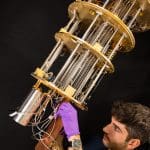
Researchers demonstrate the accurate calculation of molecular hydrogen’s ground-state energy using multi-ancilla phase estimation on a trapped-ion quantum computer. Achieving precision exceeding chemical accuracy (1 kilohartree) with limited computational resources, the method scales favourably for benchmarking near-term quantum devices and simulating small chemical systems.
The accurate simulation of molecular systems represents a significant challenge for classical computation, demanding resources that scale exponentially with system size. Researchers are increasingly turning to quantum computers as potential tools to overcome these limitations, though current devices still face constraints in qubit count and fidelity. A team from Quantinuum Ltd, comprising Andrew Tranter, Duncan Gowland, Kentaro Yamamoto, Michelle Sze, and David Muñoz Ramo, detail a method for high-precision quantum phase estimation, a core algorithm in quantum chemistry, on a trapped-ion quantum computer. Their work, entitled “High-precision Quantum Phase Estimation on a Trapped-ion Quantum Computer”, presents a benchmarking approach utilising multi-ancilla techniques to calculate the ground state energy of molecular hydrogen to a precision exceeding conventional chemical accuracy, even when accounting for approximations inherent in the quantum computation itself. This approach, while limited in scalability to larger molecules, offers a pathway to meaningful results with reduced computational cost, potentially serving as a valuable benchmark for assessing the capabilities of near-term quantum devices.
Recent advances in quantum computing present both opportunities and challenges for computational chemistry, prompting researchers to develop innovative methods that minimise computational burden while maximising accuracy. Scientists continually seek strategies to reduce demands on qubit resources and circuit execution times, commonly referred to as ‘shots’, to enable meaningful chemical simulations on near-term quantum devices. This work details a benchmarking approach utilising multi-ancilla phase estimation. This technique efficiently calculates energy levels in small chemical systems and demonstrates the potential of quantum computation for practical applications. The methodology prioritises algorithmic efficiency and leverages the strengths of specific quantum hardware, paving the way for increasingly complex chemical calculations.
Researchers designed a benchmarking approach centred around multi-ancilla phase estimation, enabling the calculation of energy levels in small chemical systems with improved efficiency and reduced computational demands. This favourable scaling, exhibiting a quadratic relationship between gate count and the number of qubits used in the readout register, is crucial as it allows for meaningful results to be obtained with a reduced number of shots, a significant advantage for near-term quantum devices. Multi-ancilla phase estimation is a quantum algorithm used to determine the eigenvalues, or energy levels, of a quantum system, and the use of multiple ‘ancilla’ qubits—auxiliary qubits not directly representing the chemical system—enhances the precision of the estimation.
The study reports achieving chemical accuracy—defined as 1 kilohartree—against Full Configuration Interaction, a highly accurate but computationally expensive classical method, underscoring the potential of the multi-ancilla phase estimation technique to deliver reliable results even with limited resources. The methodology effectively mitigates the need for extensive error mitigation strategies, simplifying the experimental setup and reducing the overall computational cost. A kilohartree is a unit of energy commonly used in quantum chemistry, and achieving accuracy at this level signifies a result comparable to high-level classical calculations.
Scientists successfully calculated the ground state energy of molecular hydrogen to eight decimal places (0.00000008 Hartree) on a ten-qubit trapped-ion quantum computer, effectively eliminating Trotter error, a common source of inaccuracy in quantum simulations. Trotter error arises from approximating the time evolution operator in quantum simulations, and its elimination represents a significant improvement in simulation fidelity. When accounting for Trotter error, the precision remains between six and eight decimal places (0.000006 and 0.000008 Hartree respectively), significantly surpassing the threshold for chemical accuracy when compared against Full Configuration Interaction. The core strength of this approach lies in its ability to generate circuits that scale quadratically, enabling the simulation of larger chemical systems with manageable computational demands.
Researchers designed the methodology to prioritise accuracy and feasibility, providing a valuable tool for validating and benchmarking near-term quantum devices. The technique’s reliance on multi-ancilla phase estimation offers a pathway to mitigate the impact of gate errors and decoherence, critical challenges in current quantum hardware. Gate errors occur due to imperfections in quantum gate operations, while decoherence refers to the loss of quantum information due to interactions with the environment. Furthermore, the use of ancilla qubits effectively distributes the computational burden, enhancing robustness, particularly for complex molecular systems where even small errors can accumulate and affect accuracy.
Scientists are actively investigating the scalability of the methodology and identifying potential bottlenecks to extend its utility to larger and more realistic chemical simulations. They are also exploring the integration of error mitigation techniques and optimising circuit design to enhance accuracy and efficiency further. The development of automated workflows for generating and analysing benchmark circuits will be essential for facilitating wider adoption within the quantum chemistry community.
This work demonstrates a viable benchmarking approach for quantum computational chemistry, utilising multi-ancilla phase estimation to achieve high precision in calculating ground state energies, even with limited quantum resources, and it paves the way for more accurate and efficient quantum simulations of chemical systems. The team’s success highlights the potential of quantum computing to revolutionise computational chemistry and accelerate the discovery of new materials and technologies.
👉 More information
🗞 High-precision Quantum Phase Estimation on a Trapped-ion Quantum Computer
🧠 DOI: https://doi.org/10.48550/arXiv.2506.17207