

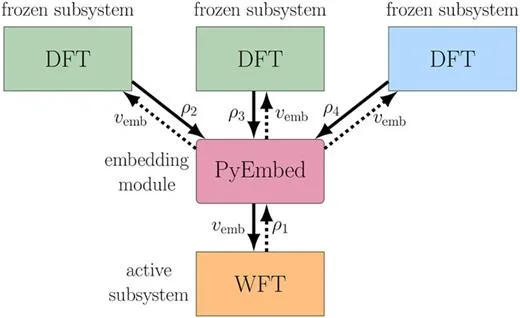
Quantum chemistry, which applies quantum mechanics principles to chemical phenomena, faces an interoperability challenge due to the need for complex workflows involving multiple quantum-chemical program packages. This challenge is addressed by exchanging electron densities and embedding potentials as grid-based data, a solution implemented in a Python scripting framework called P YEMBED.
This approach has facilitated the development of quantum-chemical subsystem and embedding methods, enabling applications such as wavefunction theory in density-functional theory embedding schemes. The future of interoperability in quantum chemistry lies in the development of more sophisticated tools for exchanging complex grid-based data.
What is the Interoperability Challenge in Quantum Chemistry?
Quantum chemistry, a branch of chemistry that applies principles of quantum mechanics to chemical phenomena, often requires complex workflows that involve multiple quantum-chemical program packages. These workflows necessitate the exchange of large amounts of data that go beyond simple quantities such as molecular structures and energies. This presents an interoperability challenge, which is the ability of different systems or programs to operate in conjunction with each other.
The interoperability challenge in quantum chemistry is addressed by exchanging electron densities and embedding potentials as grid-based data. This approach has been implemented in a dedicated code, P YEMBED, which is currently part of a Python scripting framework. This approach has facilitated the development of quantum-chemical subsystem and embedding methods, and has enabled several applications, including wavefunction theory (WFT) in density-functional theory (DFT) embedding schemes, mixing non-relativistic and relativistic electronic structure methods, real-time time-dependent DFT inDFT approaches, the density-based many-body expansion, and workflows including real-space data analysis and visualization.
How Does the Interoperability Challenge Impact Quantum Chemistry?
The interoperability challenge impacts quantum chemistry in several ways. First, it complicates the workflows required for quantum-chemical subsystem and embedding methods. These methods require the combination of different computational approaches for different parts or fragments of complex chemical systems. This often results in computational workflows that combine many individual calculations, possibly with different quantum-chemical software modules or packages, both for density-functional theory (DFT) and for various methods of wave-function theory (WFT), and with other software tools such as force-field codes or chemoinformatics toolkits.
Second, the interoperability challenge affects the exchange of data between these individual calculations. This data exchange goes beyond simple quantities such as atomic coordinates or total energies, and includes complex grid-based data such as electron densities and embedding potentials. Several computational tools have been developed to realize such multiscale workflows, particularly for QMMM schemes and for fragmentation methods.
What is the Solution to the Interoperability Challenge?
The solution to the interoperability challenge in quantum chemistry is the exchange of electron densities and embedding potentials as grid-based data. This approach has been implemented in a dedicated code, P YEMBED, which is part of a Python scripting framework. P YEMBED has facilitated the development of quantum-chemical subsystem and embedding methods, and has enabled several applications.
The P YEMBED approach demonstrates the merits of exchanging complex grid-based data and the potential of modular software development in quantum chemistry. This approach hinges upon libraries that facilitate interoperability. It has been used in various applications, including wavefunction theory (WFT) in density-functional theory (DFT) embedding schemes, mixing non-relativistic and relativistic electronic structure methods, real-time time-dependent DFT inDFT approaches, the density-based many-body expansion, and workflows including real-space data analysis and visualization.
How Does P YEMBED Work?
P YEMBED is a Python-based scripting framework that has been developed to facilitate the computational workflows required for density-based subsystem and embedding methods in quantum chemistry. Initially focused around the Amsterdam Density Functional (ADF) program, P YEMBED has been extended to facilitate density-based subsystem and embedding methods in which different quantum-chemical methods and program packages can be combined.
P YEMBED works by exchanging electron densities and embedding potentials as grid-based data. This allows for the interoperability of different quantum-chemical program packages, and facilitates the development of quantum-chemical subsystem and embedding methods. P YEMBED has enabled several applications, including wavefunction theory (WFT) in density-functional theory (DFT) embedding schemes, mixing non-relativistic and relativistic electronic structure methods, real-time time-dependent DFT inDFT approaches, the density-based many-body expansion, and workflows including real-space data analysis and visualization.
What are the Applications of P YEMBED?
P YEMBED has enabled several applications in quantum chemistry. These include wavefunction theory (WFT) in density-functional theory (DFT) embedding schemes, which combine the strengths of WFT and DFT to provide a more accurate description of electronic structure. P YEMBED has also been used in mixing non-relativistic and relativistic electronic structure methods, which allows for the accurate treatment of heavy elements and their compounds.
Other applications of P YEMBED include real-time time-dependent DFT inDFT approaches, which provide a time-dependent description of electronic dynamics; the density-based many-body expansion, which provides a systematic way of including electron correlation effects in electronic structure calculations; and workflows including real-space data analysis and visualization, which provide a visual representation of electronic structure and dynamics.
What is the Future of Interoperability in Quantum Chemistry?
The future of interoperability in quantum chemistry lies in the development of more sophisticated tools and methods for exchanging complex grid-based data. The P YEMBED approach demonstrates the potential of modular software development in quantum chemistry, which hinges upon libraries that facilitate interoperability. As quantum chemistry continues to evolve and become more complex, the need for interoperable software tools and methods will only increase.
The development of more advanced interoperable software tools and methods will enable more complex and accurate quantum-chemical calculations, and will facilitate the development of new quantum-chemical methods and applications. This will ultimately lead to a deeper understanding of chemical phenomena, and will have wide-ranging implications for fields such as materials science, drug discovery, and environmental science.
Publication Date: 2024-04-28
Authors: Kevin Focke, Matteo De Santis, Mario Wolter, Jessica A. Martinez B., et al.
Source: Journal of chemical physics online/The Journal of chemical physics/Journal of chemical physics
DOI: https://doi.org/10.1063/5.0201701


