The fundamental limits of communication rely on the delicate balance between information transfer and the inevitable tendency of physical systems towards thermal equilibrium, a state of maximal disorder. This interplay dictates how effectively signals can propagate through quantum channels, systems which mediate the transmission of quantum states. Researchers at Trinity College Dublin and Heriot-Watt University now present a rigorous thermodynamic framework for understanding this relationship, establishing quantifiable links between a channel’s ability to transmit signals and its capacity to preserve or transmit ‘athermality’ – a measure of deviation from thermal equilibrium. Yutong Luo, from the School of Physics at Trinity College Dublin, Felix C. Binder from the Trinity Quantum Alliance, and Simon Milz from the Institute of Photonics and Quantum Sciences (IPAQS) at Heriot-Watt University, detail their findings in the article, “Thermodynamic criteria for signaling in quantum channels”, demonstrating a clear trade-off between signalling power and the preservation of non-thermal states, illustrated through analysis of the quantum switch.
Quantum communication, despite its potential for secure data transmission, faces fundamental limitations dictated by the laws of thermodynamics. Recent research establishes that the capacity of quantum channels to reliably transmit information, termed their signaling power, is intrinsically linked to their susceptibility to thermalization, the process by which a system loses its non-equilibrium state and approaches thermal equilibrium. This work offers a novel thermodynamic framework for understanding these limits, moving beyond traditional approaches focused solely on channel noise.
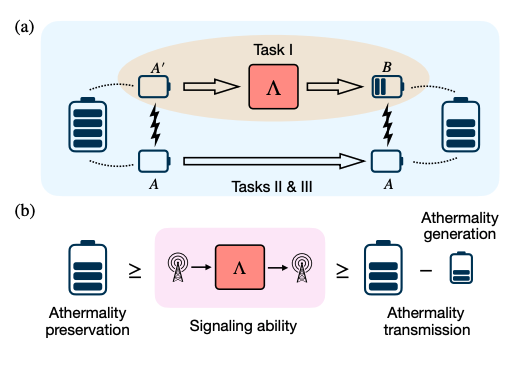
A central concept is athermality, a measure quantifying a system’s deviation from thermal equilibrium. Higher athermality indicates a greater degree of non-equilibrium, and thus, a greater potential for carrying information. The research demonstrates that a quantum channel’s ability to transmit information is fundamentally constrained by its capacity to preserve this athermality. Channels which effectively maintain non-equilibrium states exhibit superior potential for signaling, but are less efficient at actually transmitting that information across the channel.
This creates an inherent trade-off between preservation and transmission of athermality. A channel optimised for preserving non-equilibrium states will necessarily be less effective at transmitting them, and conversely, a channel designed for efficient transmission will struggle to maintain the initial athermality. Consequently, the maximum signaling capacity of a quantum channel is bounded above by its ability to preserve athermality and below by its ability to transmit it. This establishes a clear thermodynamic limit on quantum communication.
To validate these theoretical predictions, researchers investigated a specific type of quantum channel known as a ‘switch’. A switch operates by alternating between different configurations, influencing the flow of quantum information. Through analysis of this system, they confirmed the predicted trade-off between athermality preservation and transmission, demonstrating that the observed signaling limits align with the established thermodynamic boundaries. This work provides a new perspective on optimising quantum communication protocols, suggesting that managing athermality is crucial for maximising signaling capacity and achieving reliable data transmission.
👉 More information
🗞 Thermodynamic criteria for signaling in quantum channels
🧠 DOI: https://doi.org/10.48550/arXiv.2506.20428