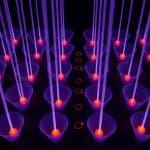
In the pursuit of capturing the unattainable, researchers at the Institute for Quantum Computing are pushing the boundaries of precision with a novel camera system that can detect individual photons of light. By harnessing the power of intricately designed metamaterials and microcircuits, PhD students Sarah Odinotski and Jack deGooyer aim to create a camera that can convert single photons into detectable electronic signals, effectively generating detailed images with unparalleled sensitivity.
With potential applications spanning quantum computing, astronomy, and medical imaging, this innovative technology can revolutionize fields such as cancer diagnosis, where accurate detection of cancerous cells could lead to faster treatment and improved patient outcomes.
As recipients of prestigious Vanier Canada Graduate Scholarships, Odinotski, and deGooyer’s collaborative research underscores the value of interdisciplinary approaches in driving groundbreaking discoveries and unlocking new possibilities at the forefront of quantum technology.
Introduction to Quantum Cameras
The concept of a camera that can detect individual photons, the smallest units of light, has sparked significant interest in the scientific community. Researchers Sarah Odinotski and Jack DeGooyer, both PhD students at the Institute for Quantum Computing and Department of Electrical and Computer Engineering, are working towards developing such a device. Their ambitious project aims to create a camera that can capture images with near-perfect sensitivity, potentially revolutionizing fields such as medical imaging, astronomy, and quantum computing.
The potential applications of this technology are vast and varied. In medical imaging, for instance, the ability to detect individual photons could enable more accurate detection of cancerous cells, leading to faster diagnosis and treatment. Similarly, in astronomy, such a camera could provide unprecedented insights into the universe by capturing high-resolution images of distant objects. The researchers’ work is focused on designing sensors capable of detecting single photons and developing microcircuits that can process and monitor the weak signals generated by these sensors.
The research team, led by Dr. Michael Reimer, is exploring the use of intricately patterned “metamaterials” to capture individual photons and convert them into detectable electronic signals. Odinotski’s work involves designing these metamaterials, which are capable of efficiently generating one electron from a single absorbed photon. This electron can then be multiplied into millions of electrons, creating an “avalanche” of current that can be detected by the sensor.
Quantum Photonic Devices Laboratory
The Quantum Photonic Devices Laboratory is at the forefront of research in quantum photonic devices, with a focus on designing and developing sensors capable of detecting single photons. The laboratory, led by Dr. Michael Reimer, is equipped with state-of-the-art facilities, including a cleanroom where students can design and fabricate their own devices. Odinotski’s work in the laboratory involves designing metamaterials that can efficiently capture individual photons and convert them into detectable electronic signals.
The use of metamaterials in this context is crucial, as they enable the creation of structures that can manipulate light at the nanoscale. By carefully designing these structures, researchers can create devices that are capable of detecting single photons with high efficiency. The laboratory’s work has significant implications for a range of fields, from medical imaging to quantum computing, where the ability to detect and manipulate individual photons is essential.
DeGooyer’s work in the laboratory involves developing microcircuits that can process and monitor the weak signals generated by the sensors. This requires the creation of tiny scales, with widths comparable to the size of a human hair, which can count electrons as they pass by. The development of these microcircuits is critical to scaling up individual sensors into a system that can generate detailed images with near-perfect sensitivity.
Applications of Quantum Cameras
The potential applications of quantum cameras are incredibly diverse and consequential. In medical imaging, for instance, the ability to detect individual photons could enable more accurate detection of cancerous cells, leading to faster diagnosis and treatment. This is because quantum cameras can provide high-resolution images of tissues and cells, allowing researchers to identify subtle changes that may indicate the presence of disease.
In astronomy, quantum cameras could provide unprecedented insights into the universe by capturing high-resolution images of distant objects. The ability to detect individual photons would enable astronomers to study the properties of these objects in greater detail, potentially leading to new discoveries about the nature of the universe. Additionally, quantum cameras could be used to study the behavior of particles at the quantum level, providing new insights into the fundamental laws of physics.
The applications of quantum cameras also extend to the field of quantum computing, where the ability to detect and manipulate individual photons is essential. Quantum computers rely on the manipulation of quantum bits, or qubits, which are incredibly sensitive to their environment. The development of quantum cameras could provide a new tool for studying the behavior of qubits, potentially leading to breakthroughs in the development of quantum computing technology.
External Link: Click Here For More