

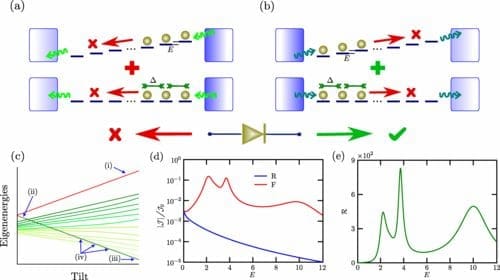
Researchers from the University of Pittsburgh and the University of Bristol have proposed a giant rectification scheme in quantum systems. The scheme, based on the asymmetric interplay between strong particle interactions and a tilted potential, could lead to the development of a perfect diode in electronic and quantum simulation platforms. The study is significant as it could potentially lead to the development of novel nanoscale technologies, particularly in the field of quantum circuit technologies. The proposed rectification scheme can exceed coefficients of 10^9 in small systems without the need for fine-tuning.
What is the Giant Rectification Scheme in Quantum Systems?
The study titled “Giant Rectification in Strongly Interacting Driven Tilted Systems” by Juan José MendozaArenas and Stephen R Clark from the Department of Mechanical Engineering and Materials Science and the Department of Physics and Astronomy at the University of Pittsburgh, and the H H Wills Physics Laboratory at the University of Bristol, proposes a giant rectification scheme. This scheme is based on the asymmetric interplay between strong particle interactions and a tilted potential, each of which induces an insulating state on its own.
In the context of reverse bias, both the strong particle interactions and the tilted potential cooperate and induce a strengthened insulator with an exponentially suppressed current. However, for forward bias, they compete, generating conduction resonances. This leads to a rectification coefficient of many orders of magnitude. The researchers uncovered the mechanism underlying these resonances as enhanced coherences between energy eigenstates occurring at avoided crossings in the bulk energy spectrum of the system.
The study also demonstrates the complexity of the many-body nonequilibrium conducting state through the emergence of enhanced density-matrix impurity and operator-space entanglement entropy close to the resonances. This proposal paves the way for implementing a perfect diode in currently available electronic and quantum simulation platforms.
How Does This Impact Quantum Circuit Technologies?
Correlated quantum systems feature a wide range of nontrivial effects emerging from interactions between their constituent particles. In nonequilibrium scenarios, these manifest in phenomena such as many-body insulating states and anomalous scaling laws of currents of conserved quantities. These are crucial for applications in quantum circuit technologies.
Many-body quantum systems have become key ingredients for the development of novel technologies at the nanoscale due to their vast and exciting phenomenology and the rapid advances on their control protocols. In nonequilibrium regimes, such systems feature properties that make them highly appealing for applications in quantum circuits. This has been exemplified in several platforms where tunable transport of particles or heat can be induced and characterized.
What is the Role of Quantum Diodes in This Context?
Much attention in this field has been directed toward quantum diodes. For such devices, spatial asymmetries and nonlinearities are engineered together to allow transport in one direction under a chemical potential or thermal bias and to suppress it in the opposite direction when the bias is inverted.
Commercial electronic semiconductor diodes have demonstrated a ratio of forward and backward currents or rectification coefficient of approximately 105-108. Meanwhile, alternative technologies remain under development, including molecular diodes with coefficients of up to O(105) and those based on superconducting components.
Theoretically, several studies have recently proposed different rectification schemes based on quantum systems. These efforts include the setups potentially displaying giant rectification, which rely on complicated geometries or potential landscapes to induce rectification coefficients of several orders of magnitude using finely tuned parameters.
How Does the Proposed Rectification Scheme Work?
The proposed rectification scheme naturally emerges over a broad range of parameters in tilted interacting quantum lattices. These systems are the object of intensive research as they have been argued to feature disorder-free Stark many-body localization (MBL), quantum scars, and counterintuitive phenomena such as time crystals and transport opposite to an applied electric field.
Neither the spatial asymmetry of the tilted onsite potential nor the nonlinearity of the interparticle interactions can on their own induce rectification. However, the ability to simultaneously engineer both ingredients in such platforms opens up the possibility of its implementation. The researchers reveal the underlying mechanism of this interaction-tilt interplay and show how the vastly differing transport properties with the direction of bias give rise to giant rectification.
What is the Significance of This Study?
This study is significant as it proposes a rectification scheme that can exceed coefficients of 10^9 in small systems with no need for fine-tuning and even with moderate interactions. Despite the simplicity of the scheme, it features a rich phenomenology resulting in a genuine many-body rectification response.
The researchers emphasize that their proposal establishes a framework to build more complex nonequilibrium physics on top of it. This could potentially lead to the development of novel technologies at the nanoscale, particularly in the field of quantum circuit technologies. The proposed scheme also paves the way for implementing a perfect diode in currently available electronic and quantum simulation platforms.
Publication details: “Giant Rectification in Strongly Interacting Driven Tilted Systems”
Publication Date: 2024-03-08
Authors: Juan José Mendoza-Arenas and Stephen R. Clark
Source: PRX Quantum 5, 010341
DOI: https://doi.org/10.1103/PRXQuantum.5.010341


